- Subject Overview: Dyna Robotics Scales Physical Intelligence With Dyna 2 World Action Model — Key developments across AI.
- Technical Context: Detailed analysis of architectural changes, product capabilities, and engineering metrics.
- Industry Impact: Key implications for software developers, startup founders, and enterprise technology adopters.
The Dawn of Embodied Intelligence
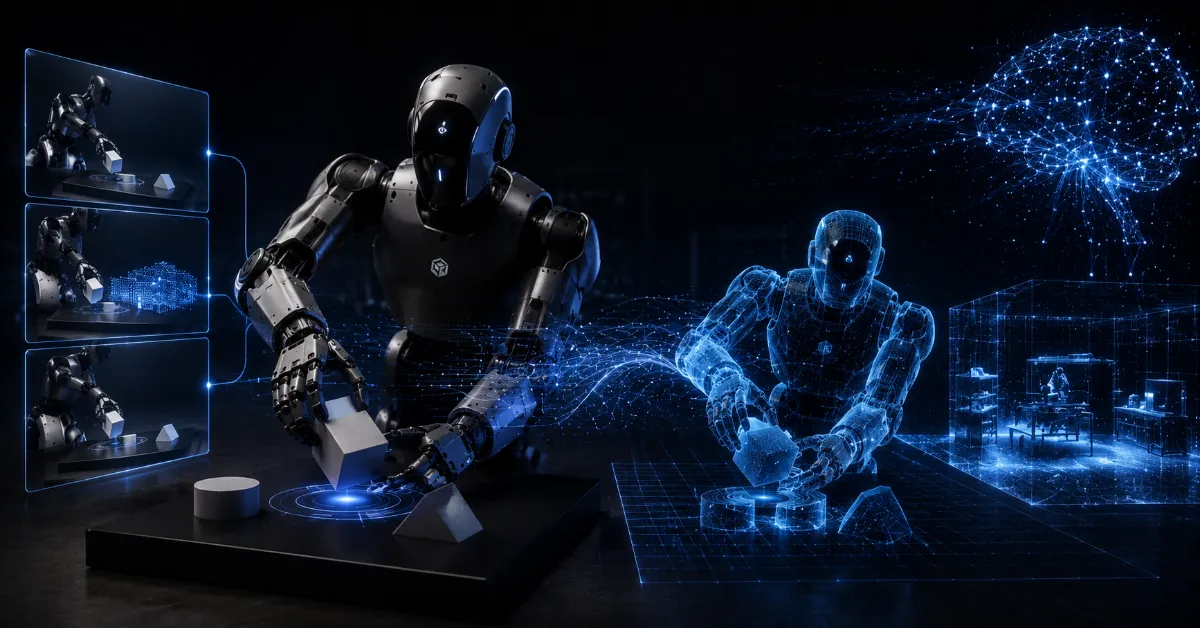
For years, the field of robotics has struggled with the bridge between high level reasoning and low level motor control. Dyna Robotics aims to solve this with the release of Dyna 2, a groundbreaking world action model that leverages an unprecedented dataset of one million hours of egocentric human video. Unlike standard large language models that process text, Dyna 2 is designed to understand the causal relationships between human intent and physical movement within three dimensional space.
The architecture focuses on predictive modeling where the agent learns to anticipate the consequences of actions before they are executed. By ingesting vast quantities of first person perspective footage, the model develops a nuanced understanding of spatial geometry, object permanence, and task hierarchy. This shift from reactive programming to proactive world modeling marks a significant milestone in the pursuit of general purpose robotic intelligence.
Technical Foundations of the Dyna 2 Architecture
The core of the Dyna 2 system lies in its unique pre-training pipeline, which utilizes a massive transformer backbone specifically tuned for temporal sequences. By treating video frames as tokens, the model compresses complex physical interactions into actionable latent representations. This allows the system to predict how objects will respond to physical force or environmental shifts.
| Feature | Legacy Systems | Dyna 2 Architecture | Impact |
|---|---|---|---|
| Training Data | Simulated Environments | 1 Million Hours Real Video | Superior Generalization |
| Latency | High (Heuristic) | Ultra Low (Predictive) | Faster Real Time Response |
| Spatial Reasoning | 2D Mapping | 3D World Model | Advanced Navigation |
Scaling the Physical World
One of the most critical aspects of this release is the scale at which the model was trained. Most robotic systems rely on synthetic data or narrow datasets that fail to translate well to real world environments. Dyna Robotics has managed to capture the diversity of human movement, from complex industrial tasks to subtle household chores, by filtering one million hours of data for high fidelity motion cues.
- Temporal Consistency: Dyna 2 maintains state tracking over long durations, ensuring that complex tasks like assembling a product remain coherent.
- Action Tokenization: By mapping human movements to specific action tokens, the model can translate visual observations into robot motor commands.
- Unsupervised Learning: The model utilizes self-supervised learning techniques to identify causal links without needing explicit human labels for every frame.
Key Takeaway: The transition to world action models suggests that the future of robotics will be defined by an agent's ability to simulate its own consequences before interacting with the physical environment.
Developer Impact and Integration
For the developer community, Dyna 2 provides a set of APIs that allow for the integration of high level reasoning into existing hardware stacks. By offloading the complexity of spatial prediction to the pre-trained model, engineers can focus on task specific implementation rather than building movement heuristics from scratch. This democratizes access to sophisticated robotic intelligence, enabling smaller firms to deploy autonomous agents in complex scenarios.
Integration involves a two step process where the developer defines the environmental constraints, and the model provides the action trajectories. This modular approach ensures that the model can be updated or fine-tuned for specific robotic embodiments, whether they are humanoid bipedal systems or specialized industrial manipulators.
Ethical Considerations and Safety
As with any powerful AI, the integration of Dyna 2 into physical systems necessitates robust safety protocols. Dyna Robotics has implemented a series of hard coded constraints that govern the velocity and force of any generated action sequence. These layers of safety exist outside the neural network, providing a fail-safe mechanism that prevents the model from attempting dangerous physical maneuvers.
Furthermore, the privacy of the original video data has been addressed through rigorous de-identification processes. Ensuring that the training data represents human activity without violating individual privacy remains a top priority, and the company has committed to ongoing auditing of its training pipelines.
The Road Ahead
The introduction of Dyna 2 signals a shift toward a future where robotics are not just automated machines but intuitive partners capable of learning from observation. As the model continues to ingest more data and refine its predictive capabilities, we can expect to see robotic agents that possess a near human level of physical intuition. The challenge will be in the long term hardware deployment and ensuring these software breakthroughs can match the ruggedness of real world environments. Dyna Robotics has provided the blueprint, but the industry must now build the platforms to realize this potential.