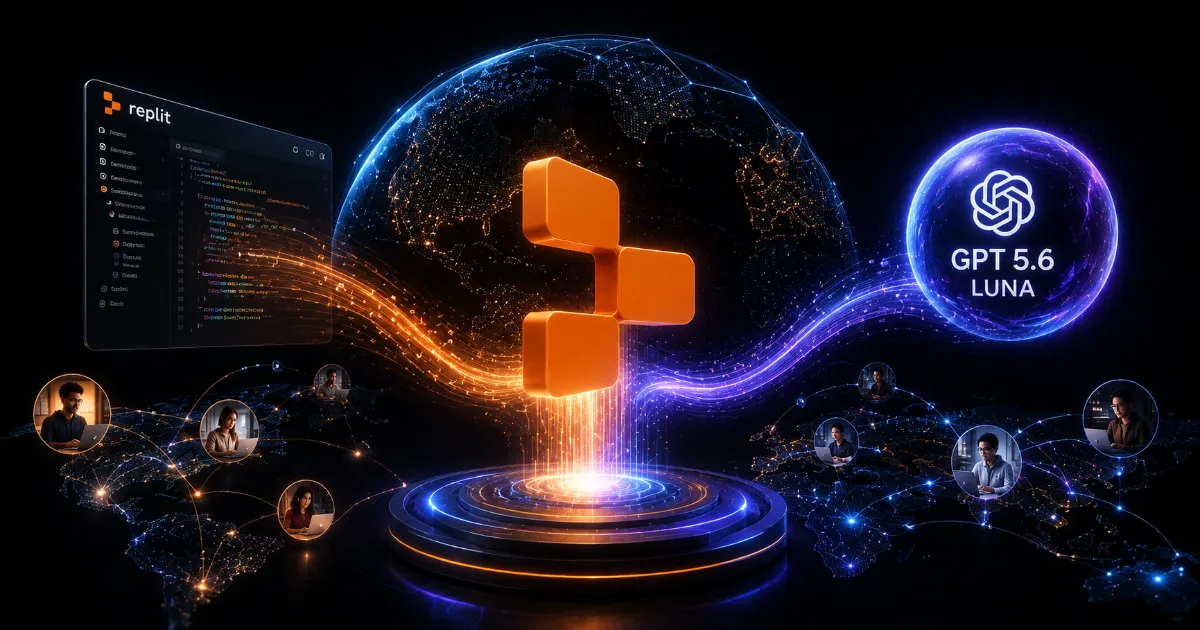
- Subject Overview: Replit Unlocks Global Software Development With GPT 5.6 Luna Integration — Key developments across AI.
- Technical Context: Detailed analysis of architectural changes, product capabilities, and engineering metrics.
- Industry Impact: Key implications for software developers, startup founders, and enterprise technology adopters.
Executive Overview and Core Hook
The landscape of software development is undergoing its most significant transformation since the invention of the high-level programming language. Replit, a long-standing leader in cloud-based integrated development environments, has officially integrated the GPT 5.6 Luna model into its core platform. This integration signifies a move away from the traditional model of software engineering—where developers spend a majority of their time managing syntax, dependency trees, and boilerplate code—toward a model centered on intent-based creation. By leveraging the advanced reasoning capabilities of Luna, Replit allows users to conceptualize, iterate, and deploy full-stack applications through natural language alone, effectively democratizing access to software creation for millions of non-technical founders and hobbyists.
The implications of this release are profound. In the past, the bottleneck of software creation was technical literacy and the prohibitive costs associated with token-based AI querying. Replit has addressed both. By embedding Luna directly into the IDE environment and optimizing the delivery mechanism to eliminate individual token-cost barriers for the end-user, the platform is removing the financial and educational friction that once gated the software industry. This development matters because it signals a future where the limitation on software innovation is no longer the ability to write code, but the quality of the user's creative vision. As Replit integrates this powerhouse model, it positions itself not just as a coding tool, but as a cognitive partner for the next generation of builders.
Technical Breakdown and Architecture
The architecture powering the GPT 5.6 Luna integration within Replit is a masterclass in latent space optimization and real-time inference. Unlike traditional chat-based AI interfaces that operate in isolated windows, Luna is deeply woven into the Replit file system and runtime environment. The model is trained on a massive corpus of repository-level context, allowing it to understand not just the isolated function it is asked to write, but the entire dependency graph of the project at hand. This context-awareness is achieved through a proprietary retrieval-augmented generation pipeline that continuously indexes the user's workspace, ensuring that every suggestion is contextually relevant and syntactically sound.
Technically, the Luna model operates on a multi-modal reasoning engine that processes intent in two distinct phases: the structural planning phase and the execution phase. During the planning phase, the model maps out the necessary files, libraries, and integration points required to achieve the user's goal. Once the structure is validated, the execution phase begins, where the model writes the actual code across multiple files simultaneously. This is a massive leap over previous generation AI tools that could only generate code in single-file chunks. Furthermore, the integration features a self-healing diagnostic loop. When a newly generated application fails to compile or exhibits a runtime error, the Luna model automatically inspects the stack trace, identifies the logical disconnect, and applies a fix without requiring the user to intervene in the debugging process.
Markdown Comparison Table and Key Metrics
| Capability | Traditional IDE Coding | Legacy AI Coding Assistants | Replit GPT 5.6 Luna |
|---|---|---|---|
| Context Window | Limited to open file | Project-aware | Repository-wide awareness |
| Cost Model | Human labor hours | Per-token billing | Flat platform access |
| Multi-file Editing | Manual | Sequential | Parallel Architecture |
| Error Correction | Human Debugging | Partial guidance | Automated Self-healing |
| Deployment Speed | Days to Weeks | Hours | Minutes to Seconds |
- Contextual Depth: Luna processes entire repository architectures, eliminating the need for manual file-by-file context priming.
- Zero-Token Friction: By moving away from per-token billing, Replit encourages iterative experimentation without the fear of compounding costs.
- Repository-Wide Synthesis: The engine manages cross-functional dependencies, ensuring that database schemas align with front-end components automatically.
- Automated Runtime Stability: The integration includes proactive linting and runtime error interception, drastically reducing time-to-production.
Developer and Ecosystem Impact
For software engineers, the introduction of GPT 5.6 Luna serves as a massive productivity multiplier. Rather than performing the rote labor of constructing standard API endpoints or boilerplate React components, senior developers can now spend their time on high-level system design and architectural strategy. The role of the engineer is shifting toward that of an editor and curator, where the primary task is to guide the AI toward the desired output rather than manually typing every character. This shift is expected to accelerate the development lifecycle of startups, where speed-to-market is often the deciding factor in long-term viability.
For the broader ecosystem, this is a clarion call for a new class of startups. We are entering an era of the micro-SaaS explosion. Because Replit has lowered the technical and financial barrier to zero, we anticipate a massive influx of niche applications designed to solve highly specific, localized problems that were previously not worth the time or money to develop. This democratized software engineering environment forces existing cloud infrastructure providers to rethink how they package their services. As more developers migrate their workflows to intent-based IDEs, the demand for modular, easily integrable cloud services will skyrocket, placing immense pressure on legacy providers to simplify their own deployment interfaces.
Strategic Market Outlook and Analysis
The market for AI-driven development tools is reaching a critical inflection point. Competition is fierce, with major players attempting to bake similar reasoning capabilities into their own environments. However, Replit’s advantage lies in its native, end-to-end integration. By owning the entire stack—from the code editor to the cloud deployment container—Replit offers a seamless experience that fragmented AI coding extensions cannot replicate. While competitors focus on providing autocomplete suggestions, Replit is focused on providing an autonomous development environment.
However, the strategy does come with inherent trade-offs. The reliance on an opaque reasoning model like Luna means that developers might experience a loss of fine-grained control over their codebase. There is a palpable tension between the desire for speed and the need for absolute technical precision. Enterprise organizations, in particular, will be cautious about adopting a system that hides the underlying logic of the software behind a black-box model. To counter this, the industry will likely see a move toward hybrid models where AI-generated code is audited by automated verification tools. As Replit continues to push the boundaries of intent-based creation, it will need to ensure that its platform remains extensible enough to satisfy those who require deep, manual configuration while simultaneously serving those who want to build entirely through natural language.