
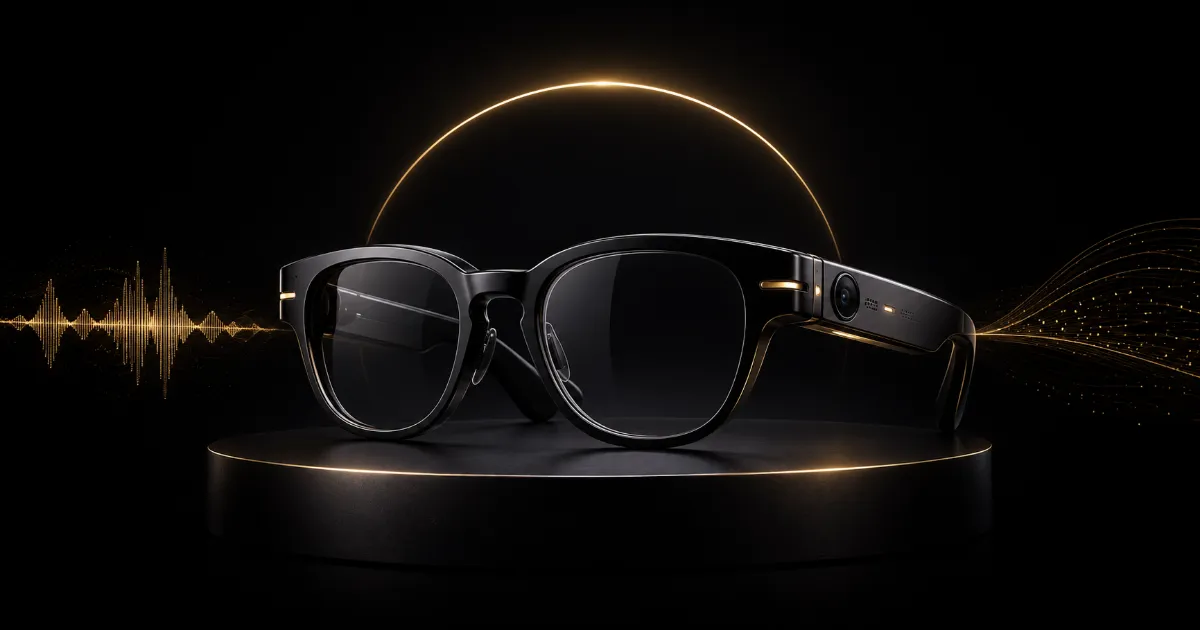
- Subject Overview: Legato Emerges From Stealth With 12 Million Dollars For AI Hearing Glasses — Key developments across AI.
- Technical Context: Detailed analysis of architectural changes, product capabilities, and engineering metrics.
- Industry Impact: Key implications for software developers, startup founders, and enterprise technology adopters.
The Evolution of Wearable Assistive Hardware
The convergence of artificial intelligence and consumer hardware has unlocked a new paradigm for assistive devices. For decades, traditional hearing aids suffered from social stigmas, bulky form factors, and limited computational processing power due to strict thermal and spatial constraints. By shifting the paradigm toward everyday consumer eyewear, innovative hardware manufacturers are completely transforming how users perceive and interact with auditory assistance in their daily environments.
Integrating complex digital signal processing pipelines into the slim arms of standard spectacles requires an unprecedented level of miniaturization. Traditional components must be redesigned from the ground up to fit within structural boundaries measuring mere millimeters. This architectural shift removes the visual friction typically associated with medical devices, allowing individuals to embrace critical sensory enhancements without sacrificing personal style or experiencing the psychological burden of visible medical hardware.
Venture capital participation in assistive technology has historically lagged behind enterprise software and general consumer electronics. However, the maturation of ultra-low-power silicon and edge artificial intelligence models has dramatically altered the investment landscape. Investors are increasingly recognizing that products solving fundamental physiological challenges within mainstream consumer form factors represent massive, underserved global markets with extraordinary customer lifetime value and retention.
Architectural Engineering of On Device Audio Processing
At the core of the newly unveiled hardware lies a sophisticated stack of neural network models running locally on edge silicon. Processing ambient audio streams in real time demands sub-millisecond latencies to prevent awkward conversational delays or phase cancellation artifacts that can disorient the listener. Achieving this level of performance necessitates custom neural accelerators optimized specifically for acoustic beamforming, spatial audio separation, and dynamic noise suppression algorithms.
Managing thermal dissipation inside enclosed eyewear arms presents a formidable engineering challenge for systems architects. Unlike smartphones or larger wearable computing devices, glasses lack active cooling systems and offer minimal surface area for passive heat radiation. Hardware designers must meticulously balance processor clock speeds, memory bandwidth utilization, and battery capacities to ensure all day reliability without causing uncomfortable thermal spikes against the user's temples.
Power management represents another critical frontier in the development of intelligent hearing glasses. Continuously sampling multiple directional microphones, executing heavy transformer based audio separation models, and streaming clean sound to miniature bone conduction or air conduction speakers drains lithium ion cells rapidly. Engineers employ highly aggressive duty cycling, waking specific hardware subsystems only when the acoustic environment changes or speech is actively detected in the soundscape.
Software Intelligence and Adaptive Acoustic Filtering
Modern auditory environments are notoriously chaotic, filled with competing frequencies, sudden transient noises, and reverberant spaces that confound legacy assistive listening devices. Advanced machine learning models trained on vast corpuses of diverse acoustic scenes enable these modern glasses to isolate target speakers with remarkable precision. By leveraging deep neural networks to dynamically separate human speech from background cacophony, users can comfortably converse in crowded restaurants or bustling city streets.
Personalization algorithms play an essential role in delivering a natural listening experience tailored to each individual's unique audiogram. Rather than relying on static frequency amplification profiles, continuous machine learning adaptation monitors listening habits and environmental preferences over time. The software seamlessly adjusts compression ratios, high frequency boosts, and directional focus parameters as the user transitions seamlessly from quiet indoor offices to noisy outdoor transit hubs.
Privacy and data sovereignty remain paramount concerns when embedding always listening microphones into consumer wearables. To protect user trust, the primary audio processing pipelines execute entirely on device without streaming raw audio conversations to remote cloud servers. Any diagnostic telemetry or optional preference backups are heavily encrypted, ensuring that personal communications remain strictly private and secure against unauthorized interception.
Market Impact and the Future of Sensory Augmentation
The launch of these innovative frames signals a broader industry shift toward ambient computing and sensory augmentation. As populations age globally, the demand for accessible, high performance hearing solutions continues to surge exponentially. Traditional medical device incumbents must now contend with agile consumer technology startups that prioritize sleek industrial design, seamless software updates, and intuitive user experiences above legacy medical distribution models.
Developer ecosystems and third party software integrations will likely play a transformative role in the future trajectory of these platforms. Opening secure application programming interfaces could eventually allow developers to build specialized audio filters for musicians, immersive augmented reality soundscapes for gamers, or language translation tools for international travelers. This extensibility transforms a single purpose assistive medical tool into a versatile, general purpose computational platform.
Commercial scaling will ultimately determine whether lifestyle oriented assistive tech can penetrate mass market retail channels successfully. Navigating traditional optometry networks, direct to consumer digital storefronts, and potential regulatory pathways requires a multifaceted go to market strategy. As production yields improve and component costs decline, intelligent eyewear is poised to become an indispensable category in the modern personal technology ecosystem.