
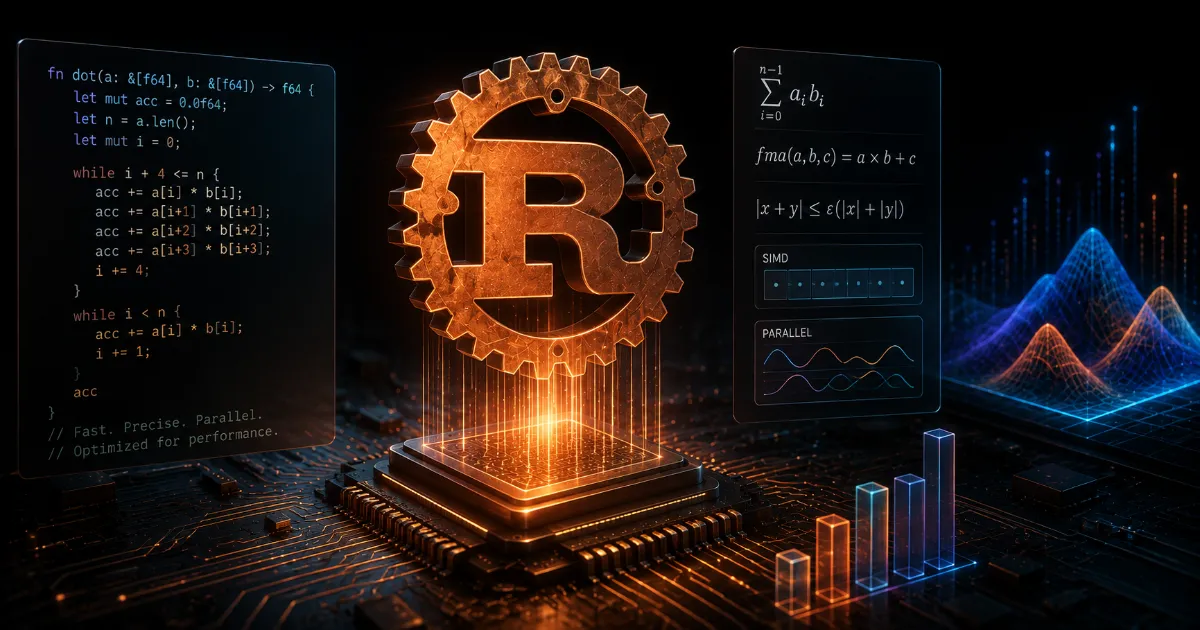
- Subject Overview: Optimizing Floating Point Math for High Performance Rust Systems — Key developments across Dev.
- Technical Context: Detailed analysis of architectural changes, product capabilities, and engineering metrics.
- Industry Impact: Key implications for software developers, startup founders, and enterprise technology adopters.
Understanding the Performance Bottlenecks
Floating point mathematics is a foundational requirement for everything from graphics rendering to financial modeling. However, the overhead associated with standard floating point operations in high level languages can be a significant barrier to performance. Rust has introduced new APIs that allow developers to access hardware level optimizations for floating point math, enabling substantial speed gains without sacrificing the language's core promise of safety and memory management.
Leveraging Hardware Acceleration
Modern CPUs contain dedicated instruction sets for floating point operations, yet these are often underutilized by general purpose software. Rust’s new, more direct approach to these instructions allows the compiler to make more informed decisions about how to perform calculations. By allowing developers to opt in to specific performance modes, Rust ensures that critical paths in code are as fast as possible, providing a competitive edge for applications that require heavy numerical processing.
Key Advantages of the New Rust API
- Reduced instruction cycle count for standard arithmetic operations.
- Improved SIMD support for parallelizing math tasks across multiple cores.
- Better compiler hints for rounding and precision modes.
- Direct integration with underlying system math libraries.
Precision Versus Speed
In many numerical applications, there is a constant tension between precision and speed. The new Rust APIs allow for more granular control over this balance. Developers can now specify whether a calculation requires absolute strictness or whether a slightly faster, less precise approach is acceptable for a given context. This capability is vital for real time systems where the cost of a slightly off calculation is far less than the cost of a frame drop or a latency spike.
Real World Impact
For systems where floating point operations are frequent, the impact of these optimizations is profound. Imagine a trading platform that can process market data 20% faster, or a physics engine that can support a significantly higher number of objects in real time. These are the types of gains that are now possible through more efficient math handling. As Rust continues to solidify its role in systems programming, these incremental improvements ensure that it remains the language of choice for performance critical applications across the tech stack.