

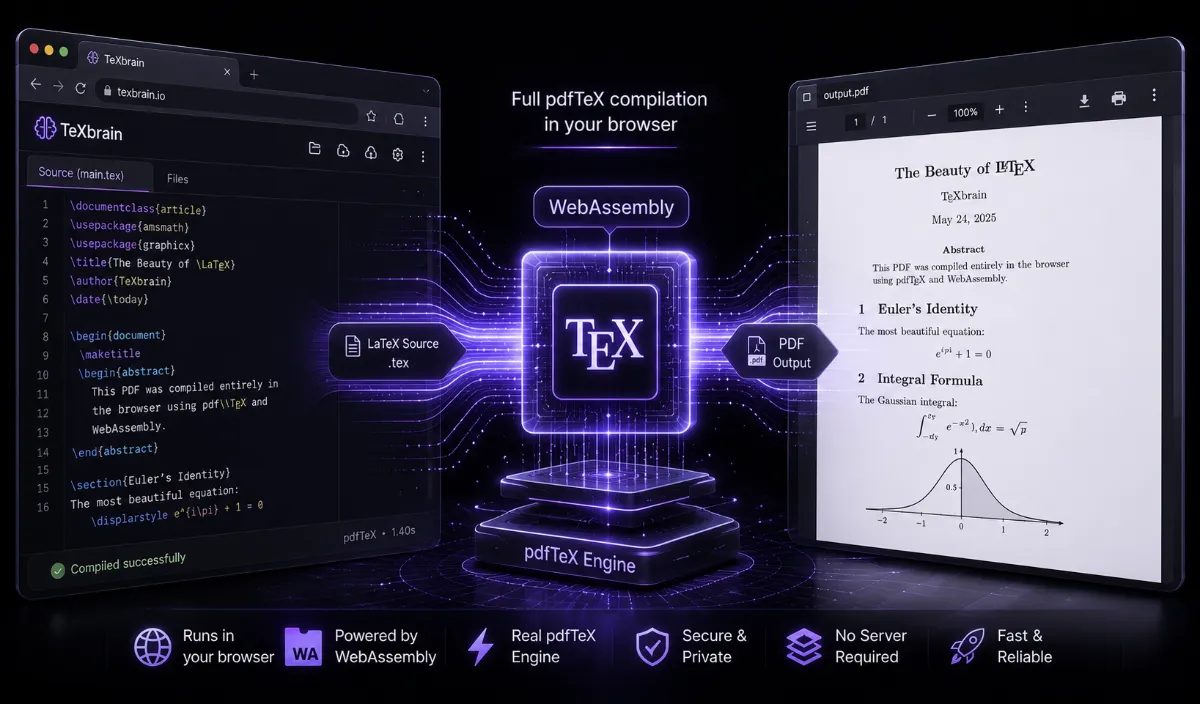
- Subject Overview: TeXbrain Brings Full pdfTeX Compilation Directly Into The Browser Using WebAssembly — Key developments across Dev.
- Technical Context: Detailed analysis of architectural changes, product capabilities, and engineering metrics.
- Industry Impact: Key implications for software developers, startup founders, and enterprise technology adopters.
The Evolution of Browser-Based Compilation
Client-side compute capabilities have expanded exponentially over the past several years, driven largely by the maturation of WebAssembly and modern JavaScript engines. Historically, complex document generation tasks like compiling large LaTeX manuscripts required heavy remote backends equipped with full TeX Live distributions. Developers and researchers had to establish SSH tunnels, configure continuous integration pipelines, or rely on third-party SaaS platforms just to render complex mathematical formulas and high-resolution vector graphics. TeXbrain fundamentally disrupts this paradigm by packaging the entire pdfTeX engine into a compact, highly optimized WebAssembly module that executes locally inside the user browser sandbox.
By shifting the heavy computational burden of tokenization, macro expansion, and font metric calculations to the client device, architects can eliminate the operational cost and latency associated with remote compilation servers. Modern web browsers possess more than enough single-threaded CPU horsepower to handle standard academic papers, while multi-core architectures allow background workers to process massive documents asynchronously without locking the user interface. This shift mirrors the broader industry trend toward edge computing and local-first software design, where user privacy, offline availability, and instantaneous feedback loops take precedence over traditional client-server roundtrip models.
The architectural foundation of TeXbrain relies on compiling legacy C-based typesetting codebases into portable WASM bytecode. Because pdfTeX is historically written in highly optimized C, leveraging toolchains like Emscripten enables developers to translate low-level memory allocations and file system operations into web-compatible primitives. This engineering feat requires careful management of virtual memory spaces, standard input-output streams, and font file assets within the browser environment. The result is a robust, self-contained typesetting workspace that functions seamlessly across diverse operating systems and hardware configurations without requiring local software installations.
Technical Implementation and WASM Sandbox Architecture
Integrating a monolithic typesetting engine like pdfTeX into a browser extension or single-page web application presents unique systems engineering challenges, particularly regarding virtual file system management. TeXbrain addresses this by constructing an in-memory virtual file system that intercepts standard file system calls made by the compiled C code. When the typesetting engine attempts to read style files, image assets, or bibliography databases, the WebAssembly bridge routes these requests to local IndexedDB storage or memory buffers. This ensures that complex projects involving multiple input files and hierarchical directory structures compile correctly without modifying the upstream source code.
Memory management within the WASM runtime requires deliberate tuning to prevent out-of-memory errors during the compilation of large documents containing thousands of pages or heavy TikZ graphics. WebAssembly modules typically operate within a pre-allocated linear memory buffer that can grow dynamically up to specific browser-imposed limits. TeXbrain implements intelligent memory pooling and garbage collection strategies for cached font metrics and intermediate DVI files, ensuring that long-running editing sessions do not degrade browser performance or trigger aggressive memory reclamation by the host operating system.
Another critical aspect of the technical architecture is the orchestration of asynchronous compilation pipelines using Web Workers. Running synchronous C code directly on the main JavaScript thread would instantly freeze the user interface, resulting in a poor developer experience during active typing and debugging. By offloading the pdfTeX compilation loop to a dedicated worker thread, TeXbrain maintains a responsive sixty-frames-per-second UI while simultaneously processing macro expansions, page breaks, and output routine computations in the background.
Developer Experience and Offline Capabilities
For developers, technical writers, and researchers, the transition to a browser-native LaTeX environment yields immediate productivity benefits and unprecedented deployment flexibility. Traditional cloud-based editors require constant internet connectivity and introduce noticeable latency every time a document preview needs to be refreshed. TeXbrain operates entirely client-side once the initial assets are loaded, enabling uninterrupted writing and compiling on airplanes, trains, or remote field locations with zero network access. This offline-first reliability makes mission-critical documentation workflows robust against intermittent network failures and cloud provider outages.
Furthermore, privacy-conscious organizations and enterprise engineering teams can utilize client-side compilation engines to handle sensitive proprietary specifications, internal documentation, and patented research securely. Because the raw manuscript data and compiled artifacts never leave the local device during the build process, compliance with strict data governance frameworks becomes significantly easier to manage. There is no risk of accidental data leakage to third-party cloud servers or unauthorized interception of intellectual property transmitted over public networks.
The integration of modern code editors with instant WebAssembly-powered previews opens up exciting possibilities for literate programming and interactive technical reports. Developers can embed live-updating mathematical proofs and architectural diagrams directly into internal wikis or developer portals without maintaining complex build pipelines. The seamless merging of text editing, live preview rendering, and zero-configuration setup lowers the barrier to entry for users who traditionally find LaTeX intimidating due to its notoriously complex installation requirements.
Strategic Outlook and Future Ecosystem Growth
Looking forward, the success of projects like TeXbrain signals a broader shift in how legacy systems software is repurposed for modern web applications. As WebAssembly specifications evolve to include garbage collection support, direct DOM manipulation interfaces, and enhanced multithreading primitives, we can expect an increasing number of desktop-class productivity tools to migrate natively to the browser. The ability to run mature, battle-tested C and C++ codebases directly inside web applications bridges the gap between native performance and web accessibility, empowering developers to build sophisticated tools without reinventing foundational software stacks.
Future iterations of client-side typesetting engines will likely incorporate advanced caching mechanisms, incremental compilation strategies, and collaborative real-time editing features powered by decentralized peer-to-peer protocols. By combining WebAssembly compilation with CRDT-based synchronization layers, multiple authors could simultaneously edit and compile massive LaTeX manuscripts entirely client-side without relying on centralized coordination servers. Such advancements will redefine the boundaries of collaborative technical writing and secure document authoring for the next generation of digital creators.


