
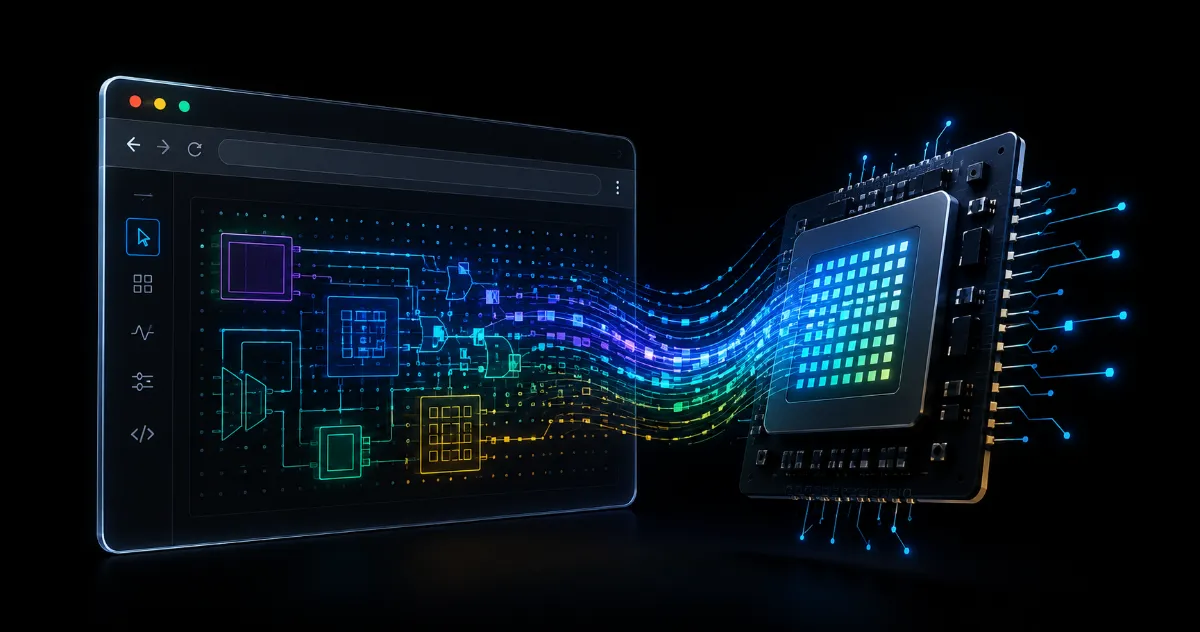
- Subject Overview: Empowering Browser-Based Hardware Synthesis With WebFPGA Technology — Key developments across Dev.
- Technical Context: Detailed analysis of architectural changes, product capabilities, and engineering metrics.
- Industry Impact: Key implications for software developers, startup founders, and enterprise technology adopters.
Bridging The Gap Between Web Developers And Hardware Engineering
The traditional entry barrier to hardware description languages and Field Programmable Gate Arrays has historically been notoriously steep. Developers wishing to prototype custom digital logic had to download gigabytes of proprietary, vendor-locked toolchains, configure complex compilation pipelines, and possess specialized hardware debugging equipment. WebFPGA fundamentally disrupts this paradigm by democratizing access to hardware synthesis through standard web browsers. By shifting the compilation and flashing pipeline to lightweight, cloud-assisted or client-side WebAssembly environments, the platform opens up hardware programming to millions of traditional web and software developers.
At the core of this innovation is the abstraction of complex hardware description languages like Verilog and VHDL into accessible web-native workflows. Developers can write, test, and synthesize custom digital circuits using familiar languages or simplified abstractions, eliminating the friction of local toolchain configuration. This accessibility accelerates educational initiatives and rapid prototyping cycles, allowing software engineers to experiment with custom accelerators, IoT controllers, and peripheral interfaces without needing a formal degree in electrical engineering.
The operational architecture relies on efficient USB-to-web communication protocols that interface directly with physical FPGA boards connected to a user's local machine via WebUSB APIs. This secure browser extension interface allows the web application to push synthesized bitstreams directly to the target hardware in milliseconds. The result is a seamless, zero-install development experience that mirrors the instant feedback loops modern web developers expect from frontend frameworks, applied directly to physical silicon devices.
Furthermore, this browser-centric approach fosters a vibrant, collaborative ecosystem for hardware design sharing. Similar to how GitHub transformed software collaboration, WebFPGA enables developers to publish, fork, and instantly test hardware modules with a single click in a browser tab. This democratization of hardware design patterns unlocks unprecedented potential for community-driven innovation, paving the way for decentralized, open-source hardware acceleration across diverse edge computing applications.
Technical Architecture Of Browser-Based Bitstream Generation
Achieving high-performance hardware synthesis entirely within or supported by web technologies requires a highly optimized compilation pipeline. When a developer triggers a build action on WebFPGA, the source code is transmitted to a high-speed cloud compilation service running open-source FPGA toolchain components such as Yosys for logic synthesis and nextpnr for place-and-route operations. Open-source toolchains are crucial here, as they provide the programmatic flexibility and lightweight binaries necessary to operate efficiently within scalable cloud microservices without licensing bottlenecks.
Once the synthesis engine translates the high-level logic description into a targeted device bitstream, the resulting binary file is streamed back to the client browser. The browser then utilizes the WebUSB API to establish a secure, low-level communication channel with the attached WebFPGA USB hardware dongle. This direct hardware interaction bypasses traditional operating system driver installation hurdles, creating a universal cross-platform experience that functions identically across Windows, macOS, and Linux environments equipped with modern standards-compliant browsers.
The physical hardware module itself is engineered for maximum versatility and low power consumption, featuring compact form factors suitable for embedded prototyping. The onboard microcontroller manages the USB protocol handshaking while securely transferring the incoming bitstream directly into the volatile configuration memory of the FPGA fabric. This instantaneous reprogramming capability allows developers to iterate on hardware logic designs dozens of times per hour, drastically reducing the traditional turnaround time associated with hardware debugging.
Security and isolation are paramount in browser-based hardware programming architectures. The WebUSB specification requires explicit user permission grants before any webpage can communicate with a connected peripheral device, preventing unauthorized websites from maliciously flashing connected hardware. Additionally, sandboxed execution environments ensure that cloud-based compilation pipelines remain isolated from client infrastructure, maintaining enterprise-grade security standards even when deployed in educational and collaborative public settings.
Developer Workflow Integration And Prototyping Trade-Offs
Adopting WebFPGA within an engineering workflow introduces distinct operational advantages and trade-offs compared to traditional desktop-bound FPGA development environments. On the positive side, onboarding new team members becomes virtually instantaneous. New engineers can review a shared project URL, inspect the digital logic schematic, modify the code, and flash physical hardware within minutes, bypassing the days of frustration typically spent troubleshooting local toolchain path errors and license server disconnections.
However, developers must also navigate the limitations inherent in cloud-assisted, browser-based hardware synthesis. Complex, enterprise-grade designs featuring hundreds of thousands of logic elements may exceed the capacity of the lightweight target FPGAs supported by the platform. Additionally, reliance on cloud compilation infrastructure means that offline development capabilities are inherently restricted unless local fallback toolchains are manually configured. Engineering teams must evaluate whether their specific target complexity aligns with the streamlined constraints of the platform.
Integration with continuous integration and continuous deployment pipelines represents another powerful dimension of WebFPGA utilization. Because the core synthesis and testing tools operate as headless command-line utilities wrapped within modern APIs, development teams can automate hardware test suites. Every code commit to a repository can trigger an automated cloud synthesis run, verifying that the Verilog logic successfully maps to the physical target without timing violations or routing conflicts before any hardware is physically flashed.
The economic implications for hardware startups and educational institutions are profound. By eliminating the need for expensive, high-end workstation licenses and reducing hardware setup overhead, WebFPGA lowers the financial barrier to entry for custom silicon prototyping. Students and indie makers can explore edge computing, digital signal processing, and hardware acceleration at a fraction of the traditional cost, accelerating the pace of hardware-software co-design across the global developer ecosystem.
Strategic Market Outlook And The Future Of Edge Acceleration
As artificial intelligence workloads and high-throughput data processing increasingly shift toward the edge, the demand for accessible hardware acceleration tools has reached an all-time high. Platforms like WebFPGA are strategically positioned at the intersection of web technologies and embedded systems, capturing the growing wave of software engineers looking to harness custom hardware for low-latency processing. Venture capital and industry investments are increasingly flowing toward open-source hardware toolchains and browser-based developer experiences that promise to unlock the next generation of edge computing devices.
The long-term vision of browser-native hardware engineering extends far beyond simple prototyping boards. As web browsers evolve to support more robust system-level APIs and low-level compute capabilities, the browser is rapidly transforming into a universal operating system for distributed application development. Enabling seamless interaction between web applications and custom FPGA accelerators paves the way for browser-executed machine learning inference, real-time cryptographic acceleration, and high-performance signal processing running directly on client-side silicon.
Industry incumbents are closely monitoring these open-source, browser-first paradigms as they challenge traditional vendor lock-in business models. By relying on open toolchains like Yosys and community-driven hardware standards, WebFPGA fosters an ecosystem that is inherently interoperable and resistant to proprietary pricing shifts. This openness attracts forward-thinking engineering organizations seeking to future-proof their hardware pipelines against supply chain disruptions and software obsolescence.
In summary, WebFPGA represents a monumental leap forward in making hardware design as accessible, fluid, and collaborative as traditional web development. By bridging the gap between browser environments and physical silicon, the platform empowers a new generation of developers to build the custom accelerators that will power the future of edge computing, IoT, and high-performance digital systems worldwide.
Related Coverage on TechRoro
- [Dev] Beyond Automated Checks Elevating Web Accessibility With Intelligent Alt Text Validation
- [Dev] Addressing the Quantitative Literacy Crisis in Modern Technology Development
- [Dev] Streamlining Developer Workflows With Maiao Gerrit Style Code Reviews For GitHub And GitLab