
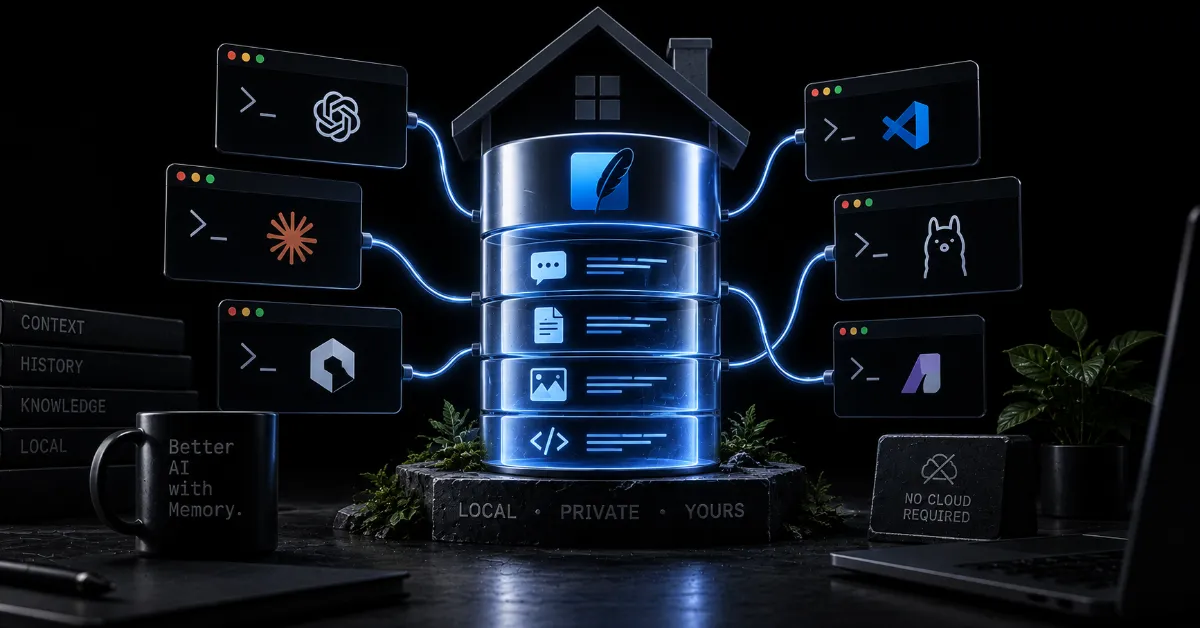
- Subject Overview: Engrim Introduces Universal Local First SQLite Memory Engine for AI CLIs — Key developments across Dev.
- Technical Context: Detailed analysis of architectural changes, product capabilities, and engineering metrics.
- Industry Impact: Key implications for software developers, startup founders, and enterprise technology adopters.
The Architecture of Local First AI Memory Engines
Modern artificial intelligence command-line interfaces have revolutionized how developers interact with codebases, automate repetitive tasks, and query documentation. However, these tools frequently suffer from amnesia, losing valuable contextual history across sessions or relying on expensive, privacy-invasive cloud-hosted vector databases for basic state retention. Engrim emerges as a sophisticated antidote to this limitation, introducing a universal, local-first memory engine built on top of SQLite. By embedding lightweight, persistent memory directly into the developer's local environment, Engrim ensures that AI agents maintain continuous context without compromising data privacy or network latency.
Designing an effective memory engine for AI CLI tools requires balancing rapid query performance against complex relational data modeling and minimal resource consumption. Traditional cloud-based vector stores introduce unnecessary network overhead and security risks when dealing with sensitive, uncommitted local source code. Engrim leverages SQLite's remarkable efficiency, transactional integrity, and zero-configuration design to deliver lightning-fast retrieval of past prompts, code snippets, and execution states. This architectural choice enables developers to maintain a seamless, offline-capable workflow while empowering their AI assistants with rich, historical context.
The local-first philosophy championed by Engrim fundamentally shifts data ownership back to the end user. In an era where telemetry collection and third-party data harvesting have become default behaviors for many software tools, a purely local memory engine guarantees that proprietary codebases and confidential conversations never leave the developer's workstation. Data is stored in standard, easily inspectable SQLite databases located on the local disk, allowing developers to back up, migrate, or purge their AI memory stores with absolute confidence and ease.
Furthermore, Engrim's modular design allows it to act as a universal middleware layer connecting diverse AI CLI utilities to a centralized, persistent memory repository. Rather than forcing every individual command-line tool to implement its own fragmented caching or history mechanism, Engrim provides a standardized API for storing and querying conversational embeddings, semantic tags, and execution logs. This unified approach eliminates data silos within the developer's local environment, creating a cohesive cognitive ecosystem where different AI agents can share and build upon historical insights generated across various workflows.
System Implementation and Data Flow Optimization
Under the hood, Engrim is engineered to handle the high-frequency read and write operations characteristic of interactive AI sessions without introducing noticeable latency to the command-line experience. When a developer issues a prompt or executes an AI-assisted command, the system captures the interaction, generates lightweight embeddings or keyword indexes, and persists the data into the local SQLite database via optimized asynchronous transactions. This ensures that the main thread remains unblocked, preserving the snappy, responsive feel expected from modern developer tooling.
Optimizing SQLite for semantic search and contextual retrieval involves leveraging advanced extensions and custom indexing strategies tailored specifically for machine learning workloads. Engrim utilizes efficient vector distance calculations and full-text search capabilities directly within the database engine, circumventing the need to spin up separate, resource-heavy external search daemons like Elasticsearch or Qdrant for local projects. This streamlined resource footprint makes Engrim ideal for deployment across diverse hardware environments, ranging from high-end developer workstations to resource-constrained edge devices and laptops running on battery power.
Data synchronization and schema evolution represent critical considerations for any persistent local storage engine, especially as AI models and their corresponding data structures evolve rapidly. Engrim incorporates robust schema migration utilities that update internal database tables transparently as new versions of the engine are adopted. Additionally, the system provides built-in mechanisms for pruning stale or irrelevant memory entries, ensuring that the local database does not bloat uncontrollably over months of intensive daily development activity.
Concurrency management is another vital engineering challenge successfully addressed by Engrim's underlying storage architecture. Developers frequently run multiple terminal windows, concurrent build scripts, and parallel AI agent instances simultaneously, all of which may attempt to access or modify the local memory store at the exact same moment. By utilizing SQLite's robust Write-Ahead Logging mode and careful connection pooling strategies, Engrim prevents database lockups and ensures data integrity across complex, multi-threaded developer workflows.
Developer Workflows and Integration Capabilities
Integrating Engrim into existing developer workflows is intentionally frictionless, requiring minimal configuration to begin capturing and utilizing persistent AI memory. The tool provides clean, well-documented command-line interfaces and software development kits that allow custom scripts and terminal utilities to interface with the memory engine effortlessly. Developers can easily query their historical interactions, search for past solutions to stubborn debugging problems, or inject relevant context from previous sessions directly into current prompts with simple commands.
The productivity gains unlocked by this persistent context are substantial, eliminating the tedious repetition of explaining project architecture, coding standards, or previous bug fixes to AI assistants at the start of every new terminal session. Engrim remembers the nuances of the codebase, recalling specific configuration quirks, library versions, and architectural decisions made weeks or months prior. This continuity transforms AI tools from transient chat windows into true collaborative partners that possess a deep, cumulative understanding of the project's lifecycle.
Customization and extensibility are core tenets of Engrim's design philosophy, allowing developers to tailor the memory engine's behavior to match their unique working styles and project requirements. Users can define custom retention policies, configure filtering rules to exclude sensitive files or credentials from being indexed, and integrate specialized embedding models depending on their hardware capabilities and accuracy preferences. This high degree of configurability ensures that Engrim adapts to the developer rather than forcing the developer to adapt to rigid system constraints.
Collaboration among team members is also facilitated through Engrim's export and import capabilities, allowing developers to share curated memory snapshots or project-specific knowledge bases with colleagues. While the primary operational mode remains strictly local-first, teams can optionally commit sanitized context repositories into version control systems, effectively bootstrapping new team members with a rich archive of institutional knowledge and AI-assisted troubleshooting history for the repository.
Future Outlook and the Evolution of Local AI Tooling
As the artificial intelligence landscape matures, the pendulum is swinging back toward edge computing and local-first architectures as developers and enterprises alike seek greater control, privacy, and cost predictability. Tools like Engrim represent the bleeding edge of this paradigm shift, demonstrating that sophisticated AI capabilities do not necessarily require perpetual connection to massive cloud datacenters. By harnessing the raw power of local hardware and proven embedded databases, the developer tooling ecosystem is entering a golden age of sovereign, high-performance utilities.
The future roadmap for Engrim includes deeper integrations with emerging local large language models, enhanced semantic clustering algorithms, and expanded cross-platform support for various terminal emulators and shell environments. As local model inference speeds continue to improve thanks to hardware acceleration and algorithmic breakthroughs, the combination of local LLMs and local memory engines like Engrim will unlock entirely autonomous, offline developer workflows capable of operating securely in air-gapped environments.
Community engagement and open-source contribution will remain central to Engrim's growth, driving rapid iteration, bug patching, and feature expansion inspired by real-world developer feedback. The repository invites contributors from across the software engineering community to experiment with its architecture, propose optimizations, and build novel extensions that expand the boundaries of what local AI assistants can achieve. This collaborative spirit ensures that the tool remains agile, innovative, and deeply aligned with the actual needs of modern software engineers.
In summary, Engrim represents a vital leap forward in how developers interact with artificial intelligence within their native command-line environments. By solving the persistent memory problem through an elegant, local-first SQLite architecture, it delivers unmatched privacy, speed, and contextual awareness. As the industry continues to demand more secure and autonomous developer tools, Engrim stands out as an exemplary model of thoughtful, high-performance engineering designed for the future of software development.
Related Coverage on TechRoro
- [Dev] Decoding the New Artificial Intelligence Vocabulary for Modern Software Engineers
- [Dev] Optimizing Artificial Intelligence Coding Economics Without Compromising Output Quality
- [Dev] RonanRX Brings Personalized Peptides and GLP-1 Treatments to Software Driven Medicine