

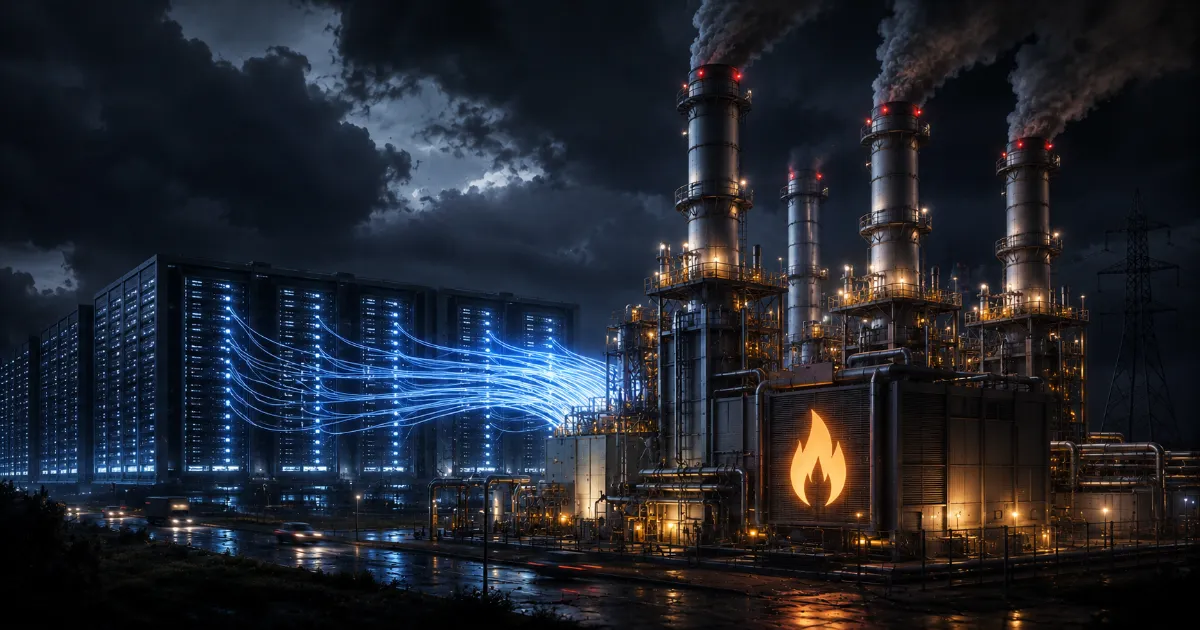
- Subject Overview: Data Centers Are Driving an Alarming Gas Power Expansion in the US — Key developments across Energy.
- Technical Context: Detailed analysis of architectural changes, product capabilities, and engineering metrics.
- Industry Impact: Key implications for software developers, startup founders, and enterprise technology adopters.
The Infrastructure Squeeze of Generative Workloads
Modern artificial intelligence models and massive hyperscale data centers require unprecedented levels of electrical capacity to sustain continuous model training and real-time inference workloads. Traditional electrical grids, many of which are decades old and already operating near their maximum designed capacity, simply cannot absorb these sudden multi-gigawatt power draws without significant upgrades or new localized generation assets. Grid operators across key regions find themselves scrambling to maintain baseline reliability while accommodating facilities that consume as much electricity as small industrial cities.
To bridge this widening power deficit in real time, technology companies and utility providers are turning increasingly to natural gas as an immediate and dispatchable energy source. Unlike wind and solar installations, which depend heavily on weather conditions and require complex battery storage arrays for firming, gas-fired combustion turbines can be brought online rapidly to meet soaring demand spikes. This operational flexibility has transformed natural gas from a transitional bridge fuel into an indispensable cornerstone of the immediate artificial intelligence expansion strategy.
Environmental regulators and energy analysts are expressing profound concern over this sudden pivot, noting that hundreds of new gas-fired generation projects have been proposed or entered active construction. These additions threaten to reverse hard-fought carbon reduction milestones established by states and federal agencies over the past decade. The race to achieve computational dominance is inadvertently locking in long-lived fossil fuel infrastructure that could emit millions of tons of greenhouse gases for decades into the future.
Grid Interconnection and Transmission Bottlenecks
Integrating massive new data center loads into the existing high-voltage transmission grid involves navigating a notoriously sluggish interconnection queue managed by regional transmission organizations. Developers often face wait times spanning many years just to receive technical impact studies and grid access approval. Consequently, localized generation strategies, including co-located gas turbines situated directly adjacent to data center campuses, have emerged as a pragmatic work-around to bypass congested transmission bottlenecks entirely.
Operating dedicated gas generation behind the meter or directly tied to local distribution substations allows technology operators to secure reliable power without waiting for multi-state transmission line upgrades. However, this decentralized approach introduces complex regulatory challenges regarding wholesale electricity markets, retail ratepayer impacts, and localized air quality standards. Surrounding communities frequently push back against the immediate proximity of heavy industrial combustion equipment, citing legitimate public health and environmental justice concerns.
Utility companies are attempting to balance these competing pressures by proposing complex rate structures and specialized tariffs that require large tech customers to fund necessary grid reinforcements. These agreements often stipulate that data center operators must either install dedicated clean energy sources or pay for the comprehensive modernization of local substations and distribution feeders. Nevertheless, the physical reality of construction timelines heavily favors natural gas turbines, which can be manufactured and deployed far faster than wind farms or advanced nuclear reactors.
Economic Trade Offs and Environmental Realities
The economic windfall for local municipalities hosting these gas-backed data centers can be substantial, generating millions of dollars in tax revenue that supports local schools, emergency services, and public infrastructure. Local economic development boards frequently champion these projects as generational opportunities to revitalize stagnant industrial zones and create high-paying technical jobs. Yet, this localized prosperity stands in stark contrast to the broader environmental externalities and global climate impacts associated with unabated fossil fuel combustion.
Financial markets are closely monitoring how utility providers finance this generation expansion, as capital expenditures for new gas plants require significant long-term debt issuance and equity investments. Investors must weigh the potential for lucrative, multi-decade service contracts with hyperscale cloud providers against the looming regulatory risk of future carbon pricing and stringent emissions caps. If federal or state administrations implement aggressive decarbonization mandates, these newly constructed gas assets could face premature retirement or severe economic depreciation.
Furthermore, the reliance on natural gas exposes the technology sector to commodity price volatility and supply chain vulnerabilities associated with domestic pipeline networks and international liquefied natural gas export dynamics. Any disruption in fuel supply directly threatens the continuous uptime requirements of mission-critical cloud regions, forcing operators to maintain expensive backup diesel generation fleets on-site. This layered redundancy underscores the immense technical and logistical complexity of powering the next generation of digital infrastructure.
Strategic Outlook for Sustainable Computing
Looking toward the horizon, the tension between aggressive artificial intelligence scaling and climate preservation will necessitate radical innovations in power procurement and energy management. Technology enterprises are already investing heavily in advanced nuclear technologies, next-generation geothermal energy, and long-duration energy storage to eventually replace or supplement interim fossil fuel solutions. These alternative clean energy vectors represent the only viable path to decoupling exponential computational growth from carbon emissions.
Policy frameworks will need to evolve rapidly to incentivize clean energy co-location and streamline the regulatory approval processes for zero-carbon generation assets. Without proactive government intervention and massive private sector capital deployment into clean firm power, the artificial intelligence boom will continue to rely on natural gas as its primary life support system. The choices made by tech executives and energy planners today will decisively shape the environmental trajectory of the industry for the remainder of the century.
Ultimately, the data center industry must internalize the true environmental cost of its relentless expansion and take active ownership of its electrical footprint. By fostering closer collaborations between utility providers, renewable developers, and regulatory bodies, the sector can engineer a sustainable transition that honors climate commitments without sacrificing technological progress. The future of intelligence depends entirely on finding a harmonious equilibrium between digital ambition and planetary boundaries.


