
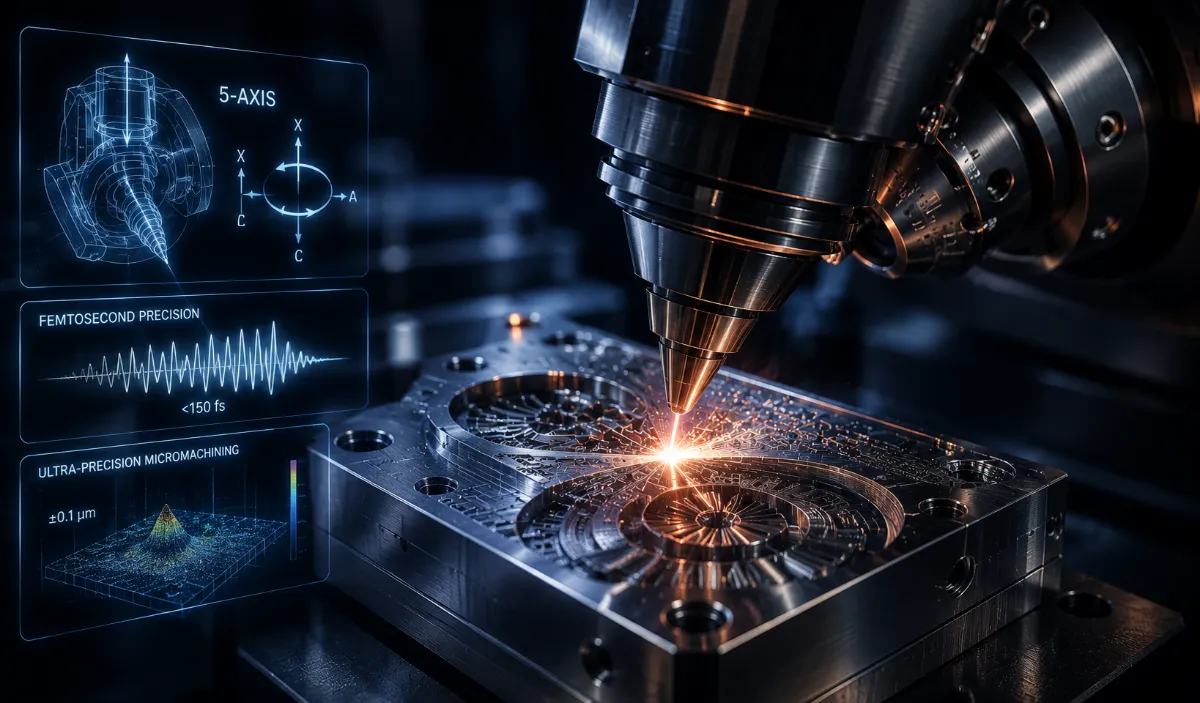
- Subject Overview: Femtosec Precision Revolutionizing Five Axis Laser Micromachining for Industrial Manufacturing — Key developments across In Brief.
- Technical Context: Detailed analysis of architectural changes, product capabilities, and engineering metrics.
- Industry Impact: Key implications for software developers, startup founders, and enterprise technology adopters.
The Technical Mechanics of Femtosecond Ablation
At the heart of the latest manufacturing advancements is the shift toward femtosecond laser systems. Unlike traditional nanosecond or picosecond lasers that rely on thermal heating to melt or evaporate material, femtosecond pulses are so incredibly short—lasting only one quadrillionth of a second—that they induce a process known as cold ablation. The energy is deposited into the material faster than the lattice structure can vibrate, meaning the bonds between atoms are broken directly without transferring heat to the surrounding area. This eliminates the common issues of recast layers, heat-affected zones, and micro-cracking, which are critical failures in the production of high-precision medical devices and aerospace components.
The integration of this technology into five-axis kinematic platforms allows for unprecedented geometric flexibility. By controlling the beam path along five degrees of freedom, manufacturers can create complex internal geometries, undercuts, and curved micro-channels that were previously impossible to produce via traditional subtractive methods. The synchronicity between the motion control system and the laser pulse rate requires advanced digital twin modeling to ensure the beam trajectory remains perfectly perpendicular to the surface geometry at every point along the cutting path.
Comparison of Laser Ablation Methodologies
| Feature | Nanosecond Lasers | Femtosecond Lasers | Industrial Impact |
|---|---|---|---|
| Pulse Duration | 10^-9 seconds | 10^-15 seconds | Higher precision |
| Heat Affected Zone | Significant | Negligible | Zero thermal damage |
| Material Versatility | Limited | Near-Universal | Enhanced design freedom |
| Edge Quality | Rough | Optical quality | Minimal post-processing |
Applications in High Precision Manufacturing
- Medical Device Fabrication: Producing surgical implants and micro-catheters that require bio-compatible surfaces without thermal degradation.
- Aerospace Componentry: Manufacturing fuel injection nozzles and cooling channels in turbine blades where structural integrity is non-negotiable.
- Electronics Packaging: Creating ultra-fine features on semiconductor wafers and complex interposers without damaging nearby sensitive circuitry.
Key Takeaway: The transition to femtosecond five-axis machining marks the end of thermal-impact constraints in micro-manufacturing, shifting the focus from material removal rate to sub-micron geometric accuracy.
Advancing Motion Control and Synchronization
True five-axis micromachining depends on the marriage of ultra-fast optics and high-rigidity motion platforms. As the laser fires at kilohertz or megahertz frequencies, the motion controller must calculate the tool path in real-time, compensating for acceleration and deceleration to maintain constant beam intensity. Modern systems utilize piezoelectric actuators combined with linear motors to achieve nanometer-level positioning accuracy. This level of control is necessary to prevent 'laser overlap' errors, where inconsistent energy density results in microscopic variations in surface roughness.
Industry participants are increasingly leveraging AI-driven predictive maintenance to monitor the optical chain. By analyzing back-scattered light signatures, manufacturers can identify lens degradation or nozzle misalignment before it results in defective parts. This integration of sensor fusion into the laser head turns a static machine tool into a self-correcting manufacturing unit, significantly increasing yield rates for high-value components.
The Bottom Line
The move toward femtosecond laser technology represents a structural shift in how we approach complex part production. By isolating the energy application from thermal diffusion, manufacturers gain the ability to work with brittle, heat-sensitive, and reflective materials that were previously deemed unmachinable. As we look toward the standards of 2026, the convergence of five-axis kinematics with these ultra-short pulses will likely become the standard requirement for any sector demanding high-fidelity micro-feature creation.
Sources
Today's Medical Developments (todaysmedicaldevelopments.com)