
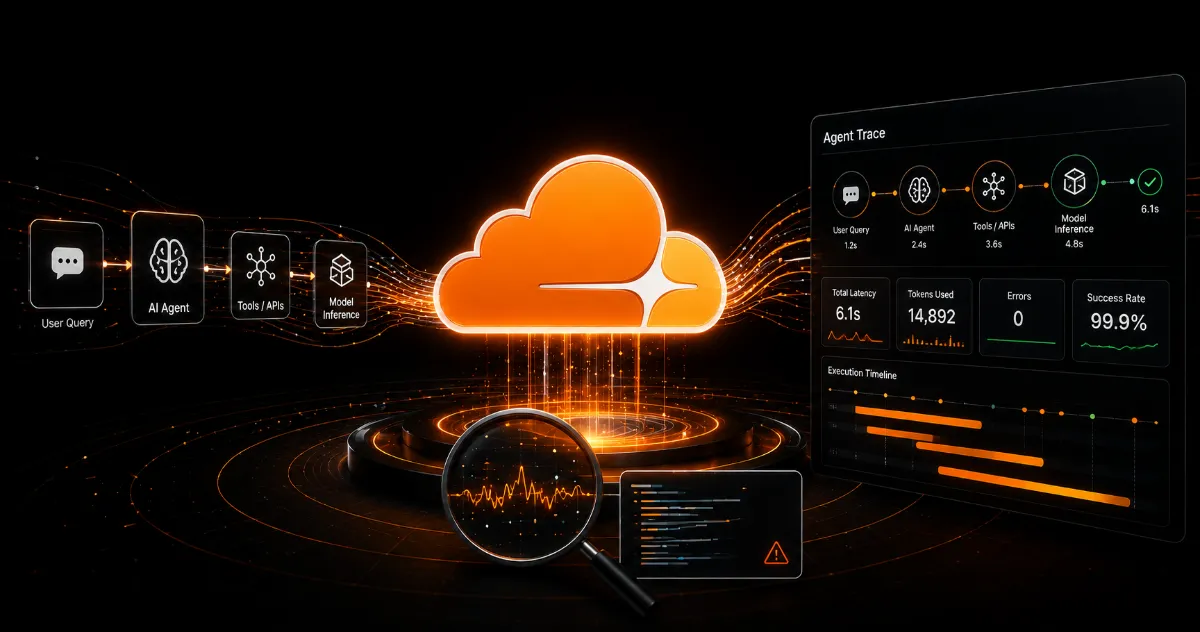
- Subject Overview: Cloudflare Introduces Native Agent Tracing to Simplify AI Application Debugging — Key developments across Infrastructure.
- Technical Context: Detailed analysis of architectural changes, product capabilities, and engineering metrics.
- Industry Impact: Key implications for software developers, startup founders, and enterprise technology adopters.
Solving the Black Box Problem
As AI development pivots toward agentic architectures—where models perform iterative tasks, tool calls, and multi-step reasoning—traditional observability tools are struggling to keep pace. Monitoring a single API request is straightforward, but tracing the lifecycle of a complex agent session is notoriously difficult. Cloudflare has stepped in to address this gap with the introduction of native agent tracing, a feature designed to provide developers with deep, granular visibility into how their AI agents interact with models and external tools.
This new functionality creates a 'span' for every step an agent takes, documenting the transition between thought, action, and final execution. For developers building on the Workers platform, this means the end of blind debugging sessions. Instead of guessing where an agent went off the rails, they can now inspect the exact sequence of events that led to a specific output, significantly reducing the mean time to resolution for production incidents.
Core Functionality and Truncation Limits
One of the most significant challenges in logging agent interactions is the sheer volume of data generated during long-running reasoning tasks. An agent might execute dozens of tool calls and internal 'thought processes' before arriving at an answer. Cloudflare’s implementation includes sophisticated truncation limits, ensuring that developers can capture necessary diagnostic data without overwhelming their observability pipelines or incurring excessive storage costs.
- Adaptive Truncation: Automatically clips verbose internal payloads that exceed defined size limits while preserving the critical metadata.
- Payload Defaults: Sensible defaults for uneven payload structures prevent data loss during complex nesting scenarios.
- Standardized Spans: Each agent action is tagged with a consistent schema, allowing for easy integration with existing dashboarding and monitoring solutions.
| Metric | Old Methodology | Cloudflare Agent Tracing |
|---|---|---|
| Granularity | Request/Response only | Step-by-step reasoning spans |
| Configuration | Manual/Custom logging | Native/Built-in observability |
| Data Volume | Uncapped/High risk | Managed via smart truncation |
| Debugging Time | High latency | Reduced through visualization |
Key Takeaway: By providing native support for tracing agentic flows, Cloudflare allows developers to move from experimental AI deployments to high-reliability production systems without sacrificing diagnostic visibility.
Optimizing Multi-Step Workflows
Beyond simple debugging, these tools allow developers to optimize the performance of their AI applications. By visualizing the sequence of events, teams can identify bottlenecks where agents are spinning in loops or making unnecessary, redundant tool calls. This is particularly important for edge-deployed applications where latency is a primary concern. Every extraneous step an agent takes adds latency that negatively impacts the user experience.
Cloudflare's approach enables developers to set performance budgets for their agentic workflows. By analyzing the spans, teams can determine which parts of the logic are consuming the most time and compute resources. This allows for fine-tuning that makes AI applications feel faster and more responsive, effectively bringing the benefits of edge computing to the AI era.
Security and Privacy Guardrails
Tracing AI agents brings unique security considerations, especially regarding the sensitive data that models might ingest or generate during their reasoning cycles. Cloudflare has built this tracing functionality with security as a first-class citizen. Developers have granular control over what information is logged, with clear options to mask or exclude sensitive payloads from their traces. This is a critical feature for enterprises that must adhere to strict data residency and privacy regulations.
Furthermore, the ability to trace agentic behavior provides a window into potential 'prompt injection' or 'jailbreak' attempts. By monitoring the spans for unexpected sequences or anomalous tool calls, security teams can proactively detect malicious behavior before it leads to data breaches. This transforms the observability tool into a secondary defense mechanism against the unique attack vectors inherent in generative AI.
Developer Experience and Integration
Integration is designed to be seamless. For developers already using Cloudflare Workers and AI Gateway, adding agent tracing is a configuration-level change rather than an architectural redesign. This low-friction entry point is key to accelerating adoption within the developer community. By reducing the complexity of monitoring, Cloudflare empowers smaller teams to build and deploy sophisticated AI agents that were previously reserved for organizations with deep-pocketed infrastructure teams.
Furthermore, the platform's support for standard trace formats means that this data can be exported to third-party tools, ensuring that teams aren't locked into a single ecosystem for their long-term analytics. This commitment to interoperability is a hallmark of the Cloudflare developer philosophy, ensuring that as the AI tooling landscape evolves, the observability layer remains robust and flexible.
The Real-World Impact
We are reaching a tipping point where AI agents are moving from chatbots to autonomous workers. To support this transition, we need more than just raw power; we need the tools to manage and understand these systems at scale. Cloudflare’s move into native agent tracing is a necessary step in the maturity of the AI ecosystem. It provides the clarity needed to iterate faster, deploy safer, and deliver more reliable experiences. As developers continue to push the boundaries of what agents can achieve, the ability to trace, analyze, and optimize those journeys will become the single most important capability in their technical stack.