
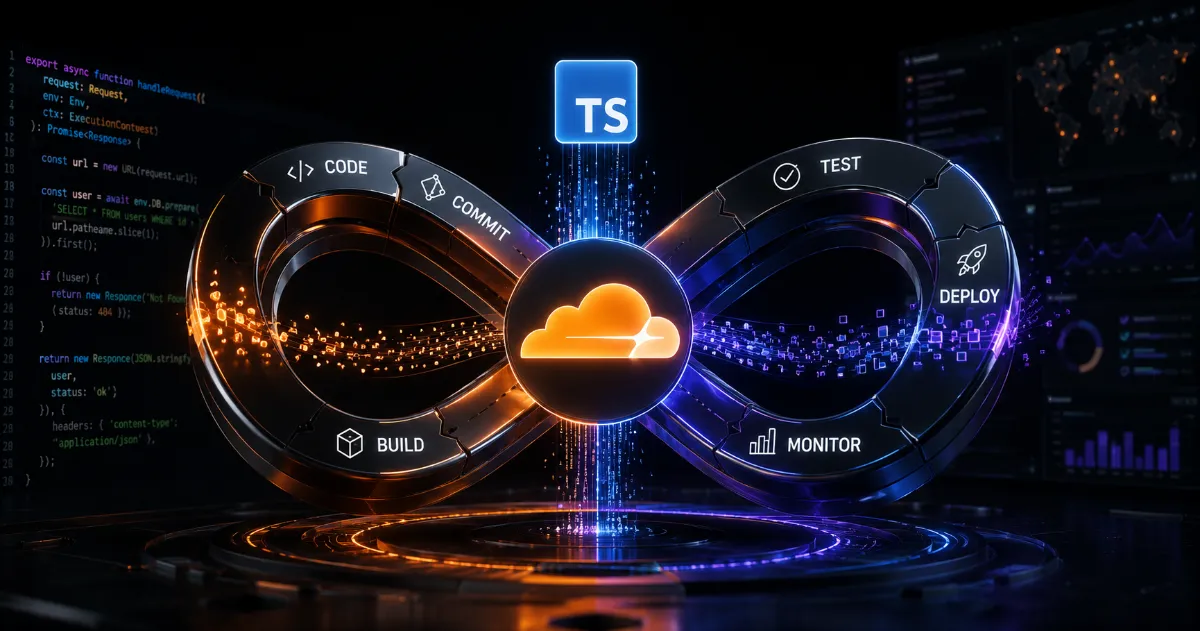
- Subject Overview: Cloudflare Transforms Continuous Integration with Native TypeScript Workflows — Key developments across Infrastructure.
- Technical Context: Detailed analysis of architectural changes, product capabilities, and engineering metrics.
- Industry Impact: Key implications for software developers, startup founders, and enterprise technology adopters.
Executive Overview and Core Hook
In the fast-paced world of global edge computing, the bottleneck for most engineering organizations is no longer the code they write, but the infrastructure through which that code must travel. For years, the Continuous Integration (CI) landscape has been dominated by static configuration languages, most notably YAML. While YAML provided a readable, declarative baseline for simple tasks, it has become a significant liability for modern, high-scale software development. As pipelines grow in complexity, teams are forced into a fragmented ecosystem of brittle bash scripts, complicated templating engines, and deeply nested configuration files that are notoriously difficult to debug, version control, and test.
Cloudflare’s introduction of a native TypeScript-based CI SDK represents a fundamental paradigm shift in how we architect deployment workflows. By enabling developers to define their entire CI lifecycle—from environment provisioning and unit testing to security auditing and production deployment—within a first-class programming language, Cloudflare is effectively turning the CI pipeline into an application itself. This transition is not merely about aesthetic preference; it is about bringing the same rigor, type safety, modularity, and testing capabilities that developers apply to their production services to the underlying delivery mechanism. This move is poised to redefine enterprise expectations for developer velocity, security compliance, and infrastructure-as-code consistency at scale.
Technical Breakdown and Architecture
At its core, the Cloudflare TypeScript CI SDK operates by abstracting the complexities of pipeline execution into a programmable interface. Unlike traditional CI tools that treat the pipeline as a series of disconnected, external commands interpreted at runtime, this SDK allows the CI runner to treat the workflow as a natively compiled TypeScript project. When a developer writes a pipeline, they are utilizing standard TypeScript classes and functions to define jobs, dependencies, and environmental variables. This allows for native IDE integration, where developers benefit from autocomplete, real-time type checking, and instant documentation lookups while constructing their workflows.
Architecturally, the system is designed around a modular worker-based execution model. Because the SDK leverages TypeScript, developers can encapsulate common pipeline patterns—such as multi-stage security scans or cross-region artifact distribution—into reusable, versioned packages. These packages can be imported across various projects, ensuring that security and compliance standards are enforced consistently without the need for error-prone copy-pasting of YAML configurations. Furthermore, the SDK integrates deeply with Cloudflare’s global edge network, allowing developers to execute pipeline tasks closer to the resources they manage. By using the same SDK for both the application code and the deployment logic, teams eliminate the context switching inherent in managing disparate configuration files, leading to a more unified, observable, and maintainable software delivery lifecycle.
Markdown Comparison Table and Key Metrics
| Feature | Traditional YAML CI | Cloudflare TypeScript SDK |
|---|---|---|
| Logic Handling | Limited (Complex bash scripts) | Native (Full TypeScript syntax) |
| Type Safety | None (Runtime errors) | Strong (Compile-time checks) |
| Modularization | Brittle (Imports/Includes) | Robust (NPM/Package Manager) |
| IDE Support | Limited (Basic linting) | Full (Autocomplete/Refactoring) |
| Debugging | Difficult (Log analysis) | Easy (Unit testing/Breakpoints) |
| Infrastructure | Static Declarations | Dynamic Programmable Logic |
- Compile-time Validation: Errors in pipeline logic are caught before execution, preventing failed production deployments caused by syntax mistakes.
- Standardized Tooling: Teams leverage familiar NPM workflows for version management, ensuring that CI infrastructure evolves in lockstep with application dependencies.
- Programmable Conditional Logic: Complex deployment branching, parallel execution, and retries are handled with native language structures rather than proprietary YAML hacks.
- Testing Infrastructure: Pipelines can now be unit-tested using standard frameworks, ensuring that infrastructure changes do not break critical deployment paths.
Developer and Ecosystem Impact
For software engineers, the impact of moving to a TypeScript-based pipeline is profound. The primary shift is psychological as much as it is functional: the pipeline is no longer a 'black box' of opaque commands, but a transparent, testable part of the codebase. Engineers can now write unit tests for their deployment logic, ensuring that if a specific environment requires a particular header or security configuration, that requirement is guaranteed by the code rather than hoped for by a human manual reviewer. This reduces the burden on Site Reliability Engineering (SRE) teams, who previously spent significant time troubleshooting deployment-specific configuration drift.
For startups and enterprises alike, this SDK democratizes infrastructure management. Startups can now package their entire deployment methodology into a private library, allowing new projects to inherit production-ready pipelines in seconds. Conversely, large enterprises can mandate global security and compliance policies by centralizing them within shared TypeScript modules. If an enterprise security team needs to rotate a secret or update an audit logging requirement across five hundred services, they can do so by updating a single NPM package, which is then pulled into the CI workflows of all dependent projects. This centralized control, combined with the flexibility of a distributed development model, is a transformative development for enterprise-scale DevOps.
Strategic Market Outlook and Analysis
Cloudflare’s entrance into the programmable CI space is a direct challenge to the legacy of static-first automation platforms. The current market is heavily saturated with tools that force users into 'YAML-hell,' where maintenance costs scale super-linearly with the complexity of the organization. As organizations shift toward increasingly complex microservices and edge-native architectures, the limitations of static configuration are becoming a significant drag on innovation. Cloudflare is positioning itself not just as a network or security provider, but as a comprehensive platform for the entire application lifecycle.
However, the move does introduce a learning curve. Teams that have spent years refining their YAML expertise will need to invest in training to fully leverage the power of TypeScript-based pipelines. Furthermore, the trade-off between the flexibility of a full programming language and the simplicity of declarative syntax will be a point of debate for smaller teams. Despite this, the long-term trend in the industry is clearly moving toward 'Infrastructure as Software.' As Cloudflare continues to integrate this SDK into its wider product suite, we expect to see an accelerated trend toward unified developer experiences, where the lines between application code, infrastructure code, and pipeline code continue to blur, ultimately resulting in faster release cadences and more stable global production environments.