
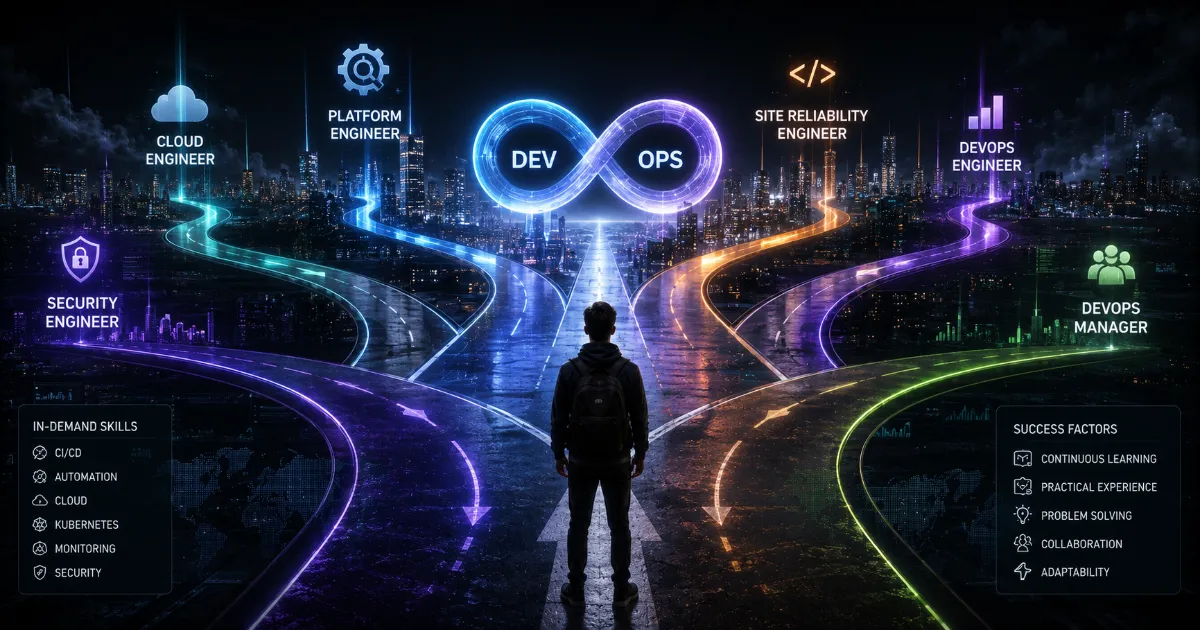
- Subject Overview: Navigating The Competitive Landscape Of Modern DevOps Careers — Key developments across Infrastructure.
- Technical Context: Detailed analysis of architectural changes, product capabilities, and engineering metrics.
- Industry Impact: Key implications for software developers, startup founders, and enterprise technology adopters.
Executive Overview and Core Hook
The global technology sector is currently witnessing a profound transformation in how software is deployed, scaled, and secured. The traditional definition of a DevOps engineer—often relegated to maintaining Jenkins pipelines or managing server configurations—is becoming obsolete. In its place, a new archetype of infrastructure professional is emerging, one who functions more like an architect of distributed systems and a guardian of cloud economics. This shift is primarily driven by the integration of Generative AI into the software development lifecycle, which has automated the low-level tasks that once occupied the majority of a DevOps professional's day, leaving them free to focus on high-level strategic architecture.
This evolution matters because the cost of cloud mismanagement and the complexity of modern security threats have reached an inflection point. Organizations are no longer looking for engineers who can simply deploy code; they are searching for specialists who can manage multi-cloud environments, implement policy-as-code frameworks, and optimize FinOps strategies to keep ballooning cloud budgets under control. The transition from manual operational tasks to fully automated, AI-augmented systems means that the barrier to entry for junior roles has shifted, while the expectations for senior leadership have expanded into the realms of product strategy and business continuity. As we look toward the next decade of infrastructure development, the value of the DevOps practitioner lies in their ability to orchestrate complexity rather than merely managing it.
Technical Breakdown and Architecture
The architecture of modern DevOps environments has evolved from a linear pipeline approach to a complex, non-linear ecosystem of interconnected services. At the heart of this transformation is the move toward GitOps, where the state of the entire infrastructure is stored in a version-controlled repository, allowing for declarative management through tools that synchronize the desired state with the actual infrastructure. This architecture relies heavily on Kubernetes as the universal control plane, abstracting away the underlying physical hardware and enabling a consistent operational experience across private data centers and public cloud providers.
Furthermore, the integration of AI-driven observability has fundamentally changed the debugging process. Modern DevOps setups utilize telemetry data from distributed tracing, structured logging, and real-time metrics to feed into machine learning models. These models can predict potential system failures before they occur, triggering automated remediation protocols. This shift toward self-healing infrastructure is a core component of the modern DevOps stack, moving the engineer from a reactive posture—where they respond to alerts—to a proactive posture where they engineer reliability into the platform itself. The technical complexity now extends into the domain of security, where DevSecOps practices ensure that security protocols are embedded directly into the CI/CD pipeline, treating security policies as version-controlled code rather than manual checklists.
Markdown Comparison Table and Key Metrics
| Capability | Legacy DevOps | Modern AI-Driven DevOps |
|---|---|---|
| Deployment Strategy | Manual/Scripted | Fully Automated GitOps |
| Monitoring | Alert-Based | Predictive Observability |
| Security | Perimeter-Based | DevSecOps/Zero Trust |
| Cloud Economics | Reactive Cost Management | Continuous FinOps Integration |
| Infrastructure Management | Ticket-Based Provisioning | Infrastructure-as-Code (IaC) |
- Efficiency Gains: Transitioning to AI-assisted infrastructure management can reduce mean time to recovery by up to 60 percent.
- Scalability: Modern modular architectures allow for horizontal scaling that is independent of human intervention.
- Security Posture: Automated policy enforcement reduces the attack surface by eliminating configuration drift.
- Economic Impact: Integration of FinOps practices often leads to a 20 to 30 percent reduction in annual cloud expenditure.
Developer and Ecosystem Impact
For software engineers and infrastructure professionals, the impact of these changes is both liberating and demanding. The automation of routine maintenance tasks allows engineers to focus on high-value architectural decisions, such as designing fault-tolerant distributed systems or optimizing microservices communication patterns. However, this also necessitates a broader skill set. An engineer today must possess fluency in multiple programming languages—beyond simple shell scripting—and a deep understanding of cloud-native networking, service meshes, and identity management protocols.
Startups, in particular, are feeling the pressure to adopt these modern standards early. By leveraging managed platforms and infrastructure-as-code modules, early-stage companies can achieve enterprise-grade reliability without the need for a massive operations team. This creates a competitive advantage where the speed of innovation is no longer hindered by operational bottlenecks. Conversely, for large-scale cloud architectures, the transition to AI-integrated DevOps is a massive undertaking that requires not just new tools, but a fundamental shift in company culture. Teams must move away from the 'developer versus operations' mentality and toward a shared responsibility model where quality, reliability, and security are treated as common goals.
Strategic Market Outlook and Analysis
The competitive landscape for DevOps talent is tighter than ever, not because there is a shortage of applicants, but because there is a severe shortage of candidates who can navigate the intersection of traditional ops and modern software engineering. The market is increasingly rewarding specialists who can bridge the gap between financial accountability and technical execution. As enterprise adoption of AI continues to scale, the role of the DevOps engineer will evolve to include the management of machine learning pipelines, a discipline often referred to as MLOps.
Trade-offs in this market are significant. While the move toward standardized, cloud-native tools reduces vendor lock-in risk, it increases reliance on complex open-source ecosystems that require constant vigilance for vulnerabilities. Companies that fail to adapt to these new realities risk falling behind in both innovation speed and operational efficiency. The most successful organizations are those that invest heavily in upskilling their workforce, recognizing that the human element remains the most critical component in any automated system. As we move forward, the definition of a DevOps professional will continue to expand, likely encompassing aspects of data engineering and ethical AI governance, making the role one of the most dynamic and essential positions in the modern technology stack.
Sources
Cloud Native Computing Foundation (cncf.io) Linux Foundation (linuxfoundation.org)