
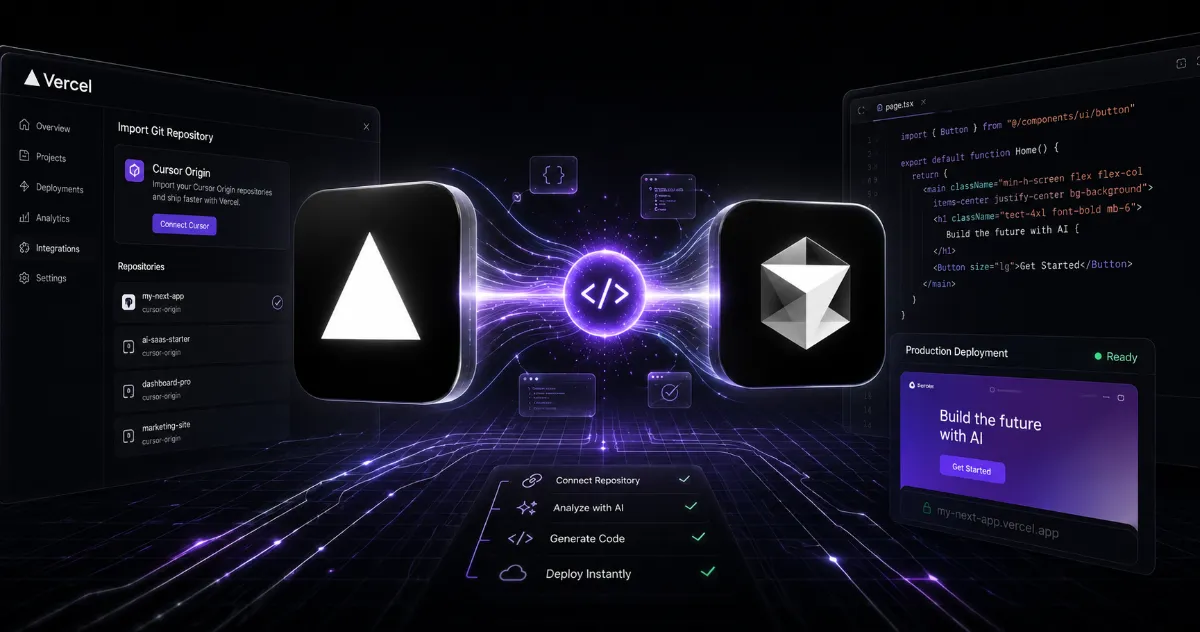
- Subject Overview: Vercel Integrates Cursor Origin Repositories to Supercharge AI Driven Web Development — Key developments across Infrastructure.
- Technical Context: Detailed analysis of architectural changes, product capabilities, and engineering metrics.
- Industry Impact: Key implications for software developers, startup founders, and enterprise technology adopters.
The rapid adoption of AI-driven coding environments like Cursor has necessitated a shift in how we think about deployment pipelines. Vercel, responding to this paradigm shift, has officially launched its public beta for connecting Cursor Origin repositories directly to the Vercel ecosystem. This integration effectively removes the friction between an AI-generated coding session and a live, scalable preview deployment, allowing developers to bridge the gap between ideation and production with unprecedented velocity.
Architecting for the AI First Workflow
Modern development is increasingly defined by AI collaboration. Cursor Origin provides a specialized environment where codebases are treated with a higher degree of context awareness. By allowing these repositories to link directly to Vercel, developers ensure that every commit or pull request is instantly validated through Vercel’s globally distributed edge network. This creates a tight feedback loop where the code suggested by AI is immediately rendered, tested, and shared, enabling rapid iteration cycles that were previously bottlenecked by manual deployment triggers.
For enterprise teams, this means that the AI-assisted code written in local dev environments can be immediately subjected to the same rigorous testing standards as traditional human-written code. Vercel’s platform automatically manages the environment variables and dependencies required for these builds, ensuring that the transition from a local Cursor environment to a production-ready preview URL is seamless and reliable.
The Technical Mechanics of Preview Deployments
When a developer connects a Cursor Origin repository to Vercel, the integration establishes an automated trigger system. Every time a pull request is created or updated within the Cursor environment, Vercel initiates a new build process. This build process consumes the specific configuration of the Cursor repo, applies the necessary environment mappings, and provisions a unique URL for the preview.
Key Takeaway: The tight integration between AI IDEs and deployment platforms is the next frontier of developer productivity. By automating the preview deployment step, teams can reduce the time-to-feedback from minutes to seconds, allowing for more aggressive experimentation.
This workflow is supported by Vercel’s proprietary build infrastructure, which handles parallel processing to ensure that even large, complex applications are built and ready for review almost instantly. For distributed teams working across different time zones, having an always-live preview environment tied directly to the source control history is an essential requirement for maintaining momentum.
Impact on the Developer Ecosystem
This development highlights a broader trend: the tooling stack for AI development is maturing. It is no longer enough to just have a smart code completion tool; that tool must be tightly coupled with the infrastructure layer. The Vercel and Cursor partnership signals that AI development is graduating from experimental side projects to critical business infrastructure. Developers who utilize this stack are effectively gaining a force multiplier, as they can spend more time on architectural logic and less time on the mechanics of CI/CD pipeline maintenance.
Moreover, the security and reliability features that Vercel provides are now natively extended to Cursor-based workflows. Teams can manage their deployments via the familiar Vercel dashboard, applying security policies, usage analytics, and performance monitoring without needing to shift contexts or learn new management systems. This unified interface is a massive win for efficiency in high-pressure development environments.
Workflow Comparison: Traditional vs AI-Integrated Deployment
| Process Step | Traditional Development | Cursor + Vercel Workflow |
|---|---|---|
| Build Trigger | Manual / CLI Command | Automatic on Pull Request |
| Environment Config | Local Syncing | Managed Vercel Variables |
| Feedback Loop | 10-20 Minutes | Sub-Minute Auto-Previews |
| Collaboration | Screen Sharing / Staging | Instant Live Preview URLs |
Looking Toward the Future of Development
The public beta is just the beginning of what is likely to be a deeper integration between AI-first IDEs and cloud infrastructure. As these models become more capable of refactoring entire applications or implementing complex features, the role of the developer will shift from writing lines of code to orchestrating the deployment and validation of AI-generated systems. Platforms like Vercel are positioning themselves to be the standard runtime for this new generation of software.
By prioritizing integrations that cater to the unique needs of AI workflows, Vercel is ensuring that the transition to an AI-augmented development paradigm remains as frictionless as possible. The current beta phase is the perfect time for early adopters to refine their CI/CD practices and prepare for a future where the deployment pipeline is as intelligent as the IDE itself.
The Road Ahead
As we look forward, the reliance on manual deployment scripts will likely continue to wane, replaced by platforms that understand the semantic context of a repository. Vercel’s commitment to this integration sets a high bar for other infrastructure providers to follow. For developers currently using Cursor, this update offers a compelling reason to unify their stack and leverage the full power of Vercel’s edge deployment network. The future of development is fast, automated, and increasingly powered by the intersection of AI and cloud-native infrastructure.