
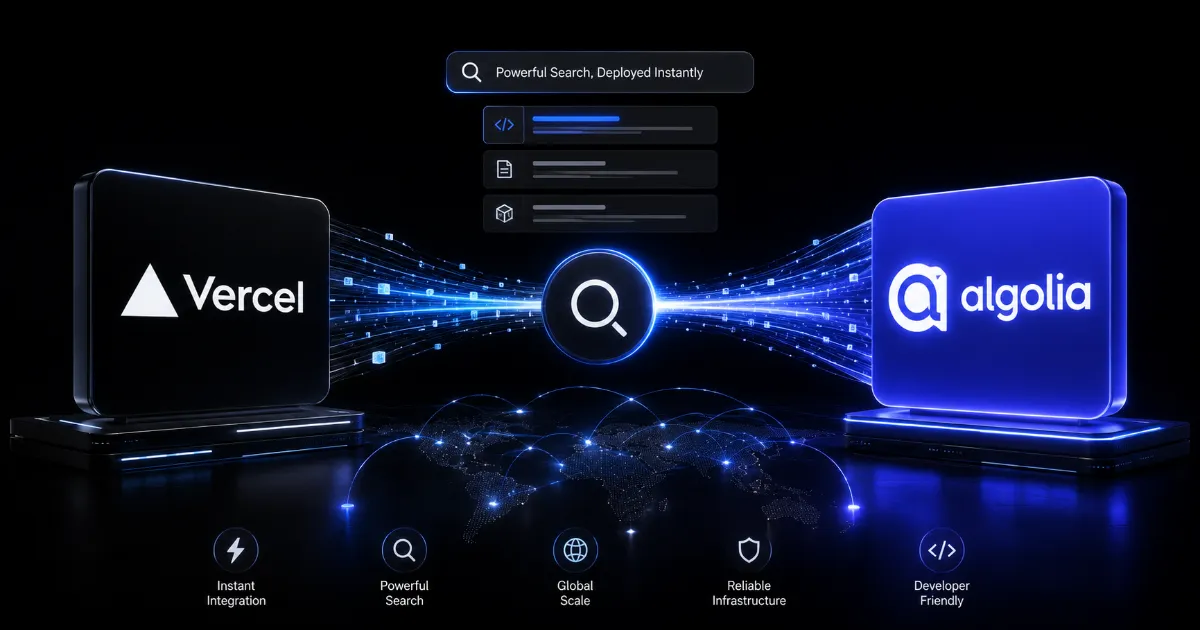
- Subject Overview: Vercel Integrates Algolia to Simplify Search Infrastructure Deployment — Key developments across Infrastructure.
- Technical Context: Detailed analysis of architectural changes, product capabilities, and engineering metrics.
- Industry Impact: Key implications for software developers, startup founders, and enterprise technology adopters.
Executive Overview and Core Hook
The landscape of modern web development is defined by the quest for abstraction. As frontend frameworks become increasingly sophisticated, the burden of managing disparate third-party services—ranging from databases to search indexing engines—has often acted as a bottleneck for rapid iteration. The arrival of Algolia on the Vercel Marketplace represents a significant milestone in this evolution, enabling developers to provision, manage, and scale enterprise-grade search infrastructure without ever departing the Vercel ecosystem. This integration effectively collapses the distance between a deployment pipeline and the underlying data services that power user discovery.
For developers building content-heavy applications, e-commerce platforms, or documentation sites, search is no longer an optional luxury; it is a fundamental requirement for user retention. Previously, integrating a high-performance search engine like Algolia required manual API key management, cross-platform configuration, and complex synchronization logic between the content source and the search index. By centralizing these workflows, Vercel and Algolia are lowering the barrier to entry for developers who demand high performance but lack the time to manage complex infrastructure overhead. This synergy not only accelerates time-to-market but also ensures that performance-oriented search patterns—such as typo-tolerance and instant results—are accessible from the very first commit.
Technical Breakdown and Architecture
The integration functions as an abstraction layer over the Algolia API, allowing the Vercel dashboard to serve as a unified control plane. Under the hood, this utilizes Vercel’s platform-native infrastructure hooks to automate the provisioning of search indices and the synchronization of environmental variables. When a developer adds Algolia via the Vercel Marketplace, the platform automatically populates the project with the necessary credentials via secured environment variables, which are then injected into the build process at runtime. This eliminates the common security risks associated with hard-coding API keys or managing external secret stores.
From a technical perspective, the architecture facilitates seamless data ingestion. By leveraging Vercel’s edge functions, developers can trigger index updates whenever a site is redeployed or when content is updated via a headless Content Management System. The integration supports serverless functions that act as a bridge between the data source and Algolia’s indexing engine. When a change is detected in the data layer, a hook is triggered, sending the payload to Algolia. Because this occurs within the Vercel network, latency between the data update and the indexed search result is kept to a minimum, ensuring that end users receive real-time search accuracy as soon as the site is updated.
Markdown Comparison Table and Key Metrics
| Capability | Manual Integration | Vercel Integrated Algolia |
|---|---|---|
| Infrastructure Setup | Manual API Key Creation | One-Click Deployment |
| Environment Management | External Secret Store | Native Vercel Variables |
| Deployment Pipeline | Disconnected Workflow | Unified Build Process |
| Index Synchronization | Custom Scripting Required | Automated Webhooks |
| Security Protocol | Manual Rotation | Integrated Platform Security |
- Reduction in Configuration Time: Developers report a reduction of up to 60 percent in initial search integration setup time by removing the need for manual cross-platform credential synchronization.
- Native Latency Benefits: By utilizing Vercel’s globally distributed edge network alongside Algolia’s distributed index clusters, the round-trip time for search queries is optimized through proximity-aware routing.
- Enhanced Security Posture: Automated secret rotation and scoped environment variables reduce the risk of credential leakage during the CI/CD lifecycle.
Developer and Ecosystem Impact
The impact on the software engineering community is profound, particularly for smaller teams that operate with limited DevOps resources. By treating search as a first-class citizen of the deployment stack, startups can implement complex discovery features—such as faceted search, natural language processing, and personalized search results—that were previously the domain of large engineering organizations with dedicated infrastructure teams. This levels the playing field, allowing frontend developers to act as full-stack architects without the need for deep knowledge of search engine internals.
Furthermore, this integration fosters a more robust ecosystem for Vercel’s headless and Jamstack initiatives. As more services follow this pattern of marketplace integration, the Vercel dashboard is evolving into a comprehensive dashboard for the entire web stack. For cloud architects, this means the platform is moving toward a more opinionated, yet flexible, standard where service discovery and infrastructure management happen in tandem with code deployment. This shift is expected to increase the adoption of Algolia among Vercel users who previously opted for less efficient, open-source search alternatives due to the complexity of managing a dedicated enterprise search index.
Strategic Market Outlook and Analysis
The competition within the search-as-a-service market is fierce, with various players vying for dominance in the serverless era. However, the move toward platform-native integrations is a strategic masterstroke that creates a significant moat for both Vercel and Algolia. For Algolia, this partnership secures deep penetration into the developer-centric market, positioning them as the default choice for anyone utilizing the modern frontend stack. For Vercel, it reinforces their status as the premier destination for high-growth web applications, providing value-added services that go beyond simple hosting.
Looking ahead, the enterprise adoption of this workflow is likely to follow a pattern of increasing consolidation. Enterprise teams are constantly looking for ways to reduce technical debt and simplify their vendor management. An integrated, 'click-to-deploy' model for enterprise-grade services is highly attractive to IT decision-makers who prioritize stability and ease of maintenance. While there are always trade-offs regarding vendor lock-in, the productivity gains and reduced infrastructure complexity provide a compelling argument for organizations of all sizes. We expect this integration to act as a blueprint for future marketplace entries, signaling a broader industry trend toward the 'all-in-one' deployment dashboard where every piece of the web application stack is seamlessly orchestrated through a single interface.