
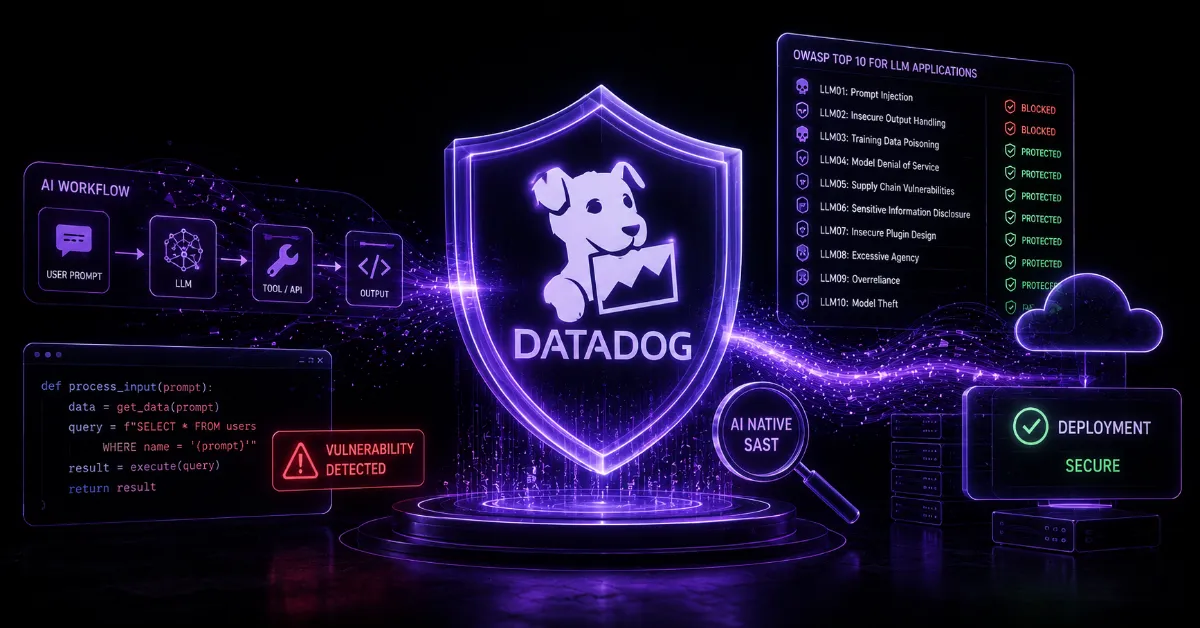
- Subject Overview: Datadog Launches AI Native SAST to Secure Generative AI Workflows Against OWASP Threats — Key developments across Infrastructure.
- Technical Context: Detailed analysis of architectural changes, product capabilities, and engineering metrics.
- Industry Impact: Key implications for software developers, startup founders, and enterprise technology adopters.
Executive Overview and Core Hook
The integration of large language models into production software stacks has introduced a complex layer of risk that traditional security tools were never designed to handle. While developers are racing to build feature-rich AI applications, the fundamental security primitives for LLM inputs, prompt injection defenses, and data leakage prevention remain nascent. Standard static analysis tools often miss the nuances of prompt chaining or vector database misconfigurations, leaving companies exposed to the evolving OWASP Top 10 for LLM Applications. Datadog’s launch of its AI-native Static Analysis Security Testing (SAST) tool represents a critical turning point in DevSecOps, providing automated guardrails for teams scaling generative AI initiatives.
This new security layer is not merely an incremental update to legacy SAST platforms; it is a fundamental shift in how security teams approach the lifecycle of generative AI. By embedding analysis directly into the CI/CD pipeline, Datadog ensures that developers receive real-time feedback on insecure prompt patterns, unsafe deserialization of model outputs, and unauthorized access configurations within vector databases. This capability is vital because, in an AI-first development environment, the speed of deployment often outpaces the manual security review process. By automating the detection of vulnerabilities that are specific to the interaction between code and LLMs, Datadog empowers organizations to innovate at pace without sacrificing their security posture.
Technical Breakdown and Architecture
The architecture of Datadog’s AI-native SAST tool is built upon a semantic analysis engine that understands the context of generative AI workflows. Unlike traditional SAST tools that look for syntax-level errors in standard languages like Python or Java, this new tool analyzes the logic of prompt construction and the data flow between the application code, the model API, and the vector storage layer. It employs a graph-based representation of the data pipeline, allowing it to trace how user-supplied inputs travel through the application, interact with system prompts, and ultimately influence the model’s output. This depth of visibility is essential for identifying indirect prompt injection attacks where malicious data is retrieved from a vector database and then injected into the model context.
Technically, the tool functions by integrating into existing developer workflows via native hooks in version control systems and build pipelines. When a developer commits code that interacts with an LLM framework—such as LangChain or custom API wrappers—the engine initiates a multi-stage scan. First, it performs a control-flow analysis to ensure that inputs are properly sanitized before reaching the model. Second, it evaluates the system prompt architecture for potential leakage or bypass vulnerabilities. Finally, it checks for misconfigurations in the orchestration layer, such as hardcoded API keys or overly permissive IAM roles assigned to the model service account. By focusing on these specific failure modes, Datadog creates a specialized security layer that complements traditional application security testing, providing a comprehensive defense-in-depth strategy for LLM-powered applications.
Markdown Comparison Table and Key Metrics
| Feature | Traditional SAST | Datadog AI Native SAST |
|---|---|---|
| Scope | Standard Code Patterns | LLM Frameworks & Logic |
| Prompt Injection Detection | None | High Accuracy Pattern Matching |
| Vector Database Analysis | Limited | Context-Aware Scanning |
| Workflow Integration | CI/CD Focused | Full Lifecycle Monitoring |
| Remediation Guidance | General Security Advice | LLM-Specific Security Patches |
- Comprehensive coverage of OWASP Top 10 for LLM Applications, including prompt injection, insecure output handling, and training data poisoning.
- Low false-positive rates due to semantic understanding of LLM orchestration frameworks.
- Seamless integration into Datadog’s unified platform, allowing correlation between code vulnerabilities and production runtime anomalies.
- Automated remediation suggestions that help developers fix prompt-based security flaws without manual research.
Developer and Ecosystem Impact
The impact of this tool on the software engineering community is profound, as it addresses the friction between moving fast and staying secure. Previously, developers building AI applications often had to rely on manual, ad-hoc security checklists or wait for expensive third-party audits to identify vulnerabilities. Datadog’s tool shifts the security responsibility left, providing immediate feedback during the coding process. This empowers developers to take ownership of their security, allowing them to experiment with new AI features confidently. Furthermore, by providing actionable remediation advice, the tool acts as a teaching mechanism, helping developers learn how to write more secure prompts and build more resilient AI-integrated backends over time.
For startups and scale-ups, this capability is a competitive advantage. The ability to deploy secure, production-ready AI applications quickly allows these companies to hit the market faster than their peers who are bogged down by manual security reviews. For larger enterprises, this tool provides a centralized governance mechanism. Security teams can set global policies for LLM usage and ensure that every service across the organization adheres to the same security standards, regardless of which team developed the AI application. This standardization reduces the risk of shadow AI deployments and ensures that security teams have a clear, audit-ready trail of the measures taken to protect the AI stack.
Strategic Market Outlook and Analysis
The generative AI market is in the midst of a rapid transition from experimentation to enterprise-grade production. As companies move beyond simple chatbots to complex, agentic AI workflows that interact with proprietary internal data, the stakes for security have never been higher. Datadog’s entry into this market segment signals a maturation of the security ecosystem. While competitors are still trying to adapt legacy tools to the AI era, Datadog is building a platform that treats AI as a first-class citizen in the infrastructure stack. The trade-offs involve a steeper learning curve for teams unaccustomed to the nuances of LLM-specific security, but the payoff is a significantly reduced risk profile.
Market competition is intensifying as both incumbents and specialized startups vie to become the de-facto standard for AI security. However, Datadog’s primary advantage lies in its existing footprint in the observability and monitoring space. By correlating static analysis results with real-time runtime data, Datadog offers a holistic view that standalone security tools cannot match. Companies are increasingly moving toward vendor consolidation, and the ability to manage both performance monitoring and security testing within a single dashboard is a compelling value proposition. As the regulatory environment around AI becomes more stringent, platforms like Datadog that provide auditable, automated security will become essential infrastructure for any enterprise operating in the generative AI space.