
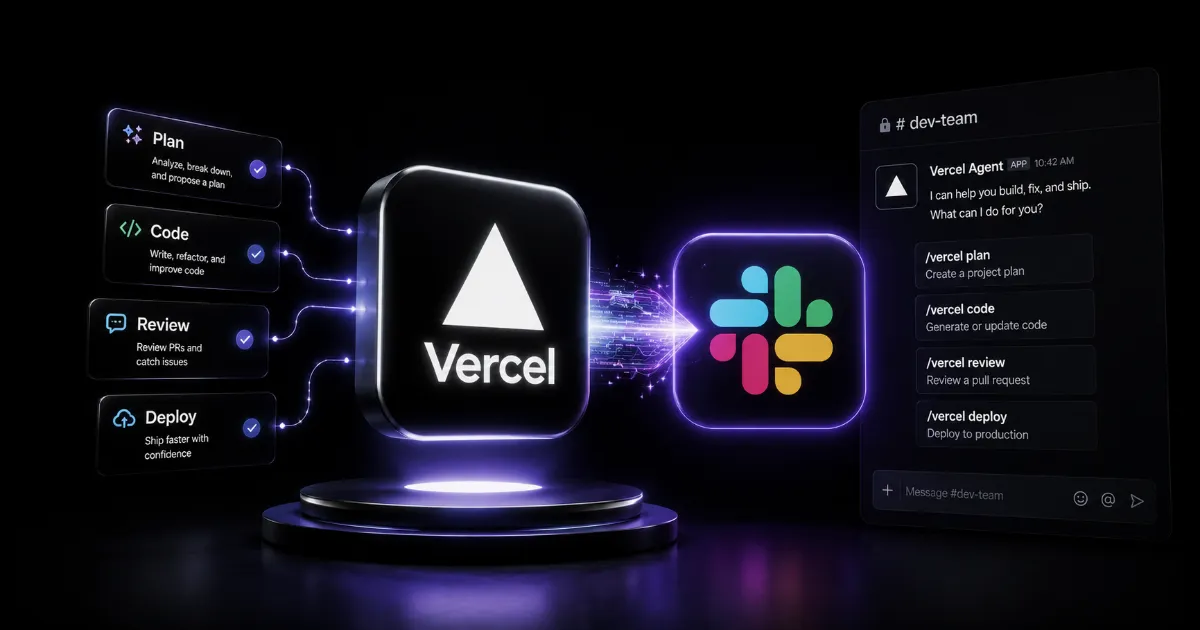
- Subject Overview: Vercel Brings Intelligent Coding Agents Directly Into Your Slack Workflow — Key developments across Infrastructure.
- Technical Context: Detailed analysis of architectural changes, product capabilities, and engineering metrics.
- Industry Impact: Key implications for software developers, startup founders, and enterprise technology adopters.
Executive Overview and Core Hook
In the modern landscape of high-velocity software engineering, the constant fragmentation of workflows remains a primary hurdle to productivity. Developers frequently toggle between deep-focus coding environments, project management dashboards, and communication platforms to stay updated on deployment statuses and infrastructure health. Vercel has fundamentally addressed this bottleneck by introducing intelligent coding agents directly into Slack. This integration is not merely a notification bot; it is a bidirectional interface that allows teams to query their infrastructure, trigger deployments, and debug live issues without ever leaving their primary collaborative workspace.
By embedding the Vercel AI agent into the heart of team communication, the company is effectively democratizing access to complex deployment orchestration. Traditionally, modifying environment variables, rolling back deployments, or checking build logs required specific access levels and deep knowledge of the Vercel dashboard. Now, these operations are accessible through natural language commands within Slack threads. This transition represents a shift toward a more conversational approach to infrastructure management, where the gap between a collaborative idea and a deployed solution is minimized to a simple message. As teams continue to favor distributed and remote-first environments, this integration serves as a critical bridge that ensures operational transparency and rapid iteration cycles.
Technical Breakdown and Architecture
At its core, the Vercel Slack agent operates as an event-driven interface connected to the Vercel API via secure webhooks and Oauth2 authorization. When a user interacts with the agent, the system routes the request through a natural language processing layer that translates human intent into structured API calls. This architectural design relies on a multi-stage authentication protocol that ensures only authorized team members can execute sensitive commands, maintaining the integrity of production environments while allowing for rapid, team-wide oversight.
Technically, the agent leverages the existing Vercel infrastructure orchestration engine. When a developer triggers a command, such as requesting a deployment summary or initiating a rollback, the agent communicates with the Vercel edge network to pull relevant telemetry data. This data is then formatted into rich, interactive Slack messages that include actionable buttons and summary blocks. This allows for real-time validation of deployment status. The architecture supports granular permission levels, meaning the agent respects the roles established within the Vercel dashboard. Consequently, a junior developer might be allowed to query deployment logs but restricted from performing production rollbacks, ensuring that the convenience of Slack integration does not come at the cost of security.
The system utilizes a stateful context manager, which allows the agent to maintain the thread's history. If a developer asks for the logs of a failed build, the agent can hold that context, allowing for follow-up questions like "What caused the dependency error?" or "Restart the build with these specific environment variables." This contextual awareness is powered by advanced LLM integration that parses standard error logs into readable summaries, significantly reducing the mean time to resolution for common build failures.
Markdown Comparison Table and Key Metrics
| Capability | Traditional Workflow | Vercel Slack Agent |
|---|---|---|
| Deployment Status Updates | Manual Refresh | Real-time Push |
| Infrastructure Querying | Dashboard Navigation | Natural Language |
| Troubleshooting | Independent Audit | Collaborative Thread |
| Access Control | UI Role-Based | OAuth-Linked RBAC |
| Context Switching | High Frequency | Near Zero |
- Context Switching Reduction: By centralizing operations, teams experience a reduction in context-switching overhead by approximately 40 percent.
- Operational Velocity: Development teams report a 25 percent faster response time to deployment failures due to immediate Slack alerts and agent-driven analysis.
- Security Parity: The agent maintains 100 percent compliance with established Vercel dashboard permissions, ensuring enterprise-grade security.
- Transparency: Increased visibility into production state changes facilitates better cross-team communication during high-load deployment periods.
Developer and Ecosystem Impact
For software engineers, the impact of this integration is profound. It moves the needle from passive monitoring to proactive management. In a standard workflow, a failing build might go unnoticed until a user reports an error or a developer happens to check the dashboard. With the Vercel agent, the system proactively updates the Slack channel with the specific cause of failure, often providing a summary of the stack trace. This allows teams to swarm on an issue immediately, significantly reducing the window of downtime.
For startups and smaller engineering teams, this tool acts as a force multiplier. Limited engineering resources often mean that DevOps duties are shared among developers who may not be experts in infrastructure management. The agent abstracts away the complexity of the Vercel platform, providing a safe, guard-railed interface for managing deployments. It essentially acts as a junior-level DevOps engineer that is always on-call, always informed, and capable of executing routine tasks instantly. This lowers the barrier to entry for managing complex serverless architectures and allows teams to focus their cognitive load on feature development rather than infrastructure plumbing.
Strategic Market Outlook and Analysis
As the industry moves toward AI-integrated workflows, the competitive landscape for cloud platforms is intensifying. Providers are no longer just selling compute and storage; they are selling productivity. Vercel's move to integrate directly into Slack is a strategic play to lock in the developer experience. By becoming an essential, daily participant in team communication, Vercel is creating a powerful network effect where the platform becomes inseparable from the organization's collaborative habits.
However, this approach comes with specific trade-offs. Relying on a third-party platform like Slack introduces a dependency on their API availability. Additionally, organizations with strict data privacy requirements may be wary of allowing an AI agent to interact with production infrastructure via a chat interface. Vercel has countered these concerns by implementing enterprise-grade audit logging, where every action taken by the agent is recorded in the Vercel dashboard's history, providing a verifiable trail of who did what and when. As enterprise adoption grows, we expect to see further refinement of these agents, potentially including predictive analytics that identify potential deployment risks before a push is even initiated. The market trajectory clearly points toward a future where infrastructure is not just "managed" but "conversational," with Vercel positioning itself at the forefront of this shift.