Neuro-Cognitive Side Effects in GLP-1 Therapy: Investigating Anhedonia Risks
Medical researchers explore the connection between high-dose tirzepatide administration and clinical anhedonia, highlighting the psychological nuances of modern metabolic treatments.
Clinical Observations on Metabolic Treatment
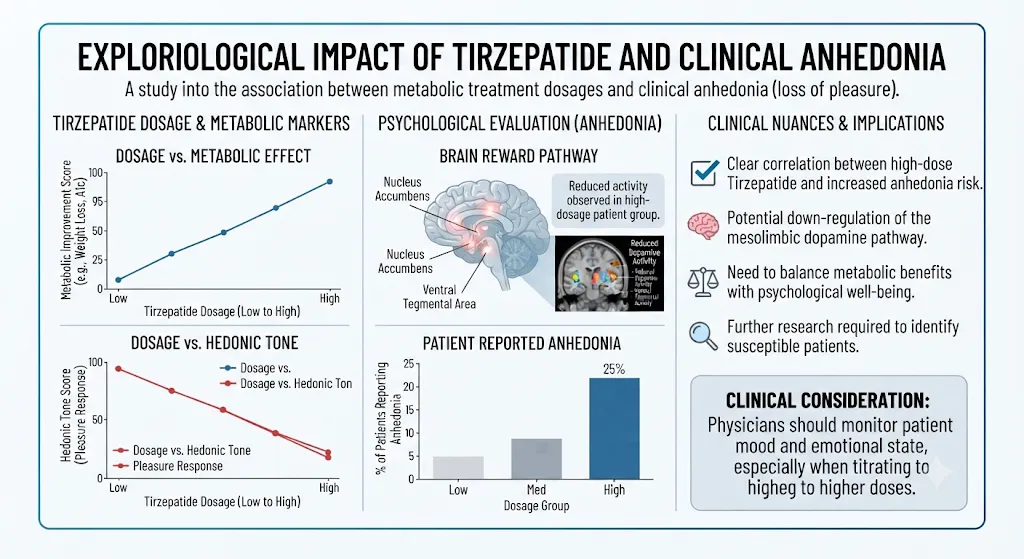
Modern metabolic health interventions have experienced an unprecedented surge, primarily driven by the efficacy of GLP-1 receptor agonists. As these therapeutics become commonplace, clinical practitioners are beginning to observe a subset of neuropsychiatric responses that require closer scrutiny. Recent documentation has surfaced regarding a potential link between high-dosage administration of tirzepatide and the onset of anhedonia, a condition characterized by a diminished capacity to experience pleasure.
Understanding the Anhedonic Response
At the neuro-biological level, the mechanism of action for GLP-1 analogs involves systemic modulation of appetite-regulating pathways. These pathways often overlap with the brain’s mesolimbic reward circuitry—the same neural architecture governing dopamine release and executive motivation. When these pathways are persistently suppressed, some patients report a flattened affect, effectively described as a loss of zest for life. The interaction between metabolic satiety signals and hedonic reward systems is a complex frontier in endocrinology.
- Mechanism: Modulation of hypothalamic and reward-center signaling.
- Observed Symptom: Reduction in dopamine-mediated reward response.
- Management: Clinician-led titration and pharmacological adjustment.
Navigating Therapeutic Boundaries
While the correlation appears in specific case studies, it is essential to distinguish between systemic physiological regulation and psychological baseline shifts. Most practitioners emphasize that these effects are dose-dependent and reversible. As we refine the application of metabolic tech and pharmacology, patient monitoring must expand beyond simple weight loss metrics to include longitudinal assessments of cognitive well-being. Ensuring that treatment protocols account for neuro-chemical homeostasis is the next evolution in high-precision healthcare delivery.
The Big Picture
As metabolic treatments integrate deeper into daily life, the industry must pivot toward holistic wellness tracking. The goal is to maximize physiological efficiency without compromising the neuro-biological systems that facilitate human enjoyment and motivation. Future research will likely focus on optimizing the 'precision-dose'—finding the precise window where efficacy is maintained while neurological side effects remain statistically negligible.