Interstellar Sugars: The Discovery of Four-Carbon Molecules Reshapes Astrochemistry Models
Astronomers have detected erythrulose in deep space, a breakthrough that challenges our current understanding of prebiotic chemistry and cosmic evolution.
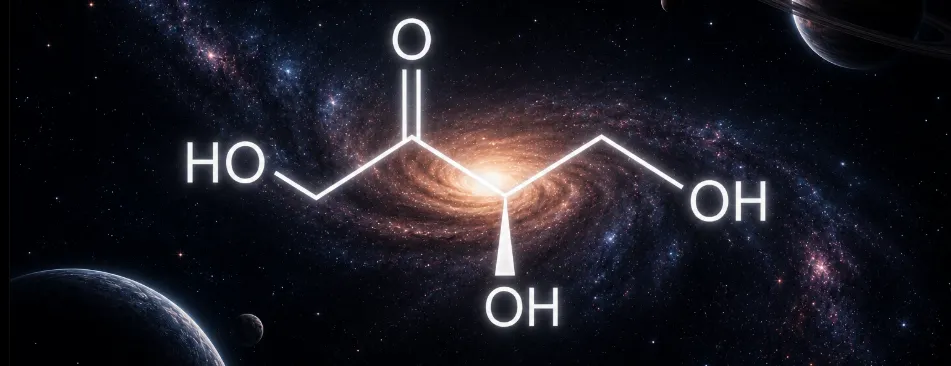
Mapping the Building Blocks of Life
Deep space exploration has reached a significant milestone with the discovery of erythrulose, a four-carbon monosaccharide, located thousands of light-years from Earth. This finding marks the first time a sugar molecule of this complexity has been identified outside our solar system, providing empirical evidence that the fundamental building blocks of life are not exclusive to planetary environments. The detection, facilitated by advanced spectroscopy, forces a rigorous reassessment of how organic molecules form and persist in the harsh, high-radiation environments of interstellar clouds.
The Chemistry of Prebiotic Synthesis
Identifying erythrulose serves as a crucial data point for astrobiologists and chemists tracking the potential for life across the cosmos. While simple organic compounds have been identified previously, the presence of a four-carbon sugar indicates that complex, life-supporting pathways can emerge spontaneously from diffuse molecular clouds. The research highlights several key variables:
- Spectroscopic signatures of complex carbon chains in low-density interstellar medium.
- The role of ionizing radiation in synthesizing sugar chains rather than simply degrading them.
- Correlation between interstellar chemistry and the chemical inventory of comets and primitive meteorites.
By observing the structural stability of these sugars, scientists are refining models that trace how cosmic dust grain surfaces act as chemical reactors. This discovery narrows the gap between the chaotic molecular precursors found in space and the structured biological systems required for cellular function.
The Big Picture
This discovery does not imply the existence of extraterrestrial organisms, but it significantly elevates the likelihood that the necessary materials for biology are widely distributed across our galaxy. As observation technology continues to improve, the ability to pinpoint these molecules will allow researchers to create a more comprehensive map of the 'chemical landscape' of space. Future missions focusing on high-resolution atmospheric spectroscopy will likely reveal that sugar-based complexity is a standard feature of stellar system development rather than a rare anomaly.