Unlocking Edge Intelligence: The Strategic Shift Toward NVIDIA Jetson Hardware
NVIDIA is transforming the edge computing landscape by downsizing high performance AI compute, enabling sophisticated model inference in compact form factors.
The New Frontier of Edge Compute
For decades, artificial intelligence was synonymous with massive server farms and cloud infrastructure. We have entered a new epoch where the architecture of intelligence is moving closer to the data source itself. The NVIDIA Jetson ecosystem represents the physical manifestation of this transition, bringing high performance GPU acceleration into constrained environments that were previously inaccessible to deep learning workloads. By shrinking the hardware footprint without sacrificing the parallel processing power that defines the company, NVIDIA is enabling developers to deploy sophisticated neural networks in everything from industrial robotics to autonomous drones.
Under the Hood Architecture
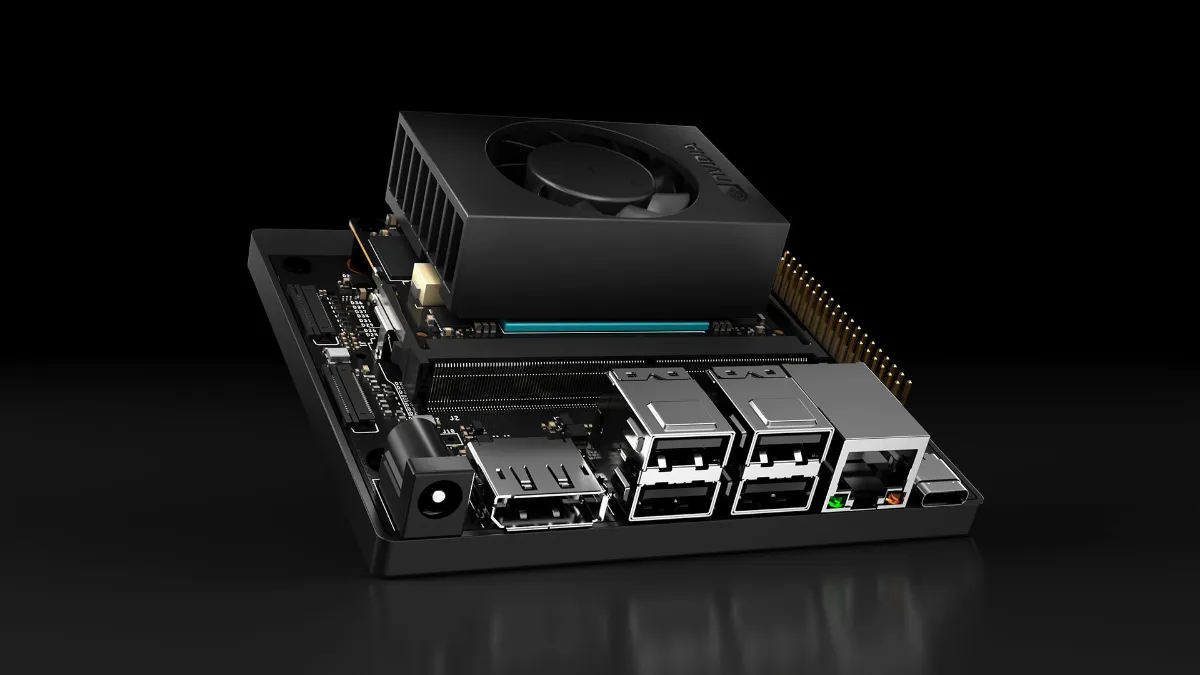
The technical design of the Jetson module is a masterclass in hardware efficiency. Unlike general purpose processors, these system on modules leverage a unified architecture that integrates CPU cores, a high performance GPU, and specialized deep learning accelerators. This integration minimizes data latency by eliminating the need for external memory transfers between a host processor and an accelerator, effectively creating a single point of truth for AI inference in real time. The cooling solutions for these modules are as impressive as their silicon, allowing for sustained high clock speeds even in fanless configurations that operate in the most demanding environmental conditions.
Democratizing Spatial Intelligence
Accessibility remains the primary hurdle for widespread edge adoption, yet the Jetson ecosystem addresses this by lowering the barrier to entry for independent developers. By standardizing the development environment through the JetPack SDK, NVIDIA provides a bridge between cloud based training workflows and local deployment. Developers can train a model using traditional frameworks on high end workstations and seamlessly containerize that model for deployment on Jetson hardware. This workflow ensures that the transition from a research prototype to a production grade intelligent system is devoid of the usual hardware abstraction layers that typically cause fragmentation.
Why Portability Matters
The investment community is increasingly recognizing that intelligence without mobility is significantly limited in scope. Whether it is an agricultural drone monitoring crop health or a manufacturing sensor identifying micro fractures on an assembly line, the ability to run inference locally changes the economic profile of automation. By reducing reliance on constant cloud connectivity, businesses can eliminate the recurring operational costs of data transmission and storage, while simultaneously enhancing the privacy and security of sensitive telemetry data that never needs to leave the local network.
The Real World Impact
As we look toward the future of robotics, the significance of compact, high performance compute becomes clear. We are witnessing a decoupling of software innovation from hardware constraints. When a researcher can place the processing power of a high end desktop GPU into a device the size of a credit card, the speed of iteration increases exponentially. This acceleration creates a feedback loop where improved hardware enables more complex models, which in turn necessitates further advancements in the Jetson roadmap to accommodate the rising demand for on device compute throughput.
The Road Ahead
The trajectory for edge AI is pointing directly toward an autonomous future where intelligence is ubiquitous. NVIDIA is positioning its hardware not just as a component, but as the essential backbone of the modern robotics economy. As power efficiency benchmarks continue to improve, we expect to see even more sophisticated large language models and vision transformers running entirely locally. This convergence of hardware miniaturization and algorithmic efficiency marks the beginning of a truly distributed intelligence, where every connected device becomes an active, thinking agent capable of making decisions in real time.