Modern Frontend State: Architecting Production Grade Forms with TanStack
Stop struggling with React form states. Learn how to combine TanStack Form, Zod, and Shadcn for a type-safe, maintainable, and performant UI architecture.
The Complexity of Frontend Forms
Building production grade forms in React has historically been one of the most frustrating aspects of frontend engineering. Between managing individual input states, handling validation logic, and ensuring proper accessibility, even a simple contact form can quickly spiral into a mess of boilerplate code. Modern frontend architecture solves this by leveraging a type safe approach that decouples the form state from the UI components, allowing developers to build complex multi step interfaces with ease.
Combining Modern Tooling
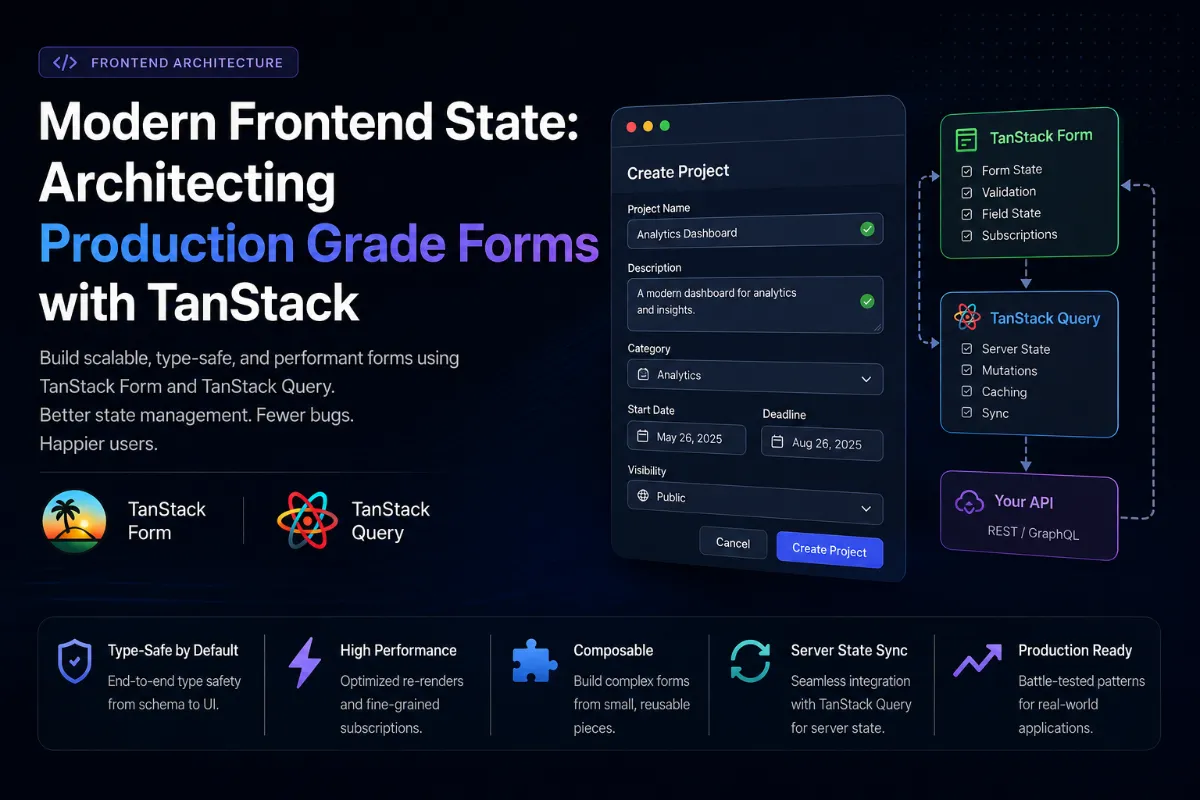
Effective form management now relies on three core pillars: TanStack Form for state orchestration, Zod for schema validation, and Shadcn for interface design. TanStack Form provides a headlessly oriented library that handles the complexities of field registration and submission without forcing a specific UI look. Zod ensures that the data collected matches the expected shape before it ever hits the backend, providing a single source of truth for validation rules. Finally, Shadcn provides accessible, high quality components that are easily themed to match any design system.
Structural Advantages
By centralizing validation in Zod schemas, developers can share the same validation logic between the client and the server, reducing the risk of discrepancies. TanStack Form takes advantage of this by allowing developers to hook into the validation state of the entire form, providing real time feedback to users as they type. This architecture improves performance by preventing unnecessary re-renders and ensures that the UI remains fast even as the number of fields grows.
The Real World Impact
Implementing this stack fundamentally changes the developer experience by removing the cognitive load of tracking individual state changes. When the architecture is clean, the business logic of your application becomes easier to read, test, and maintain. For teams dealing with high volume user input, this approach is not just a preference; it is a necessity for maintaining a stable and reliable frontend codebase.
The Road Ahead
As frontend frameworks continue to evolve, the focus is shifting toward zero runtime overhead and tighter type safety. Adopting these modern patterns now ensures your project is future proof and capable of scaling as your application requirements grow more sophisticated.