NVIDIA Launches Molt to Streamline Agentic Reinforcement Learning Research
NVIDIA introduces Molt, a PyTorch native framework designed to simplify the development and testing of agentic reinforcement learning workflows.
Architectural Implications
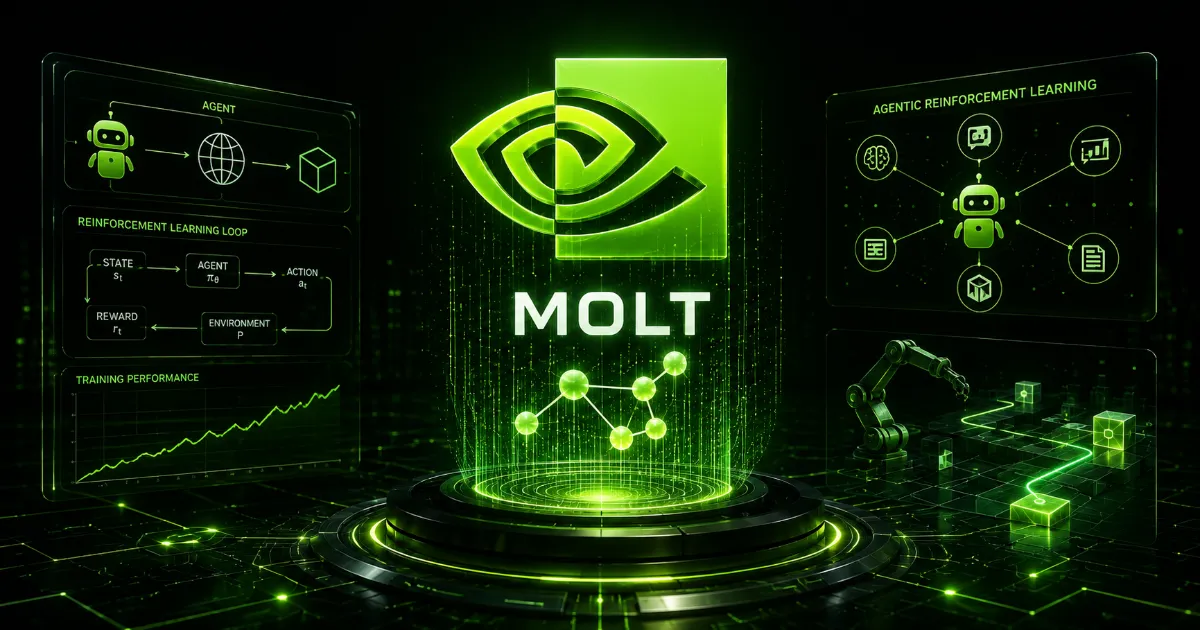
NVIDIA has unveiled Molt, a framework engineered to resolve the structural complexities inherent in modern agentic reinforcement learning (RL) research. Historically, agentic systems have been difficult to iterate upon because changes in algorithms required deep refactoring across trainers, distributed backends, and rollout glue code. Molt solves this by providing a unified, PyTorch native architecture that abstracts the boilerplate, allowing researchers to focus entirely on agent logic rather than the underlying infrastructure. By standardizing the interaction between these components, the framework facilitates rapid experimentation for highly complex environments.
Solving the Agentic Complexity Bottleneck
In traditional RL setups, every minor modification to an agent's objective function or memory architecture risks destabilizing the distributed rollout mechanism. Molt introduces a modular design where trainers and environment interfaces are decoupled, ensuring that modifications are localized. This modularity is essential for the current generation of AI agents, which require sophisticated state management and long term memory capabilities. By reducing the friction of these updates, NVIDIA is enabling a faster cycle of research, particularly for agents designed to handle multi-step reasoning or autonomous tool usage.
Core Advantages of the Molt Framework
- PyTorch Native Integration: Ensures seamless compatibility with existing research workflows and standard deep learning libraries.
- Modular Trainer Architecture: Separates the learning algorithm from the environment interaction layer.
- Optimized Distributed Rollouts: Simplifies the scaling of training across multiple nodes without complex boilerplate code.
- Agentic Focus: Designed from the ground up to support high level agent decision making patterns and memory persistence.
Impact on the Research Community
The ability to iterate quickly is the primary differentiator in the competitive landscape of agentic AI. NVIDIA’s Molt provides a common foundation that could standardize how researchers share and build upon each other's work. By alleviating the engineering burden, the framework is likely to accelerate the development of autonomous agents that can effectively navigate complex tasks, from coding assistants to sophisticated automated problem solvers. This tool is a direct response to the industry's need for more structured, reproducible, and efficient research pipelines.
The Technical Roadmap
As NVIDIA continues to refine Molt, we expect to see further integrations with their broader ecosystem of hardware and software tools. The focus on agentic RL suggests that future versions will likely include native support for more advanced architectures like Transformer based policy heads and memory augmented networks. By providing this framework to the community, NVIDIA is positioning itself as the primary architect for the next generation of autonomous AI systems. The ability to deploy these agents in real world scenarios depends heavily on the robustness of these training frameworks, and Molt is a major step toward making that transition seamless.