Hardware Friction Solves Digital Addiction with Nine Dollar NFC Keys
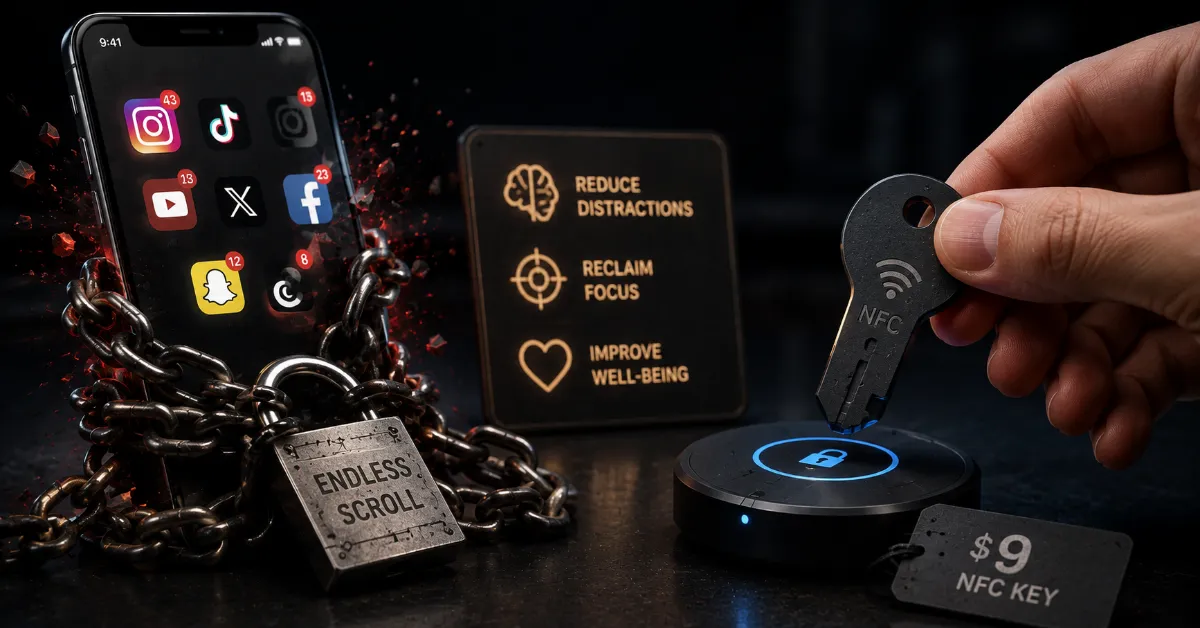
A new physical NFC key forces users to consciously unlock their most distracting mobile applications, introducing intentional friction to curb phone usage.
Reclaiming Attention Through Physical Barriers
In an era where software design is weaponized to maximize engagement, developers are increasingly turning toward hardware solutions to reclaim cognitive autonomy. The latest innovation in the digital wellness space is a modest, nine dollar NFC tag that acts as a physical gatekeeper for your most addictive mobile applications. By requiring a deliberate physical interaction to access specific software, this solution forces a momentary pause in the user experience, disrupting the reflexive loop of infinite scrolling and notification checking.
The Psychology of Frictional Design
Modern interfaces are engineered for flow states, stripping away any resistance between desire and consumption. This physical key operates on the opposite principle: deliberate friction. When a user attempts to launch a restricted app, the operating system triggers a verification prompt that cannot be bypassed without scanning the dedicated NFC key. This creates a spatial requirement, meaning the user must physically locate the token to proceed. This process engages the prefrontal cortex, transforming an impulsive behavior into a conscious decision.
| Feature | Traditional Software Lock | NFC Physical Key |
|---|---|---|
| Activation | Automatic | Physical Scan |
| Cognitive Load | Extremely Low | Moderate |
| Barrier to Entry | None | Tangible Obstacle |
| Success Rate | High Failure | High Success |
Behavioral Modification and Digital Hygiene
For many, the struggle with screen time is not a lack of willpower but an architecture designed for distraction. Apps are built on reinforcement schedules similar to slot machines. By introducing a physical dependency, users can effectively gate their most problematic software behind a threshold. The key acts as a totem of intent, allowing individuals to designate specific windows of time where they commit to deep work or rest without the interference of constant digital pings.
Implementation and Accessibility
This system integrates directly with mobile OS accessibility and background processes. Once configured, the application remains locked until the specific cryptographic signature of the NFC tag is verified. The simplicity of the hardware ensures it is durable, battery free, and universally compatible with modern smartphones. For those struggling to set boundaries in a hyper connected environment, this simple plastic token offers a surprisingly robust defense against the algorithmic capture of human attention.
The Road Ahead
As the industry continues to grapple with the ethics of attention economy design, we expect to see a surge in hardware backed wellness tools. While software based solutions like focus modes are helpful, they are easily toggled off in moments of weakness. Physical hardware provides a permanent, inescapable boundary. Whether this approach scales to mass adoption remains to be seen, but for power users seeking to reclaim their time, this nine dollar investment represents a significant shift in how we manage our relationship with the devices in our pockets.