Kubeflow SDK Reaches Milestone With One Million PyPI Installs
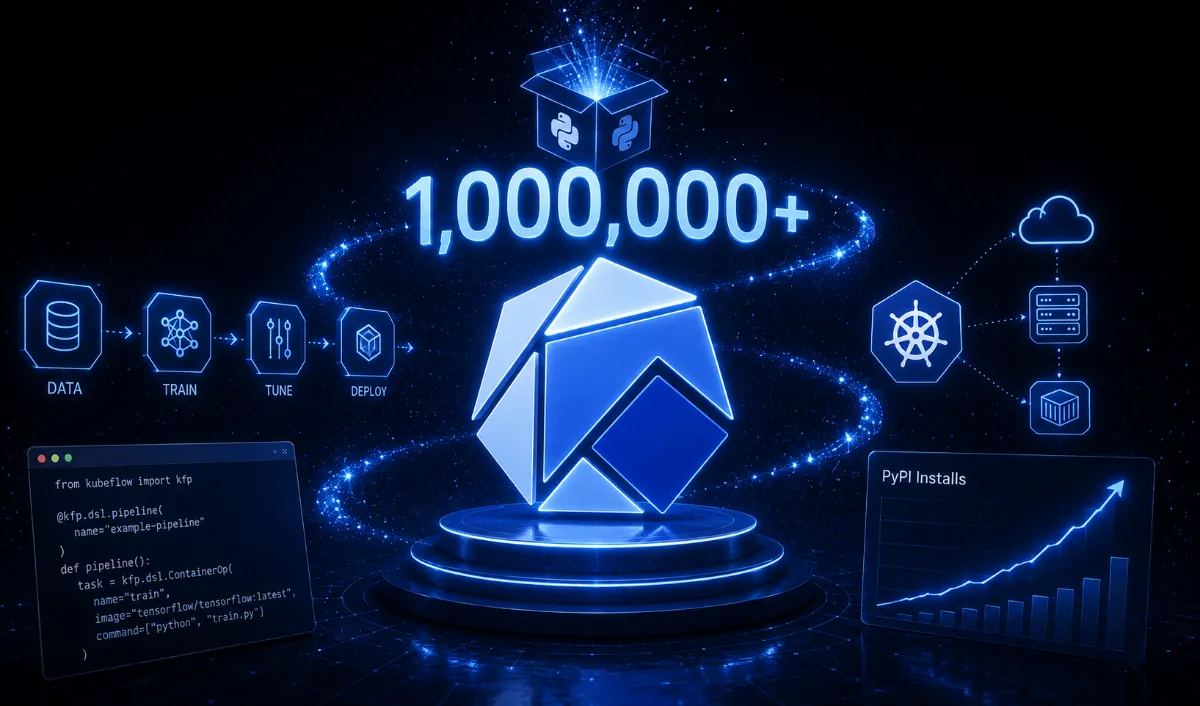
The Kubeflow SDK has officially surpassed one million downloads, marking a significant shift in how machine learning pipelines are orchestrated in cloud native environments.
A New Standard for ML Orchestration
The landscape of machine learning operations has been fundamentally reshaped by the rapid adoption of the unified Kubeflow SDK. Crossing the one million download mark on the Python Package Index represents more than just a vanity metric for the Cloud Native Computing Foundation. It signifies a maturation in the developer ecosystem where standardized interfaces for orchestrating complex machine learning pipelines have become non negotiable. As teams move from experimental research environments to production grade infrastructure, the reliance on a consistent and reliable SDK has proven to be the backbone of effective MLOps.
The Evolution of the Developer Experience
Historically, the barrier to entry for managing sophisticated ML workflows on Kubernetes was prohibitively high. Developers often found themselves juggling fragmented toolsets that struggled to communicate effectively with one another. The consolidation into a unified SDK changed the trajectory for engineers, allowing them to define, deploy, and manage pipelines through a declarative, code first approach. By simplifying the interaction layer with the underlying Kubernetes clusters, the SDK has enabled smaller teams to manage infrastructure that previously required dedicated platform engineering squads.
Comparison of Pipeline Orchestration Approaches
| Feature | Traditional Custom Scripting | Unified Kubeflow SDK |
|---|---|---|
| Scalability | Manual and brittle | Automated via Kubernetes |
| Observability | Fragmented logging | Integrated dashboarding |
| Portability | Environment dependent | Agnostic across cloud providers |
| Maintenance | High overhead | Low, community driven updates |
Strengthening the MLOps Lifecycle
For engineers working within the CNCF ecosystem, the SDK acts as the glue connecting disparate components such as model training, hyperparameter tuning, and serving. The recent improvements in the SDK have prioritized modularity and reduced verbosity, which directly impacts the daily velocity of data scientists. By abstracting away the complex API calls required for Kubernetes resource management, the SDK empowers practitioners to focus on model architecture rather than infrastructure plumbing. This focus on developer productivity has been a primary driver for the sustained growth in adoption seen over the last fiscal year.
The Road Ahead
The current milestone is merely a checkpoint in the broader mission of simplifying the deployment of artificial intelligence at scale. As the industry shifts toward larger foundational models and more complex distributed training tasks, the role of the SDK will evolve to support more aggressive automation and tighter integration with service mesh technologies. The focus for the next iteration of the toolset lies in improving local development parity, ensuring that what runs on a developer laptop behaves identically when deployed to a massive multi node cluster in the cloud. With a million strong user base, the community feedback loop remains the most significant asset for the ongoing development of these tools, ensuring that the software continues to solve real world pain points for machine learning practitioners everywhere.



