AirLLM Enables 70B Model Inference on Consumer Grade 4GB GPUs
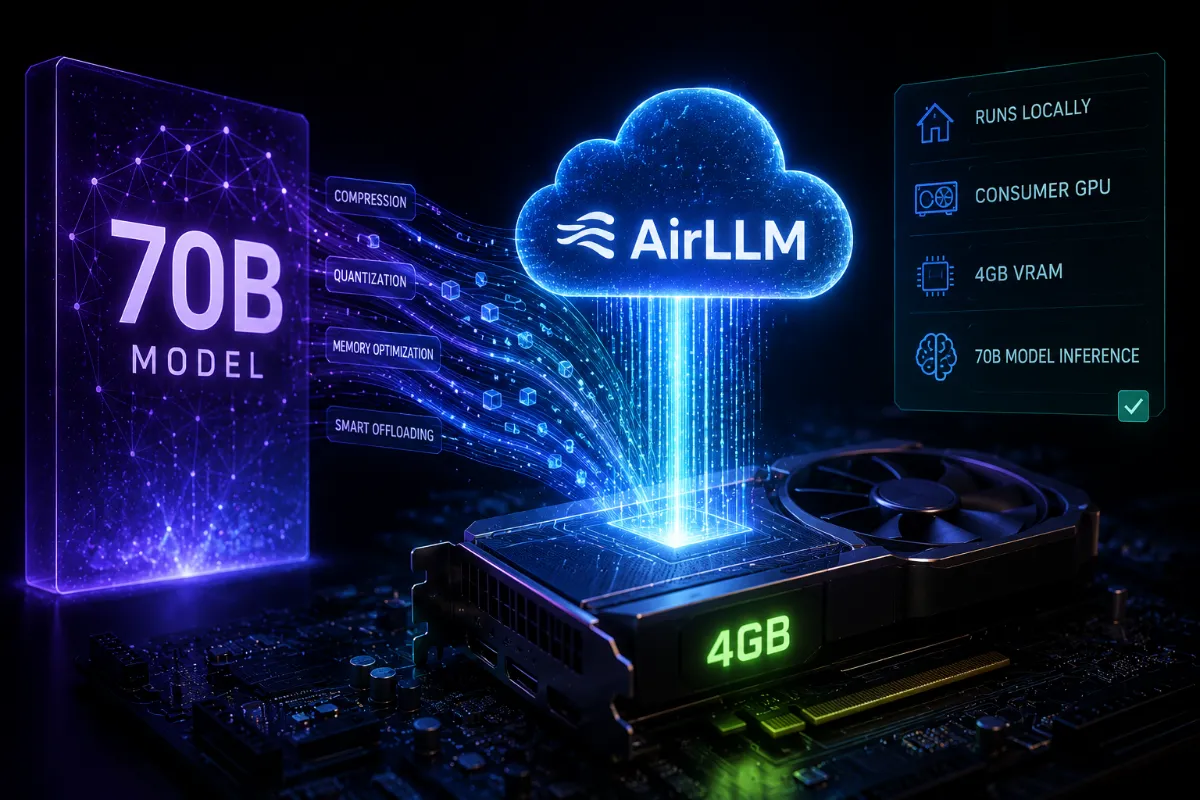
AirLLM breaks the hardware barrier for large language model inference, allowing 70B parameter models to run on limited 4GB VRAM hardware.
Breaking the Memory Barrier
For most developers, running large language models (LLMs) with 70 billion parameters has been a distant dream restricted by the astronomical costs of enterprise-grade GPU clusters. AirLLM has shattered this ceiling, introducing a framework that enables 70B model inference on consumer-grade hardware equipped with as little as 4GB of VRAM. This breakthrough effectively democratizes access to frontier-class intelligence, moving the needle from server-side dependency to edge-based local execution.
Architectural Innovation
AirLLM achieves this by leveraging a highly efficient layer-by-layer inference methodology. Instead of loading the entire model into memory—a task that would normally require tens of gigabytes of VRAM—the framework optimizes the execution sequence to swap parameters in and out of the GPU dynamically. This process, while historically slower due to PCIe bandwidth limitations, has been refined within AirLLM to provide a usable, interactive experience on commodity hardware.
Key Advantages for Developers
- Accessibility: Lowers the barrier to entry for local AI development, making high-capability models available to researchers and hobbyists.
- Data Privacy: Enables local, offline processing of sensitive data, eliminating the need to transmit private information to third-party cloud APIs.
- Cost Efficiency: Eliminates the requirement for expensive hardware upgrades or cloud instance rental fees for basic testing and deployment.
Performance Trade-offs
It is important to understand the practical implications of running large models on constrained hardware. While AirLLM allows 70B models to function on 4GB VRAM, users will observe latency during token generation compared to high-bandwidth setups. However, for development testing, prototyping, or offline applications, this trade-off is often negligible. The ability to run a 70B model locally allows developers to test performance, verify prompt engineering strategies, and refine fine-tuning approaches without incurring continuous compute costs.
Real-World Impact
This technology is fundamentally changing the way developers interact with large models. By moving inference to the local machine, AirLLM invites a surge in innovation regarding localized agents, specialized expert systems, and private data analysis. As optimization techniques continue to improve, we can expect the gap between model size and hardware capability to close further. AirLLM has established a clear technical roadmap for a future where high-performance AI is not just a service accessed via a cloud portal, but a standard component of every developer's local utility belt.



