
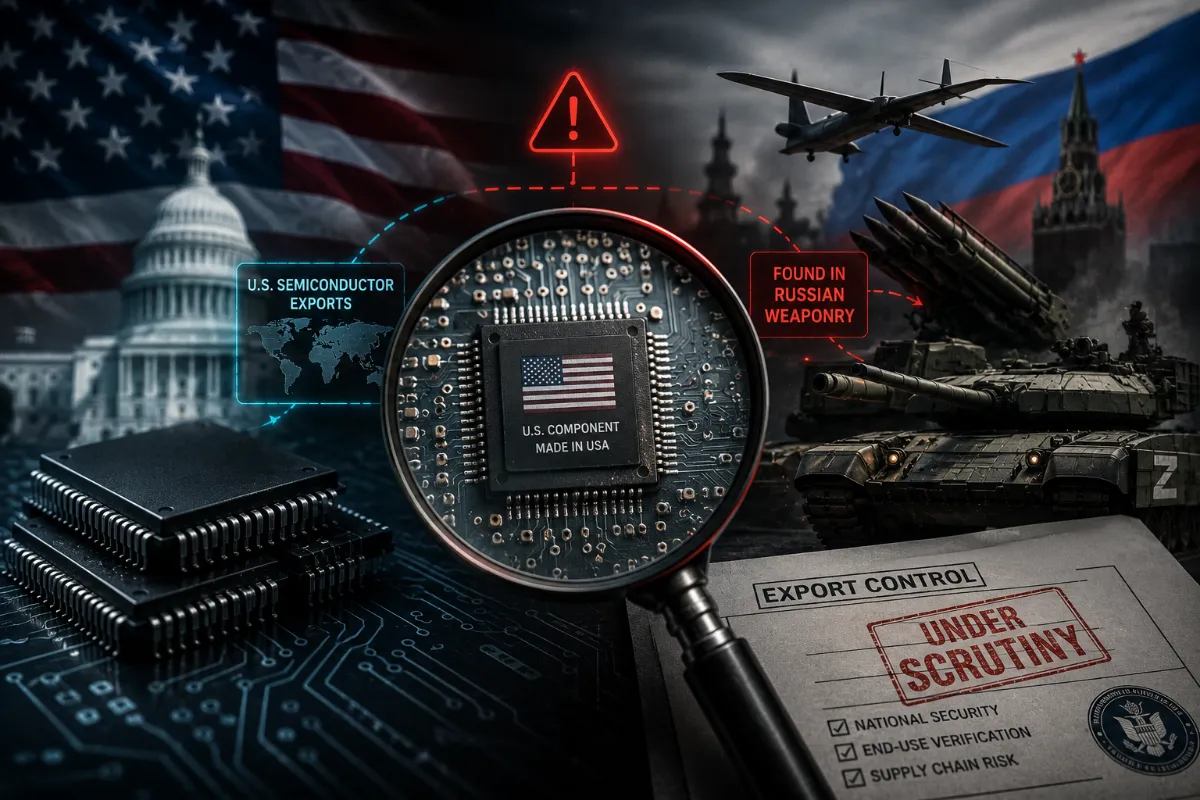
- Subject Overview: US Semiconductor Exports Face Scrutiny as Domestic Components Surface in Russian Weaponry — Key developments across Security.
- Technical Context: Detailed analysis of architectural changes, product capabilities, and engineering metrics.
- Industry Impact: Key implications for software developers, startup founders, and enterprise technology adopters.
US Semiconductor Exports Face Scrutiny as Domestic Components Surface in Russian Weaponry
Executive Overview and Core Hook
The recent identification of sophisticated American-designed semiconductor technology inside recovered Russian cruise missile hardware has sent shockwaves through both the defense sector and the global microelectronics industry. This finding raises critical questions regarding how dual-use technology, which is intended for consumer or industrial artificial intelligence applications, finds its way into state-sponsored defense systems despite rigorous international trade sanctions. The complexity of the modern chip supply chain, which often spans dozens of countries and hundreds of intermediaries, has created an environment where illicit diversion is difficult to track and even harder to prevent. As policymakers and chip manufacturers scramble to tighten oversight, the incident underscores a fundamental shift in the security landscape: the lines between civilian commercial goods and military-grade hardware have effectively vanished.
At the heart of this geopolitical crisis is the sheer volume of commercial-off-the-shelf electronics that now populate modern weaponry. Historically, military hardware relied on custom, hardened components produced in specialized facilities with tightly controlled domestic supply lines. Today, the efficiency of mass-produced, high-performance semiconductors makes them highly attractive for integration into guidance systems, signal processing units, and drone navigation modules. The discovery that these chips have migrated into conflict zones despite multi-layered export controls highlights a significant failure in current enforcement mechanisms. This article explores the technical, economic, and regulatory ramifications of these findings, examining why current safeguards are faltering and what structural changes are required to address this systemic vulnerability.
Technical Breakdown and Architecture
The semiconductors identified in these recovered missiles are primarily high-end logic controllers and specialized AI processors originally designed for high-performance computing, medical imaging, or sophisticated industrial automation. These chips are characterized by their sub-14 nanometer architecture, which allows for immense processing power in a physically compact footprint. In a civilian context, these components are responsible for running neural networks for image recognition or data synthesis. In a military context, the same architecture is repurposed to power inertial navigation systems and real-time terminal guidance, allowing cruise missiles to adjust their flight paths with unprecedented accuracy.
From a technical perspective, the integration process is surprisingly modular. The chips in question are often delivered on standardized printed circuit board assemblies that facilitate rapid prototyping. By stripping away non-essential consumer interfaces and housing these chips within hardened, thermal-resistant casings, military engineers can repurpose commercial hardware into weapon systems with minimal modifications. The reliance on these chips is largely due to their superior signal processing speeds compared to older, radiation-hardened military components that, while more durable, lack the throughput necessary for modern electronic warfare environments. This reliance on advanced commercial silicon creates a significant paradox: the very technology that drives global economic innovation also provides the essential performance boost for modern guided munitions.
Markdown Comparison Table and Key Metrics
| Feature Category | Commercial High-Performance Silicon | Legacy Radiation-Hardened Silicon | Impact of Diversion |
|---|---|---|---|
| Processing Throughput | Extremely High (TFLOPS) | Low (GOPS) | Significant Gain |
| Supply Chain Transparency | Complex and Opaque | Controlled and Domestic | High Risk |
| Energy Efficiency | High (optimized for battery) | Low (legacy architecture) | Critical for Missiles |
| Regulatory Oversight | Export Restricted/Dual-Use | Classified/ITAR Controlled | Enforcement Gap |
- Performance Delta: Commercial chips offer nearly 10x the processing power of legacy military-spec chips, facilitating faster target identification.
- Supply Chain Complexity: A single chip can change hands between brokers and shell companies in over seven countries before reaching its final destination.
- Enforcement Lag: Current regulatory software struggles to monitor transactions involving secondary and tertiary intermediaries who operate outside of direct jurisdiction.
- Economic Incentive: The high demand for these chips in the civilian sector drives massive production volume, making them harder to track than low-volume, specialized military components.
Developer and Ecosystem Impact
The software and hardware engineering community finds itself at an uneasy crossroads. For engineers working on AI and edge computing, these revelations may lead to more restrictive licensing requirements, increased demand for provenance documentation, and potential limits on how their software models can be deployed on specific silicon architectures. Startups and mid-sized firms that rely on the global distribution of hardware components may face higher compliance costs as manufacturers implement stricter "Know Your Customer" protocols. The burden of proof for the final destination of a product is shifting from the distributor to the developer, necessitating a more robust digital trail for hardware assets.
Furthermore, the ecosystem is seeing a shift toward regionalized supply chains. There is growing pressure to move away from global, cross-border distribution models toward "trusted foundry" networks where every step—from design to fabrication to packaging—occurs within a friendly jurisdiction. While this enhances security, it potentially stifles the cross-pollination of technical ideas that has fueled the AI boom over the last decade. For software engineers, this means that the underlying hardware targets for their code will become increasingly fragmented based on the geographical region in which the application is intended to run.
Strategic Market Outlook and Analysis
The market for high-performance semiconductors is currently balancing the need for massive civilian growth with the imperative of national security. As enforcement agencies increase scrutiny, we expect to see a consolidation of supply chain intermediaries. Major semiconductor companies are likely to invest heavily in blockchain-based provenance tracking, where every chip is cryptographically signed at the factory floor to ensure its movement can be verified in real-time. This "digital twin" approach to hardware will be the next major hurdle for global logistics.
Competition between major powers will likely manifest in "silicon decoupling." Countries with advanced fabrication capabilities are increasingly treating semiconductors as a strategic asset rather than a commodity. The trade-offs are significant: moving toward a closed, domestically controlled supply chain increases security but significantly raises the cost of goods sold. Enterprises must prepare for a future where the cost of AI silicon continues to rise, not just because of technical complexity, but because of the expensive compliance infrastructure required to ensure those chips do not end up in the wrong hands. The era of frictionless global hardware trade is effectively over, replaced by a "security-first" procurement model that prioritizes state-level oversight over operational efficiency.
Sources
Bureau of Industry and Security (bis.doc.gov) U.S. Department of Commerce (commerce.gov)