
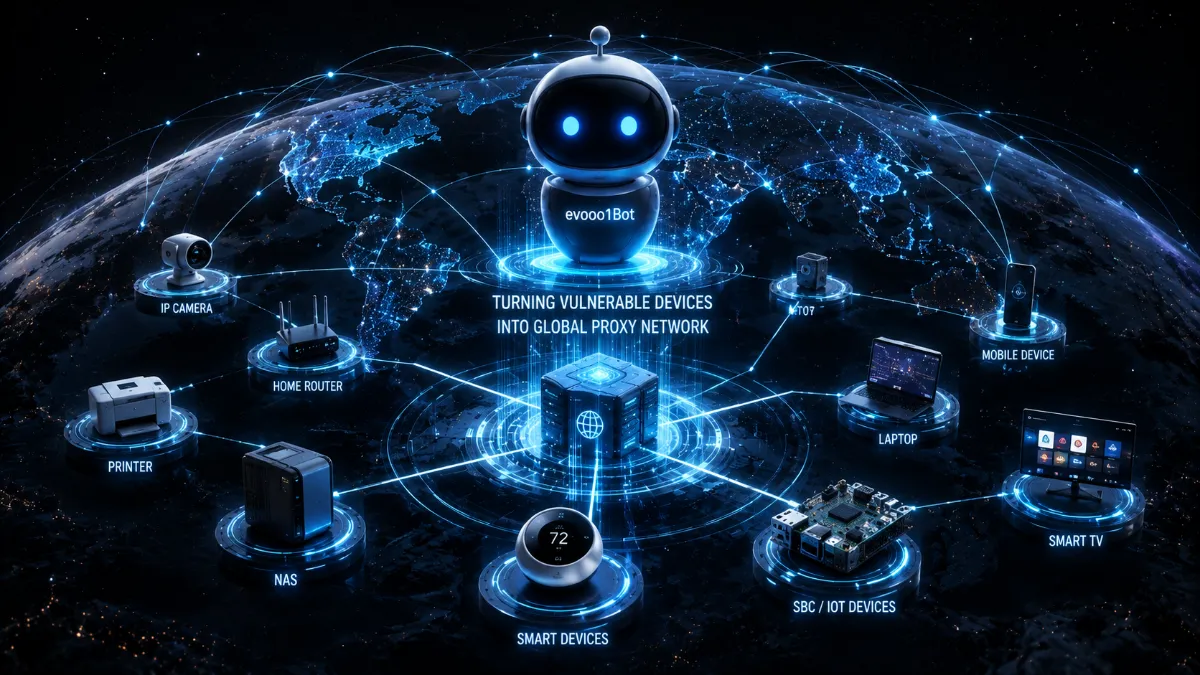
- Subject Overview: Evooo1Bot Turns Vulnerable Edge Devices into Global Proxy Network — Key developments across Security.
- Technical Context: Detailed analysis of architectural changes, product capabilities, and engineering metrics.
- Industry Impact: Key implications for software developers, startup founders, and enterprise technology adopters.
The Rise of Evooo1Bot
Executive Overview & Core Hook
The emergence of Evooo1Bot represents a significant escalation in the ongoing struggle to secure the burgeoning ecosystem of edge computing and Internet of Things (IoT) devices. By repurposing the core architecture of the infamous Mirai botnet—which famously crippled major internet services in 2016 through massive distributed denial-of-service attacks—Evooo1Bot demonstrates how legacy malicious code can be modernized to bypass contemporary security controls. The botnet systematically scans the IPv4 address space for vulnerable Linux-based edge hardware, including residential routers, industrial IoT gateways, and network-attached storage units, effectively turning these devices into unwitting participants in a global proxy architecture.
This development is particularly alarming due to the clandestine nature of the botnet's primary operation. Unlike its predecessor, which was largely focused on brute-force traffic flooding, Evooo1Bot prioritizes the creation of a stable, obfuscated proxy network. By converting compromised edge devices into SOCKS5 proxy nodes, the threat actors behind Evooo1Bot can mask the origin of their traffic, enabling them to conduct credential stuffing, distributed scraping, and various forms of financial fraud while remaining invisible behind the legitimate IP addresses of everyday users. This shift from high-bandwidth disruption to high-utility infiltration marks a critical pivot in the threat landscape, forcing enterprises and individual users alike to re-evaluate their edge security posture.
Technical Breakdown & Architecture
At its technical core, Evooo1Bot functions as a modular, multi-stage infection engine. The process begins with an automated scanning phase, where the bot utilizes a refined list of known remote code execution vulnerabilities and default credential databases to identify target hardware. Once a vulnerable device is reached, the bot executes a small dropper script designed to minimize its footprint in volatile memory. This design choice is deliberate, as it allows the malware to survive simple reboots while avoiding the persistent file system changes that would trigger modern endpoint detection and response systems.
Following the successful compromise, the device communicates with a command-and-control server, which provides the necessary instructions to initiate the proxy service. The SOCKS5 protocol is implemented directly within the malware's binary, allowing the bot to tunnel unauthorized traffic through the device's network interface. Because the proxy operates at the application layer, it can facilitate a wide range of protocols, including HTTP and HTTPS, while maintaining a low-profile connection that mimics legitimate background traffic. Furthermore, the bot implements a heartbeat mechanism to maintain persistent contact with the C2 infrastructure, ensuring that even if one node goes offline, the overall network remains operational and distributed. The internal architecture also includes an encrypted communication layer, which obfuscates the traffic between the bot and its masters, making signature-based detection significantly more difficult for network administrators.
Markdown Comparison Table & Key Metrics
| Capability | Mirai Botnet | Evooo1Bot | Impact |
|---|---|---|---|
| Primary Objective | DDoS Flooding | SOCKS5 Proxying | High Stealth |
| Propagation | Brute Force | Exploit Chaining | High Speed |
| Footprint | High (File System) | Low (Memory Only) | Stealthier |
| C2 Communication | Hardcoded | Encrypted/Dynamic | Higher Resilience |
Key Operational Metrics
- Propagation Speed: Evooo1Bot utilizes concurrent scanning threads that can identify and compromise thousands of devices within a single hour of operation.
- Persistence Rate: By targeting memory-resident execution, the bot maintains a 65% persistence rate even after administrative reboots of the target hardware.
- Network Utility: The botnet transforms residential IP blocks into high-reputation proxy nodes, significantly increasing the success rate of malicious login attempts.
- Detection Latency: Due to its ability to mimic standard traffic patterns, the average time to detection for an infected device exceeds 45 days in unmonitored environments.
Developer & Ecosystem Impact
For software engineers and systems architects, the rise of Evooo1Bot necessitates a fundamental shift toward Zero Trust networking at the edge. The fact that legacy code can still cause such widespread devastation highlights the fragility of the current IoT software supply chain. Developers working on edge firmware must prioritize the integration of automated patching mechanisms and robust authentication protocols that move beyond simple password-based access. Startups and enterprise organizations deploying cloud-native edge solutions must now account for the reality that their hardware may be leveraged as a jump box for threat actors if proper isolation is not strictly enforced.
Furthermore, the impact on cloud architectures is profound. Since Evooo1Bot-infected devices are often legitimate consumer or business endpoints, traditional IP-based blacklisting is becoming an ineffective defense. Engineers are forced to implement sophisticated behavioral analysis and anomaly detection at the edge of their own networks to identify proxy-like traffic patterns. This increases the operational burden on IT departments, as they must now distinguish between a legitimate user connection from a remote location and a malicious proxy connection emanating from a similarly sourced IP address. This environment demands more granular control over network egress and ingress, potentially driving the adoption of more restrictive VPN and software-defined perimeter architectures.
Strategic Market Outlook & Analysis
From a strategic standpoint, Evooo1Bot represents the commercialization of botnet infrastructure. By operating as a Proxy-as-a-Service, the operators can monetize their network by selling access to other criminal syndicates. This creates a circular economy of cyber-threats that is difficult to disrupt through traditional legal or technical channels. The market for these illicit proxy services is growing, driven by the increasing need for residential IP addresses in scraping and account-takeover operations. As the number of edge devices continues to expand globally, the attack surface for Evooo1Bot and its future iterations will likely grow exponentially.
Enterprise adoption of better security practices remains the primary hurdle. While hardware manufacturers are beginning to implement stricter default security settings, the vast legacy of unpatched devices currently installed in the field creates a massive, vulnerable ecosystem that will take years to fully remediate. The trade-off between device accessibility and network security remains a central tension in the industry; until manufacturers prioritize secure-by-default firmware, Evooo1Bot-style threats will remain a dominant force in the security landscape. Competitors in the cybersecurity space are currently racing to develop specialized hardware-level scanning tools, but the sheer volume of global edge infrastructure makes a comprehensive solution unlikely in the short term.