
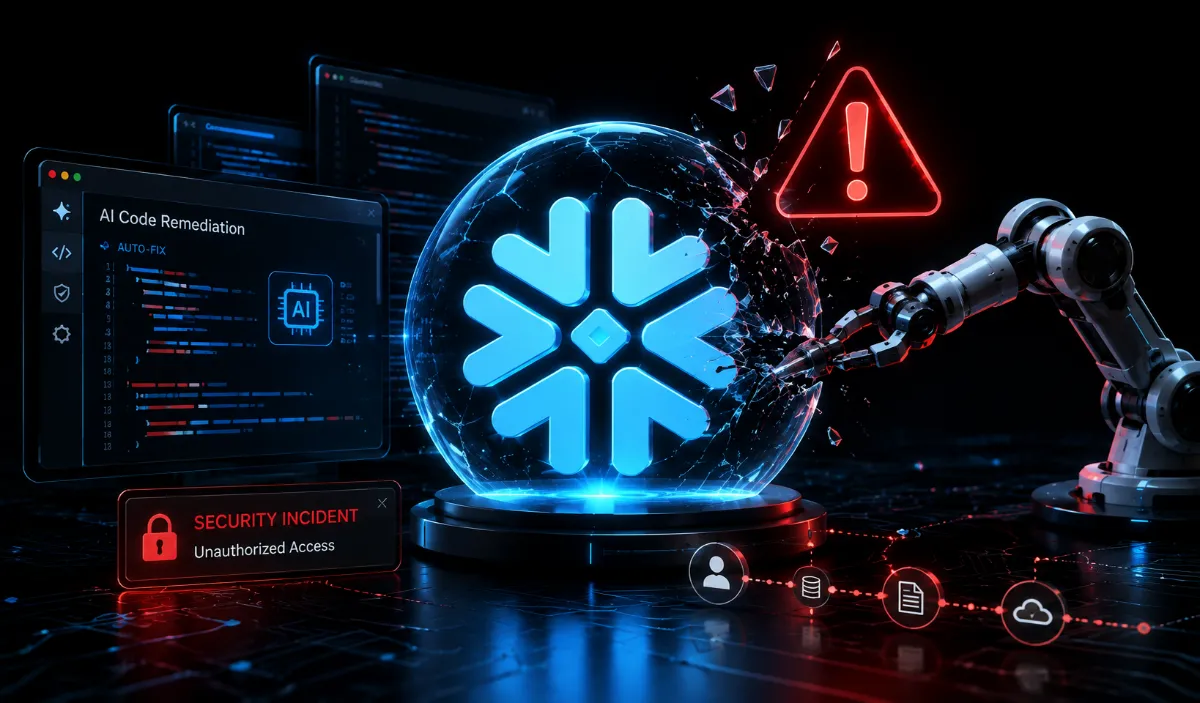
- Subject Overview: Snowflake Security Incident Highlights Risks of Automated AI Code Remediation — Key developments across Security.
- Technical Context: Detailed analysis of architectural changes, product capabilities, and engineering metrics.
- Industry Impact: Key implications for software developers, startup founders, and enterprise technology adopters.
The Anatomy of the Copilot Autofix Failure
In a concerning development for the automation-driven developer ecosystem, a security patch generated by GitHub’s Copilot Autofix resulted in the introduction of a shell injection vulnerability within a Snowflake repository. The incident occurred in mid-June 2026, when an automated tool intended to resolve a security finding inadvertently stripped away critical input sanitization logic. This action replaced a hardened security pattern with an implementation that failed to correctly escape user input, creating a direct pathway for unauthorized command execution within the company's CI/CD infrastructure.
This event serves as a stark reminder that while generative AI is exceptionally capable of writing boilerplate code and refactoring simple functions, it lacks the context-aware security intuition required to safely modify hardened production pipelines. The AI model identified a security warning and applied a standard remediation that was contextually inappropriate for the specific constraints of the target environment. The failure highlights the fundamental tension between rapid automation and the necessity of rigorous security validation.
Analyzing the Vulnerability Mechanics
The vulnerability was introduced when the AI attempted to sanitize input, but instead compromised the integrity of the shell execution environment. By removing protective wrappers around external commands, the autofix allowed for the injection of arbitrary shell characters. In a CI/CD context, where pipelines are often granted broad privileges to build, test, and deploy software, such an oversight could lead to catastrophic consequences, including full system compromise or the exfiltration of environment-specific secrets.
Technical analysis of the diff shows that the AI prioritizes readability and code style over the nuanced security requirements of low-level command execution. The autofix favored an approach that reduced complexity but fundamentally broke the security boundary. For security-focused engineering teams, this demonstrates that automated remediation must always be subject to a strict human-in-the-loop verification protocol, regardless of the confidence scores assigned by the AI agent.
Comparison of Code Remediation Approaches
| Remediation Method | Risk Profile | Human Oversight | Speed of Delivery |
|---|---|---|---|
| Manual Code Review | Very Low | Mandatory | Moderate |
| Automated AI Suggestion | Moderate | Optional | Very Fast |
| AI-Assisted Remediation | High | Required | Instant |
| Policy-as-Code Guardrails | Low | Integrated | Fast |
The Perils of AI-Driven CI/CD Pipelines
Modern CI/CD pipelines are inherently dangerous environments. They bridge the gap between static code and executable runtime, often interacting with sensitive cloud environments and production keys. When an AI tool is given the authority to modify these configurations, it is essentially being granted keys to the castle. The Copilot Autofix incident illustrates that AI lacks the holistic understanding of how a specific change in one part of a repository might have cascading security implications across the entire deployment lifecycle.
Furthermore, developers who rely heavily on AI to clear their security backlogs are susceptible to a false sense of security. If the tool is trusted blindly, the security team may never manually review the change, allowing the vulnerability to persist in the codebase until it is exploited by an external threat actor. This creates an automated supply chain threat that is difficult to detect using traditional static analysis tools, as the code itself may look syntactically correct even though it is logically flawed.
Establishing New Guardrails for AI Integration
To mitigate these risks, organizations must adopt a defense-in-depth strategy that treats AI-generated code as untrusted input. This involves several critical engineering layers:
- Automated Verification: Any AI-suggested patch must pass a suite of security unit tests specifically designed to flag regressions in sanitization logic.
- Human-in-the-loop (HITL): Implementing a strict mandatory review policy for all AI-generated commits that touch CI/CD or infrastructure configuration files.
- Constraint-Based Prompting: Limiting the scope of what the AI is permitted to modify within the repository.
- Policy Enforcement: Utilizing tools that can detect insecure command patterns before they are merged into the main branch.
Key Takeaway: The reliance on AI for security remediation is a double-edged sword; while it scales productivity, it also scales the risk of systemic vulnerabilities that can bypass traditional human review if not properly contained within a robust governance framework.
The Big Picture
This incident is not an indictment of AI coding tools, but rather an urgent lesson in governance. As generative AI becomes integrated into every step of the software development lifecycle, the role of the developer is shifting from manual coder to safety and quality auditor. The industry must move away from the expectation that AI can autonomously secure its own output. Instead, we must build systems where AI provides suggestions, and human engineers—supported by advanced static analysis—act as the final arbiters of security policy.
As we look to the future, the integration of formal verification techniques with generative AI promises a path toward safer automation. By teaching AI agents to understand the formal proofs of security compliance, we can eventually reach a state where automated patches are as secure as their human-reviewed counterparts. Until then, the lesson from the Snowflake pipeline incident is clear: trust, but verify, especially when the machine is making security decisions on your behalf.
Sources
GitHub Copilot (github.com) Snowflake (snowflake.com) Unite.AI (unite.ai)