
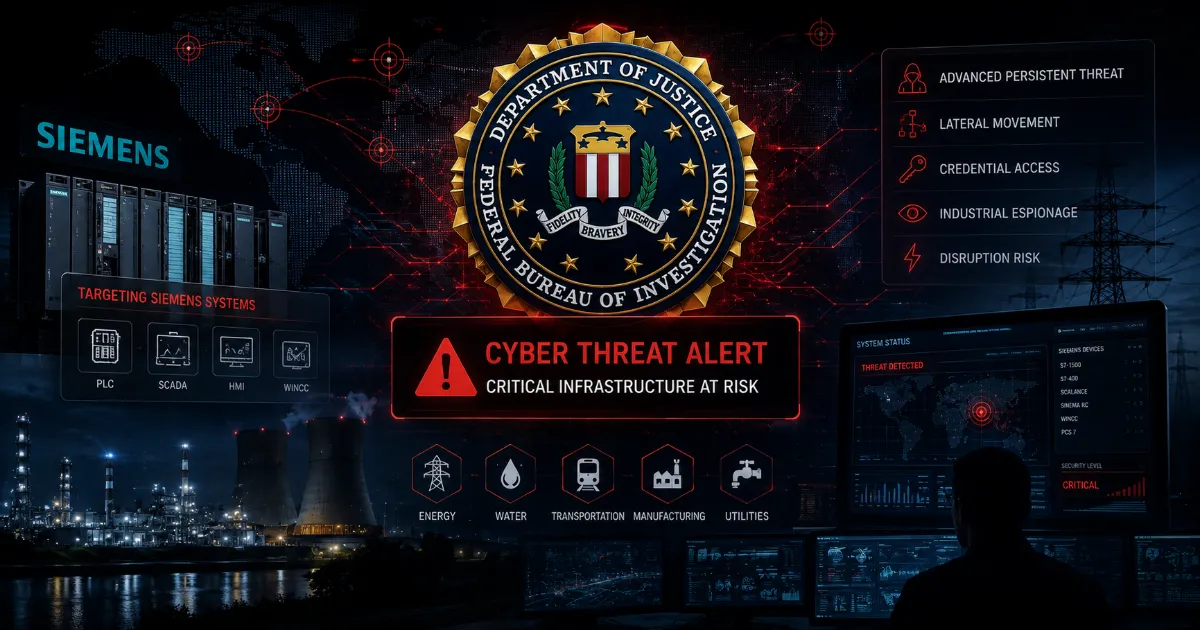
- Subject Overview: FBI Alerts Critical Infrastructure Operators to Advanced Cyber Threats Targeting Siemens Systems — Key developments across Security.
- Technical Context: Detailed analysis of architectural changes, product capabilities, and engineering metrics.
- Industry Impact: Key implications for software developers, startup founders, and enterprise technology adopters.
Executive Overview and Core Hook
The landscape of industrial cybersecurity has shifted into a precarious new era where the convergence of operational technology and advanced artificial intelligence creates unprecedented vulnerabilities. The Federal Bureau of Investigation, alongside global cybersecurity partners, has recently disseminated an urgent advisory concerning the systematic exploitation of Siemens industrial control systems. These systems act as the digital central nervous systems for critical infrastructure, including water treatment facilities, regional power grids, and automated manufacturing hubs. As these utilities transition toward smarter, more interconnected frameworks to improve efficiency, they have inadvertently expanded the attack surface available to sophisticated adversaries who are now utilizing automated intelligence to identify and map vulnerabilities with startling precision.
This development marks a significant departure from traditional, manual penetration testing methods used by cybercriminal groups. By deploying AI-driven reconnaissance tools, malicious actors can now probe Siemens PLC and SCADA environments for misconfigurations, default credentials, and unpatched firmware vulnerabilities at a scale and speed that human defenders struggle to match. The implications for national security are profound. Should these threat actors successfully compromise the integrity of industrial control systems, they gain the capability to manipulate physical processes, potentially leading to the disruption of water purification cycles or the destabilization of electrical distribution networks. The FBI's alert serves as a stark reminder that the digital transformation of industrial sectors must be accompanied by a rigorous, security-first architecture to mitigate the risks posed by these next-generation cyber threats.
Technical Breakdown and Architecture
At the center of this threat are the Siemens SIMATIC S7 series controllers, which are ubiquitous in industrial settings due to their reliability and modularity. These devices utilize proprietary protocols and communication interfaces designed for high-speed industrial environments. However, the integration of these devices into broader enterprise networks for remote monitoring and data analytics has introduced significant risks. The architecture of these vulnerabilities often centers on the interface between the operational technology network and the corporate network. Attackers are currently exploiting the lack of robust segmentation between these environments, utilizing compromised enterprise credentials to pivot into the industrial control network.
Once access to the internal network is achieved, the attackers employ automated scripts that perform deep packet inspection of industrial protocols. These scripts, often bolstered by machine learning models trained on publicly available documentation for industrial automation equipment, are capable of identifying specific Siemens device models and their current firmware versions. By correlating this information with known Common Vulnerabilities and Exposures databases, the AI-driven toolset can automatically select and deploy the most effective exploit payload. This process effectively automates the reconnaissance, scanning, and exploitation phases of the cyber kill chain, significantly reducing the time from initial access to full system control. Furthermore, these attackers are increasingly targeting the engineering workstations used to configure these controllers, as compromising these nodes allows them to push malicious logic directly to the PLC, effectively hiding their activity from standard network monitoring tools.
Markdown Comparison Table and Key Metrics
| Capability | Legacy Threat Methods | AI-Driven Threat Actors |
|---|---|---|
| Reconnaissance Speed | Slow, manual mapping | Real-time, automated scanning |
| Vulnerability Detection | Known exploit databases | Zero-day pattern matching |
| Persistence Tactics | Manual installation | Polymorphic evasive logic |
| Target Identification | Broad, non-specific | High-precision industrial targeting |
- Exploitation Velocity: AI-integrated toolkits have reduced the time required to compromise an industrial control system from weeks of manual analysis to hours of automated probing.
- Evasive Capabilities: Threat actors are now utilizing polymorphic code that alters its signature to bypass legacy signature-based intrusion detection systems.
- Credential Harvesting: There is a marked increase in the use of automated phishing campaigns specifically designed to harvest credentials from engineers and facility managers who possess high-level access to industrial control environments.
- Lateral Movement: Modern attackers are prioritizing the compromise of engineering workstations, which function as a gateway to the entire industrial control ecosystem.
Developer and Ecosystem Impact
For software engineers and industrial systems integrators, this threat necessitates a fundamental shift in how industrial software is developed and maintained. The traditional reliance on security through obscurity—assuming that proprietary industrial protocols are safe because they are not widely understood—is no longer a viable defense strategy. Developers must now adopt a DevSecOps approach to industrial automation, incorporating rigorous vulnerability scanning, automated testing, and secure coding practices into the lifecycle of industrial control applications. This includes the implementation of hardware-based root of trust mechanisms and the enforcement of zero-trust network access policies within industrial environments.
Startups and cloud infrastructure providers serving the industrial sector must also pivot. There is a growing demand for specialized industrial security monitoring solutions that leverage AI-driven threat intelligence to counter these modern exploits. Companies are now being forced to invest in deep-packet inspection tools that can distinguish between legitimate operational commands and malicious instructions disguised as normal traffic. Furthermore, the ecosystem must prioritize the transition to encrypted communication protocols for all inter-device traffic, ensuring that even if an attacker gains network access, they cannot interpret or manipulate the commands being sent to the controllers. This requires a collaborative effort between equipment manufacturers, software providers, and facility operators to standardize security protocols.
Strategic Market Outlook and Analysis
The market for industrial cybersecurity is undergoing rapid consolidation as enterprise-grade security vendors seek to acquire niche industrial control system security firms. As the FBI alert suggests, the economic and societal cost of a successful breach is becoming too high for organizations to ignore. We anticipate a significant shift in enterprise spending toward robust, AI-powered defensive platforms that can proactively monitor for anomalies in industrial traffic. However, organizations face significant trade-offs between system availability and security. Implementing stringent security controls, such as air-gapping or multi-factor authentication for every industrial command, can introduce latency and operational friction that may impact productivity.
Despite these challenges, the regulatory environment is tightening. National governments are increasingly mandating strict cybersecurity compliance for utilities, which will force laggard organizations to modernize their legacy infrastructure. This transition period presents both a risk and an opportunity. While the risk of a catastrophic event remains high, the push toward modernization provides an opening to replace aging, vulnerable equipment with newer systems designed with modern security architectures at their core. Ultimately, the competition will be won by those who can provide seamless security integration without compromising the real-time operational requirements that are the lifeblood of global utilities. The era of the unprotected industrial controller is effectively over, and the market is responding with a massive influx of investment into defensive AI technologies.
Sources
Federal Bureau of Investigation (fbi.gov) Siemens (siemens.com)