
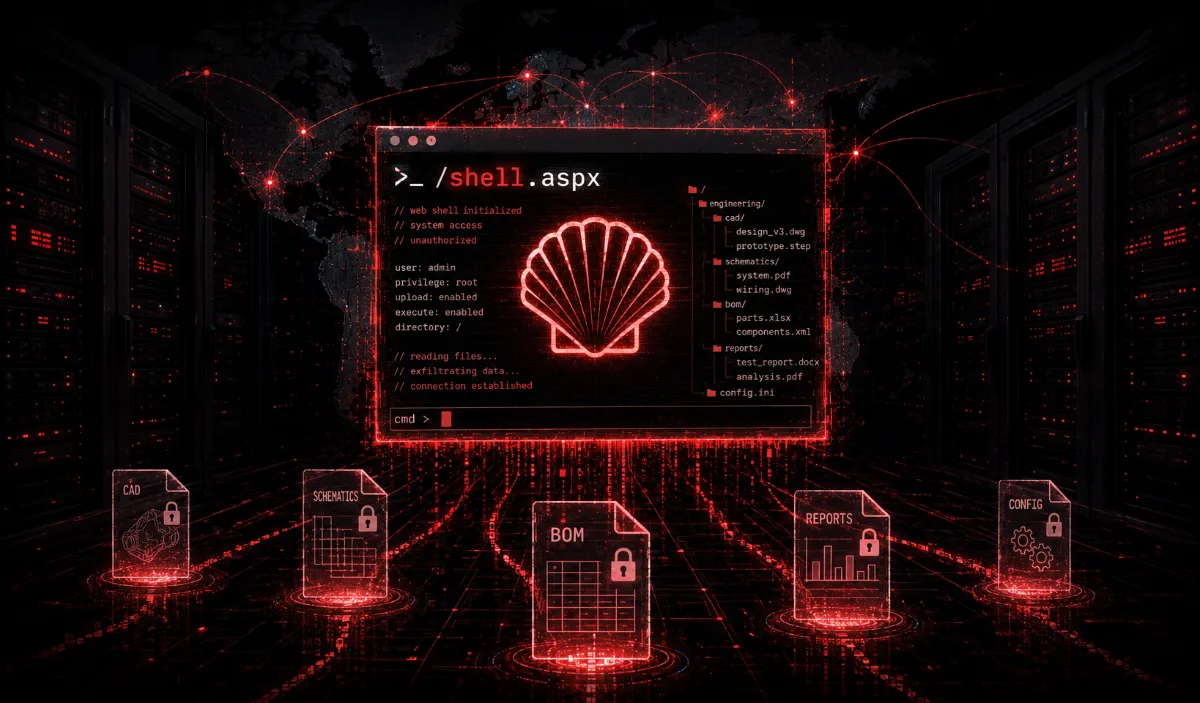
- Subject Overview: Sophisticated Web Shell Campaign Targets Enterprise Engineering Data Across Vulnerable Servers — Key developments across Security.
- Technical Context: Detailed analysis of architectural changes, product capabilities, and engineering metrics.
- Industry Impact: Key implications for software developers, startup founders, and enterprise technology adopters.
Advanced Persistent Threats Targeting Industrial Lifecycle Management Infrastructure
Executive Overview & Core Hook
The landscape of industrial espionage has undergone a dramatic shift as threat actors increasingly move beyond generic ransomware tactics toward precision-engineered exfiltration campaigns. Recent intelligence reports have identified a highly specialized JavaServer Pages (JSP) web shell specifically designed to compromise PTC Windchill and FlexPLM servers. These platforms serve as the backbone for product lifecycle management (PLM) in major manufacturing, aerospace, and defense industries. By targeting these specific environments, attackers gain access to the "crown jewels" of modern engineering: CAD files, proprietary design specifications, and internal supply chain logistics data. This development is particularly alarming because it signals that threat actors are no longer just looking to encrypt data for financial leverage, but are actively harvesting actionable intelligence that can be sold or utilized for long-term strategic disruption.
This campaign is linked to the Clop ransomware group, a sophisticated entity known for its "big game hunting" approach. Unlike opportunistic malware that scans the internet for low-hanging fruit, the deployment of this custom web shell suggests a multi-stage reconnaissance effort. The attackers are not merely brute-forcing credentials; they are leveraging zero-day or recently patched vulnerabilities within the Java-based frameworks that underpin these enterprise applications. For Chief Information Security Officers and engineering managers, this represents a fundamental change in the threat model. The ability to exfiltrate intellectual property directly from the source of truth—the PLM system—bypasses traditional network perimeter defenses, effectively turning the engineering platform itself into a point of failure. This escalation highlights the urgent need for enhanced visibility into the deep architecture of supply chain software.
Technical Breakdown & Architecture
The malicious JSP web shell identified in this campaign is a masterclass in stealth and persistence. Written in Java, the shell is designed to be injected directly into the application server's web directory, specifically targeting the file structure of PTC Windchill. Once the initial vulnerability is exploited—often through an arbitrary file upload or a deserialization flaw within the Java framework—the shell establishes a communication channel with an external command-and-control server. The code is heavily obfuscated to evade signature-based detection by standard antivirus or endpoint detection and response (EDR) solutions. It functions by intercepting incoming HTTP requests directed at the web server, allowing the attacker to execute arbitrary commands, browse the file system, and extract sensitive configuration files that contain database credentials or administrative access tokens.
Technically, the shell operates by leveraging the server’s local context. Because PTC Windchill and FlexPLM environments require extensive permissions to interact with databases and file storage systems, the web shell inherits these high-level privileges. This allows the attacker to move laterally across the engineering server without triggering excessive alerts. Furthermore, the shell includes modules for data staging. Rather than exfiltrating data in a single, noisy burst, the script compresses engineering documents into hidden, encrypted archives located in temporary directories. These archives are then exfiltrated over time using standard outbound ports, such as HTTPS, to blend in with legitimate traffic. The sophistication lies in the integration: the attackers have clearly studied the PTC architecture to identify which files constitute the most valuable engineering designs, effectively automating the reconnaissance process once the shell is deployed.
Markdown Comparison Table & Key Metrics
| Feature | Conventional Ransomware | Specialized PLM Web Shell |
|---|---|---|
| Primary Objective | Encryption for Extortion | Strategic Data Exfiltration |
| Target Scope | General Endpoint/Network | Engineering/PLM Servers |
| Detection Difficulty | Moderate | Extremely High |
| Dwell Time | Short (Days) | Long (Months) |
| Exfiltration Method | Bulk Data Dumping | Targeted File Harvesting |
Key Metrics of the Campaign:
- Persistence Mechanism: Utilizes stealthy JSP injection to maintain access even after server reboots.
- Data Focus: Specifically targets CAD, CAM, and proprietary engineering database schemas.
- Detection Lag: Typical exposure time is estimated at over 90 days before detection.
- Protocol Usage: Communicates via standard encrypted outbound ports to bypass firewall inspection.
Developer & Ecosystem Impact
The impact on software engineers and enterprise architects is profound. When a PLM system is compromised, the integrity of the entire design process is called into question. Engineers may no longer be able to trust the versions of files stored on the server, as the attackers could have potentially modified design parameters, leading to catastrophic physical failures in the end product. For developers, this necessitates a move toward "Security by Design" in enterprise applications. There is an immediate need to implement stricter containerization for web-based services, ensuring that even if an application server is compromised, the attacker is confined to a sandbox with minimal access to the underlying OS or the file system.
Moreover, the rise of such targeted shells forces a rethink of the CI/CD pipeline for industrial software. Enterprises must now treat their engineering servers with the same, if not higher, security rigor as their customer-facing web applications. Startups building on top of industrial frameworks must prioritize vulnerability management, specifically focusing on the sanitization of all file uploads and the strict control of user-executable permissions within the Java application environment. The ecosystem must shift toward zero-trust architectures where every internal request, even those originating from the application itself, is verified and logged for anomalous behavior.
Strategic Market Outlook & Analysis
The current threat landscape indicates that we are entering an era of "precision exfiltration." As global manufacturing relies increasingly on digital twins and cloud-synchronized design files, the motivation for state-sponsored and criminal groups to penetrate these systems will only rise. Competition in the market is now as much about security as it is about features. Enterprises are likely to move away from monolithic, legacy-heavy environments toward more modular, cloud-native PLM solutions that offer better visibility, automated patching, and identity-based access controls.
However, the trade-off is the complexity of migration and the potential for new, unforeseen vulnerabilities. Enterprises must balance the agility of modern development with the stability required for long-term engineering. We can expect a surge in demand for specialized security services that focus specifically on supply chain software and industrial-grade monitoring. Organizations that fail to address these architectural weaknesses will face not only financial loss through ransomware but also the irreparable loss of intellectual property, which remains the lifeblood of competitive advantage in the industrial sector. The Clop group’s focus on PTC platforms serves as a clarion call for the industry to prioritize the hardening of engineering infrastructure as a top-tier security imperative.