
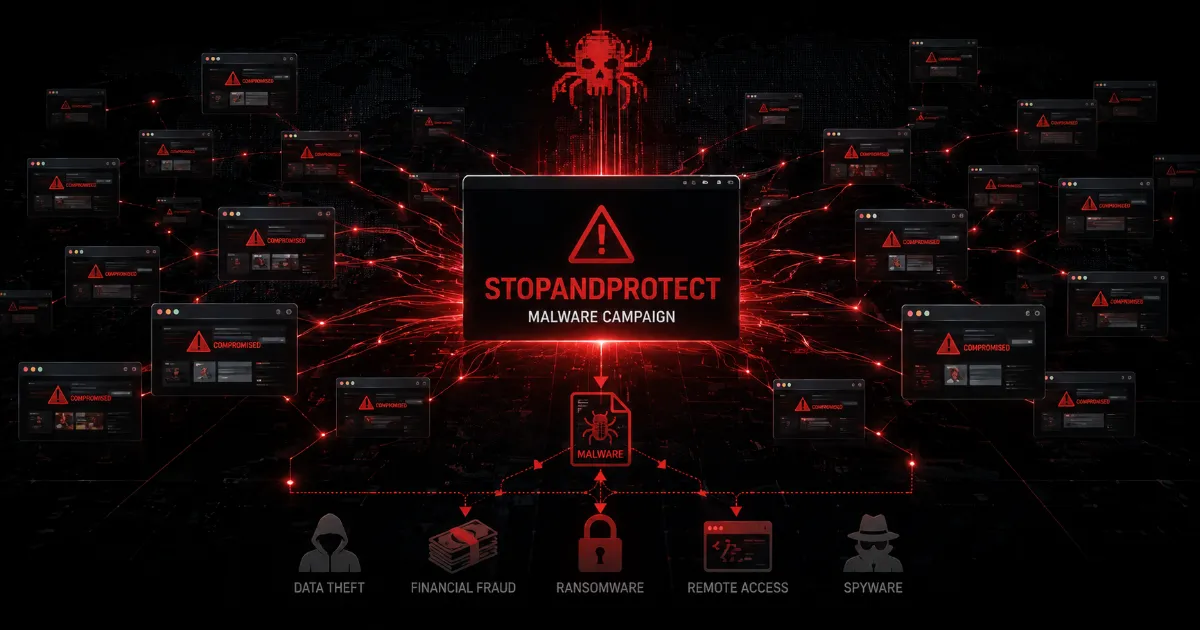
- Subject Overview: StopAndProtect Campaign Leverages Botnet of 2000 Compromised Sites to Syndicate Malware — Key developments across Security.
- Technical Context: Detailed analysis of architectural changes, product capabilities, and engineering metrics.
- Industry Impact: Key implications for software developers, startup founders, and enterprise technology adopters.
Unveiling the StopAndProtect Operation
Executive Overview and Core Hook
In a recent discovery that has sent ripples through the cybersecurity community, security researchers have identified an expansive and highly coordinated cybercrime network dubbed StopAndProtect. This operation represents a sophisticated evolution in infrastructure-as-a-service, where the attackers do not build their own servers. Instead, they weaponize nearly 2,000 compromised WordPress websites to disseminate malware and harvest sensitive user data from unsuspecting victims across the globe. By leveraging legitimate, high-reputation domains, the perpetrators have managed to bypass traditional blacklisting protocols that often rely on domain age and reputation scores to filter malicious traffic.
The significance of the StopAndProtect campaign lies in its architectural resilience. Rather than relying on a centralized command-and-control server that can be easily identified and shuttered by law enforcement or hosting providers, the attackers have opted for a decentralized, modular approach. By compromising individual websites, the threat actors ensure that the removal of one node does not impact the stability of the overall network. This persistence mechanism forces security professionals to reconsider the efficacy of static threat intelligence, as the infrastructure itself is constantly shifting, utilizing clean, legitimate traffic patterns to mask nefarious activity.
Technical Breakdown and Architecture
The technical backbone of StopAndProtect is rooted in the strategic exploitation of common vulnerabilities within the WordPress ecosystem, specifically focusing on outdated plugins and weak administrative credentials. Once a site is compromised, the attackers inject a lightweight, obfuscated script that acts as a redirector. This script monitors incoming traffic, filtering for specific user-agent strings or geolocation data before deciding whether to deliver a malicious payload. This selective delivery is a critical feature, as it helps the attackers avoid detection by automated crawlers, sandboxes, and security researchers who might be investigating the network from non-targeted regions.
At the core of the distribution mechanism is a complex syndication layer that effectively turns each compromised site into a micro-distribution point. When a visitor navigates to a compromised site, the injected script silently fetches content from a secondary, hidden staging server. By keeping the primary malicious payload hosted on a revolving set of auxiliary nodes, the perpetrators prevent security vendors from establishing a long-term correlation between the infected WordPress sites and the source of the malware. The infrastructure also utilizes advanced evasion tactics, such as time-based activation, where the malicious scripts remain dormant for specific intervals, further complicating forensic analysis and log auditing.
Data exfiltration from the StopAndProtect campaign is equally methodical. The malware is designed to hook into the browser sessions of users, siphoning login credentials, financial information, and session cookies. Once captured, this data is encrypted and tunneled through the same compromised WordPress network, effectively hiding the exfiltration traffic within the noise of legitimate HTTP/S requests. This strategy ensures that the data egress is difficult to detect using standard network monitoring tools, as the outgoing traffic appears to be bound for legitimate web servers rather than known malicious command-and-control infrastructure.
Markdown Comparison Table and Key Metrics
| Feature | Traditional Botnets | StopAndProtect Network | Detection Difficulty |
|---|---|---|---|
| Infrastructure | Centralized Servers | Distributed WordPress Sites | High |
| Reputation | Low (New Domains) | High (Aged Domains) | Very High |
| Persistence | Single Point of Failure | High (Modular Redundancy) | High |
| Evasion | Signature-Based | Behavioral-Based | Moderate |
| Traffic Profile | Anomalous/Spiky | Blended/Legitimate | Very High |
- Node Distribution: Over 2,000 unique IP addresses identified across diverse global hosting providers.
- Payload Delivery: Utilizes selective redirection based on user-agent analysis to evade security sandboxes.
- Data Exfiltration: Employs encrypted tunnels masked within legitimate HTTPS traffic flows.
- Persistence Strategy: Leverages legitimate site administrative access to maintain a foothold after initial remediation attempts.
Developer and Ecosystem Impact
The StopAndProtect operation serves as a stark reminder of the security debt inherent in managing large-scale web applications. For software engineers and site administrators, the campaign underscores the critical importance of rigorous patch management and the implementation of robust security plugins. Because the attackers are targeting vulnerabilities rather than zero-day exploits, the defense is straightforward in theory but difficult in practice: maintain strict update cycles, utilize two-factor authentication, and monitor file integrity to catch unauthorized modifications immediately.
For cloud architects and enterprise security teams, this campaign signals a shift toward zero-trust networking. Relying on IP reputation is no longer a viable security posture. Instead, architectures must move toward behavioral analysis and deep packet inspection that can identify subtle deviations from standard site behavior. Startups and small businesses, which are often the primary victims of these compromises, must prioritize the security of their CMS environments as part of their broader operational risk management. The potential for reputational damage following a site compromise—where the company’s own domain is used to attack its customers—is a significant risk that can lead to long-term trust erosion.
Strategic Market Outlook and Analysis
The rise of syndication operations like StopAndProtect is a direct consequence of the increasing difficulty in establishing new, credible malicious infrastructure. As global registries and domain registrars tighten controls, attackers are turning to existing, trusted infrastructure to conduct their operations. This trend is likely to continue, with future campaigns potentially expanding into more sophisticated CMS platforms beyond WordPress. The market for defensive security solutions is already responding, with an increased focus on AI-driven threat detection that can differentiate between human-driven site interaction and programmatic malware delivery.
From a strategic perspective, the trade-offs are significant. Enterprises must balance the need for high-availability, content-heavy sites with the reality that every plugin and theme is a potential backdoor. We are seeing a move toward headless CMS architectures and static site generation as a means to mitigate these risks. By decoupling the content management system from the live site delivery, organizations can drastically reduce their attack surface. However, this architectural transition is costly and requires significant engineering overhead. The StopAndProtect campaign proves that the cost of inaction is far higher, as the financial and reputational losses associated with being a node in a massive criminal network far outweigh the investment required for proactive infrastructure hardening.
Sources
WordPress (wordpress.org) Cybersecurity and Infrastructure Security Agency (cisa.gov)