
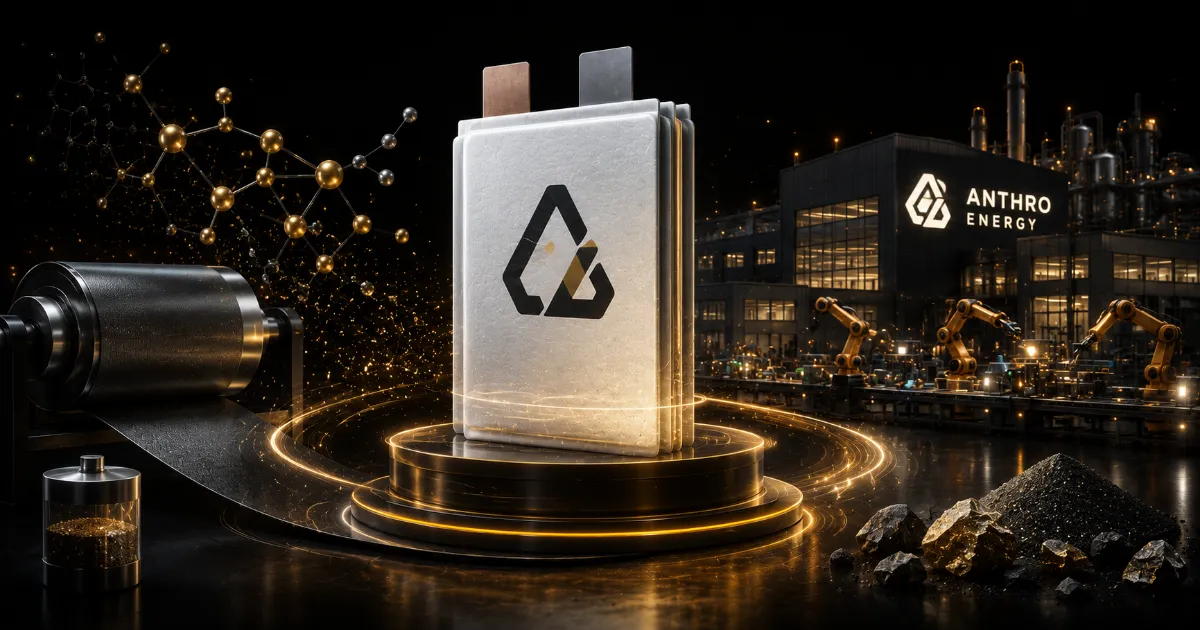
- Subject Overview: Anthro Energy Scales Solid State Battery Materials Production with New Louisville Manufacturing Hub — Key developments across Startups.
- Technical Context: Detailed analysis of architectural changes, product capabilities, and engineering metrics.
- Industry Impact: Key implications for software developers, startup founders, and enterprise technology adopters.
The global transition to electric mobility and grid-scale energy storage hinges on one critical bottleneck: the energy density and safety profile of lithium-ion batteries. While the industry has made incremental gains, the fundamental limitations of liquid electrolytes have kept the dream of safe, high-capacity solid-state batteries largely confined to the laboratory. Anthro Energy is now moving to bridge this gap, breaking ground on a new manufacturing facility in Louisville that aims to scale the production of proprietary electrolytes essential for the next generation of energy storage technology.
The Engineering Challenge of Liquid Electrolytes
Traditional lithium-ion batteries rely on liquid electrolytes, which facilitate the flow of ions between the cathode and the anode. While effective, these liquids are notoriously volatile. They are flammable, sensitive to temperature fluctuations, and subject to dendrite growth—microscopic structures that can pierce the separator and trigger thermal runaway events. For years, material scientists have sought to replace these liquids with solid-state alternatives, which promise higher energy density, faster charging speeds, and a significantly improved safety profile.
Developing a solid electrolyte is only half the battle. Creating a substance that maintains ionic conductivity comparable to a liquid while remaining mechanically robust enough to withstand the stress of rapid charge-discharge cycles requires extreme precision in chemical formulation. Anthro Energy has focused its research on creating high-performance materials that can be integrated into existing manufacturing processes. This approach is designed to avoid the prohibitively expensive retooling typically associated with transitioning from liquid to solid-state battery production.
Scaling Production for Mass Market Adoption
The groundbreaking of the Louisville facility represents a pivot from research and development to industrial-scale manufacturing. By securing a dedicated space for production, the company is positioning itself to serve as a critical supplier for battery manufacturers looking to move beyond the limitations of current chemistry. The factory is designed to produce electrolytes that are chemically stable and compatible with a wide array of existing manufacturing equipment, ensuring that the transition to solid-state is not just technically feasible, but economically viable.
| Feature | Traditional Liquid Electrolytes | Anthro Energy Solid Electrolytes | Impact |
|---|---|---|---|
| Flammability | High Risk | Inherently Stable | Improved Safety |
| Charging Speed | Limited by Dendrites | High Capacity for Fast Charge | Efficiency Gain |
| Energy Density | Standard | Superior | Longer Range |
| Manufacturing | Established | Drop-in Compatibility | Reduced Capital Cost |
Developer and Manufacturer Impact
For engineers building the next generation of electric vehicles and portable electronics, the availability of high-quality, solid-state electrolyte materials is a game changer. The ability to source consistent, high-purity materials from a domestic facility in the United States helps de-risk the supply chain. This is particularly important as regulatory bodies continue to tighten safety requirements for battery systems in both automotive and consumer electronics markets.
- Safety Integration: Developers can design thinner, lighter battery packs without the bulky thermal management systems required by liquid-based cells.
- Supply Chain Security: Domestic manufacturing ensures consistent supply and helps shield partners from geopolitical risks affecting rare earth and refined material imports.
- Performance Benchmarks: Solid-state materials provide the foundation for battery chemistries that can endure thousands of cycles without significant degradation.
Key Takeaway: By focusing on the material interface between the anode and cathode, Anthro Energy is providing the essential building blocks that will enable the next wave of energy density breakthroughs without requiring a total overhaul of the battery manufacturing ecosystem.
The Path Toward Solid State Integration
While the industry has seen many prototypes, the path to mass-market adoption requires a focus on manufacturing throughput. Anthro Energy’s strategy of building out its own facility suggests a high degree of confidence in its chemical formulations and their readiness for commercial integration. The coming years will be defined by how effectively these materials can be scaled to meet the massive demand from automotive OEMs who are desperate to increase the range and safety of their electric fleets.
Building a battery factory is an immense infrastructure challenge that requires specialized equipment for vacuum processing and atmospheric control. The Louisville facility serves not just as a production hub but as a center for process engineering where the company can refine its manufacturing yields and establish the quality control standards necessary to achieve the high-purity levels required for solid-state performance.
The Road Ahead
As the facility in Louisville comes online, the industry will be watching closely to see how Anthro Energy integrates its products into the broader battery supply chain. The transition to solid-state technology is no longer a matter of theoretical physics; it is now a matter of industrial engineering and material logistics. By establishing a robust manufacturing footprint, the company is setting the stage to become a foundational player in the energy transition, providing the components that will power everything from long-haul electric trucks to the next generation of smartphones.