
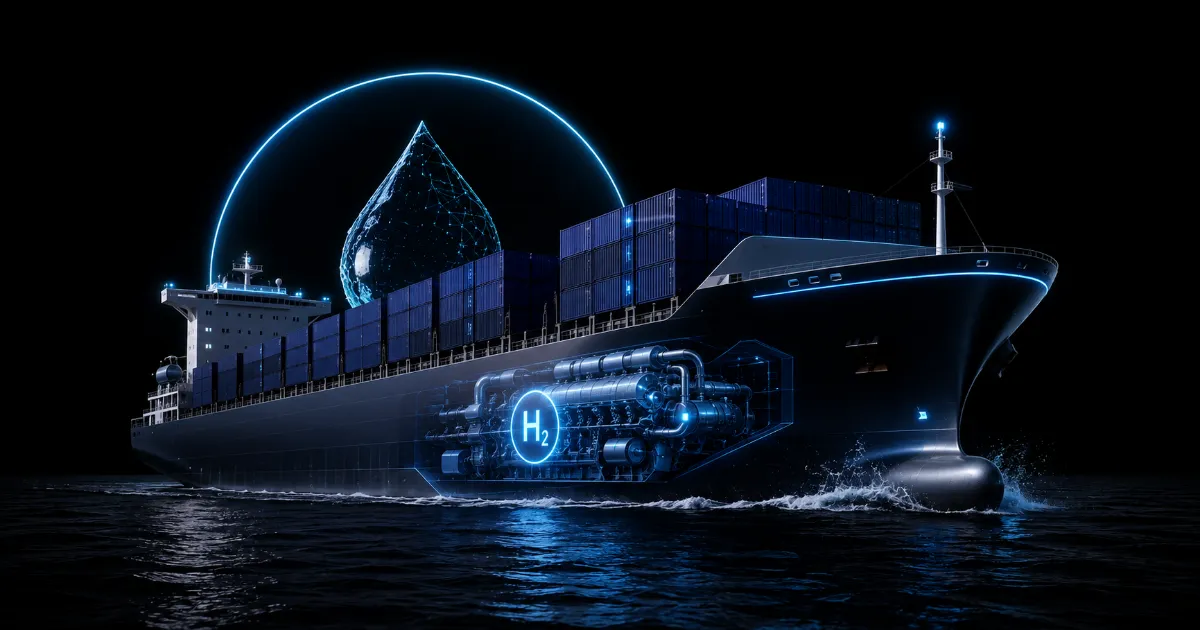
- Subject Overview: Newlight Secures Seed Funding to Pioneer Hydrogen Fuel-Injection for Maritime Cargo — Key developments across Startups.
- Technical Context: Detailed analysis of architectural changes, product capabilities, and engineering metrics.
- Industry Impact: Key implications for software developers, startup founders, and enterprise technology adopters.
The Decarbonization Imperative in Global Maritime Logistics
Global maritime shipping is the foundational backbone of international commerce, carrying over eighty percent of global trade volume while simultaneously accounting for nearly three percent of total global greenhouse gas emissions. As international regulatory bodies impose increasingly stringent carbon intensity reduction targets, shipowners and operators face a daunting technological hurdle in finding scalable, economically viable alternatives to heavy fuel oil. Traditional alternative fuels, such as liquefied natural gas and green ammonia, require massive capital expenditures for vessel retrofitting, present severe safety challenges, and suffer from profoundly underdeveloped global bunkering infrastructures.
In this high-stakes environment, transitional technologies that can optimize existing marine diesel internal combustion engines without requiring total fleet replacement represent the most pragmatic path toward immediate emissions reduction. Maritime operators cannot afford to scrap trillion-dollar fleets overnight, nor can they wait decades for nascent zero-emission bunkering networks to materialize across every major commercial port globally. Instead, the industry desperately requires retrofit-friendly engineering solutions that can squeeze greater thermodynamic efficiency out of conventional bunker fuels while systematically slashing particulate matter and carbon dioxide output.
Enter Newlight, a pioneering maritime tech startup that has developed a breakthrough fuel-injection technology designed to blend hydrogen directly into conventional marine diesel engines. By introducing metered amounts of hydrogen gas into the combustion chamber alongside traditional heavy fuel oil, the startup's proprietary system optimizes the flame propagation speed and burn completeness of the fuel mixture. This thermodynamic enhancement drastically reduces specific fuel oil consumption while simultaneously mitigating harmful nitrogen oxide and sulfur emissions, offering a vital bridge technology for fleet operators striving to meet mandatory environmental compliance standards.
Engineering the Hydrogen Fuel-Injection Architecture
The thermodynamic challenge of burning heavy fuel oil efficiently in large maritime diesel engines lies in the inherently slow combustion kinetics of heavy hydrocarbons, which often results in incomplete burning, carbon buildup, and wasted thermal energy. Newlight addresses this fundamental engineering bottleneck by designing a precision fuel-injection module that dynamically introduces compressed hydrogen gas into the air-fuel mixture immediately prior to the power stroke. Hydrogen boasts an extremely high flame speed and broad flammability limits, acting as a powerful ignition promoter that accelerates the combustion of the surrounding heavy fuel oil droplets.
Implementing this architecture within the hostile, high-vibration environment of a massive marine engine room requires exceptionally robust mechanical and electrical engineering. The system must precisely meter and time the introduction of hydrogen gas down to milliseconds, synchronizing with the engine's crank angle sensor to ensure optimal pressure distribution within the cylinder. Furthermore, the hardware must comply with rigorous maritime classification society standards regarding explosion-proof enclosures, double-walled gas piping, and automated emergency shut-off valves to prevent any risk of hydrogen gas accumulation.
The integration process is engineered to be non-invasive, allowing shipyard technicians to install the hydrogen injection manifolds and electronic control units during routine dry-dock maintenance without requiring a complete teardown of the primary engine block. This modular approach significantly lowers the capital barrier to entry for commercial shipping companies, transforming what would otherwise be a multi-million-dollar vessel replacement project into a manageable retrofit operation. By upgrading existing propulsion systems with intelligent combustion enhancement, shipowners can dramatically improve their fleet efficiency while extending the operational lifespan of older, structurally sound cargo vessels.
Validating Performance Across Trans-Oceanic Voyages
Theoretical thermodynamic models and controlled laboratory bench tests are insufficient to convince conservative maritime executives to adopt unproven propulsion modifications on multi-hundred-million-dollar container ships and bulk carriers. To prove the commercial and operational viability of its technology, Newlight recently achieved a monumental milestone by completing a grueling 8,500-nautical-mile test run from Singapore to Ghana. This extended voyage subjected the hydrogen fuel-injection system to punishing real-world marine conditions, including heavy ocean swells, fluctuating ambient temperatures, and continuous high-load engine operation across multiple weeks at sea.
During this trans-oceanic journey, the startup's engineering team gathered terabytes of high-frequency telemetry data measuring cylinder pressures, exhaust gas temperatures, turbocharger speeds, and overall fuel consumption metrics. The empirical results demonstrated a significant reduction in overall fuel consumption and a dramatic drop in greenhouse gas emissions compared to baseline performance data from identical sister ships running solely on heavy fuel oil. Additionally, engine inspections conducted upon arrival in Ghana revealed cleaner combustion chambers with noticeably reduced carbon soot accumulation on the piston crowns and exhaust valves.
This successful voyage served as the ultimate stress test for the reliability and resilience of the hardware, proving that the electronic control systems and gas-handling manifolds can withstand the relentless mechanical vibration and corrosive salt-air environment of open-ocean transit. Backed by a newly closed $9 million seed funding round, Newlight is now utilizing this empirical validation data to secure commercial partnerships with major global ship management firms and advance toward formal classification society certification for wide-scale commercial deployment.
Economic and Strategic Outlook for Maritime Operators
The commercial success of any green shipping technology ultimately hinges on its total cost of ownership and the speed at which it can deliver a tangible return on investment for asset owners operating in margin-thin markets. Unlike expensive green fuel alternatives that carry a massive cost premium over traditional bunker oil, Newlight's hydrogen injection system delivers immediate cost savings through improved fuel efficiency that helps offset the operational expense of hydrogen procurement. This economic alignment is crucial for driving voluntary adoption across commercial fleets without relying entirely on regulatory subsidies or punitive carbon taxes.
As global regulatory bodies like the International Maritime Organization tighten carbon intensity indicators and enforce stricter regional emissions trading systems, shipping companies face severe financial penalties for non-compliance. Technologies that offer an immediate percentage reduction in carbon emissions without sacrificing vessel speed, cargo capacity, or operational range provide an indispensable tool for fleet compliance officers. By enabling ships to burn less fuel overall while cleaner combustion reduces engine wear and maintenance frequency, the technology protects operators from escalating carbon compliance costs.
Looking forward, Newlight plans to scale its manufacturing capabilities and establish strategic supply chain partnerships with port authorities to ensure reliable hydrogen bunkering availability along major global shipping lanes. As the maritime sector navigates the difficult multi-decade transition toward complete decarbonization, transitional innovations that bridge the gap between legacy fossil fuels and future zero-emission energy carriers will play a decisive role in shaping the future of global logistics. Through rigorous engineering, successful long-range validation, and smart financial backing, the startup is positioning itself at the vanguard of maritime efficiency.
Related Coverage on TechRoro
- [Startups] Generative Intelligence Redefines Interactive Entertainment By Empowering Players To Become Creators
- [Startups] Executive Mental Models For Artificial Intelligence Strategy
- [Startups] Navigating The Complex Realities Of Artificial Intelligence In Recruitment