
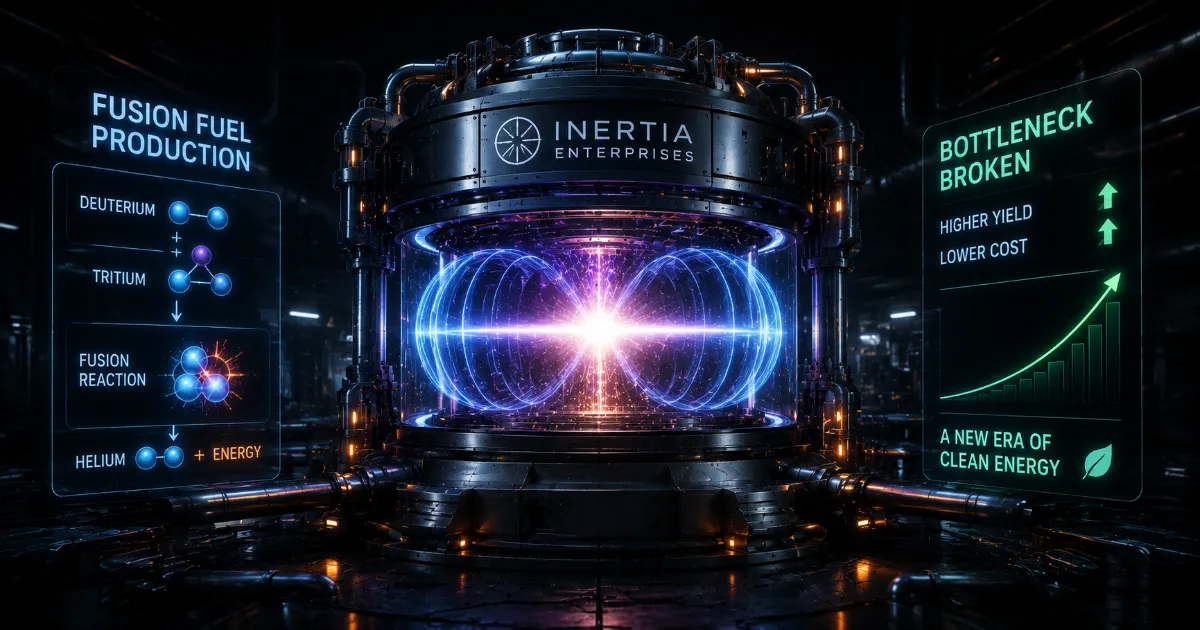
- Subject Overview: Inertia Enterprises Breaks Bottleneck in Fusion Fuel Production — Key developments across Energy.
- Technical Context: Detailed analysis of architectural changes, product capabilities, and engineering metrics.
- Industry Impact: Key implications for software developers, startup founders, and enterprise technology adopters.
The Fusion Bottleneck Problem
For decades, the promise of fusion power has been perpetually stalled by technical hurdles that range from plasma confinement stability to the logistical challenges of fuel handling. Inertia Enterprises, a startup operating at the intersection of material science and high-energy physics, has identified one of the most persistent bottlenecks: the preparation and injection of fusion fuel pellets. Previously, the process of filling and preparing these microscopic targets required a manual, painstaking workflow that consumed roughly a full week of labor for a single batch.
By re-engineering the cryogenic filling process and automating the material handling systems, the company has managed to condense this timeline into just a few hours. This is not merely an incremental improvement; it is a fundamental shift in the throughput capability of the fusion facility. Reducing the fuel preparation time addresses a critical logistical constraint that has prevented fusion reactors from moving toward the high-frequency pulsing required for continuous energy generation.
Engineering the Quantum Leap
At the heart of the innovation is a new proprietary method for high-pressure gas infusion into fuel capsules. Traditional methods involve slow diffusion processes, which are prone to contamination and require constant human monitoring to maintain the precise environmental conditions necessary for isotope stability. Inertia Enterprises developed an automated, closed-loop vacuum system that manages pressure and temperature cycles with digital precision.
- Automated Cryogenics: The system utilizes robotic thermal management to ensure that fuel capsules remain in a stable superconducting state during the entire filling cycle.
- Precision Monitoring: Real-time feedback loops allow the system to adjust gas pressure autonomously, preventing structural defects in the fuel pellets.
- Scaling Potential: By moving to a modular, automated architecture, the facility can now produce several batches per day, significantly increasing the potential data points available for reactor testing.
Addressing the 10 Hurdles of Commercialization
Inertia Enterprises has publicly categorized its path to commercial fusion into 10 distinct technical challenges. The successful optimization of the fuel filling process accounts for one of these, but the company acknowledges that much work remains. The other hurdles include plasma ignition consistency, energy capture efficiency, and long-term material resilience to neutron bombardment. The success with fuel preparation serves as a proof of concept for the firm's overall engineering philosophy: focus on the bottlenecks that prevent high-frequency experimental runs.
Key Takeaway: By solving the fuel cycle bottleneck, Inertia Enterprises has transitioned the industry from a regime of slow, expensive testing to one of rapid, iterative experimental validation, which is vital for achieving the goal of net-positive fusion energy.
Comparing Production Methodologies
| Metric | Traditional Batch Processing | Inertia Enterprises Process | Improvement |
|---|---|---|---|
| Prep Time | ~168 Hours (7 days) | ~4 Hours | 42x faster |
| Human Intervention | High | Low (Automated) | 90% reduction |
| Consistency | Low (Variance prone) | High (Digital control) | Significant |
| Scalability | Limited | High | Modular |
The Strategic Importance of Iteration
In fusion research, the rate of learning is directly proportional to the frequency of experiments. When a single fuel batch takes a week to prepare, a team can only perform a limited number of shots per year. By moving to a four-hour cycle, Inertia Enterprises can perform hundreds of shots in the same timeframe. This exponential increase in experimental velocity allows the company to iterate on its plasma confinement algorithms and reactor geometries much faster than competitors relying on legacy fuel preparation methods.
This shift is essentially the application of agile software development principles to heavy industry physics. In the same way that continuous integration changed the speed of software deployment, high-throughput fuel preparation is changing the speed of fusion energy development. This capability is likely to attract further venture interest and talent, as the path to commercial viability becomes increasingly transparent and measurable.
Market Outlook
The fusion sector is entering a phase of professionalization where incremental gains in efficiency are being rewarded with massive capital inflows. Inertia Enterprises, by solving a tangible and widely recognized bottleneck, has solidified its position as a serious player in the race for clean, limitless power. The industry is currently watching to see if these improvements can be replicated at the larger scale required for pilot reactors and, eventually, grid-connected power plants.
The Road Ahead
While the reduction in fuel preparation time is a monumental success, the team at Inertia Enterprises is already looking toward the next set of challenges. With the logistics of fuel handling optimized, the focus will now shift to the energy extraction phase—specifically, the design of more efficient blanket systems that can capture the heat generated during the fusion reaction without degrading the reactor core over time. If the company maintains its current pace of innovation, it may well provide the roadmap for a functional, cost-effective fusion power generation model within the next decade.