
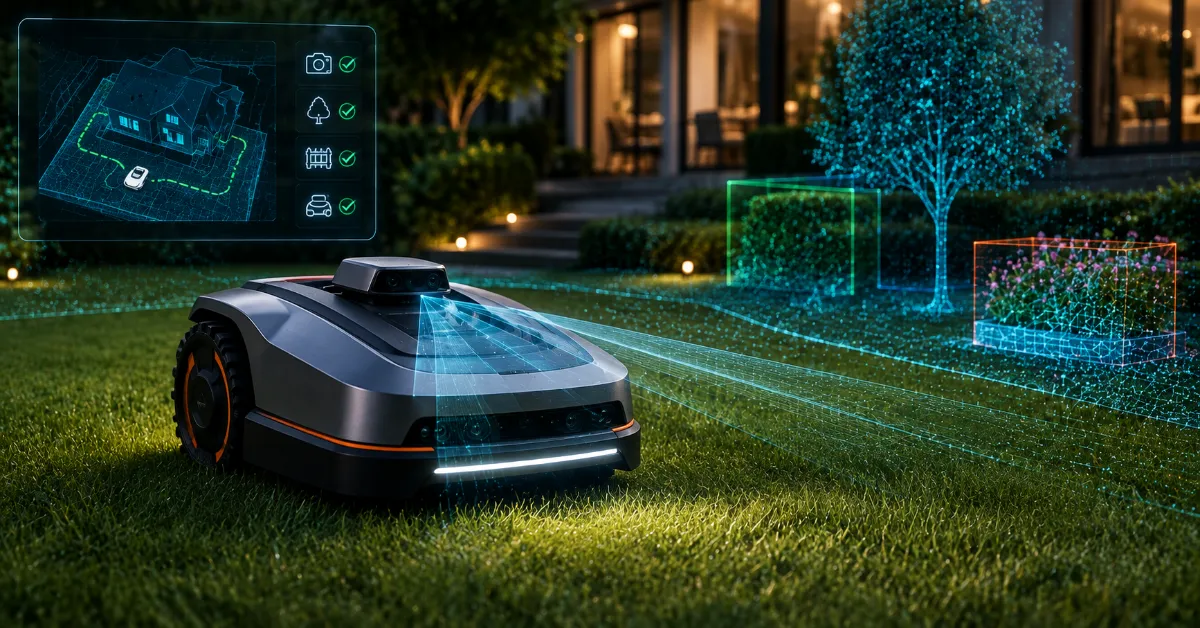
- Subject Overview: TerraMow V1000 Autonomous Mower Redefines Residential Landscaping with Computer Vision — Key developments across Gadgets.
- Technical Context: Detailed analysis of architectural changes, product capabilities, and engineering metrics.
- Industry Impact: Key implications for software developers, startup founders, and enterprise technology adopters.
The Shift Toward Vision Based Navigation
For years, the world of robotic lawn care was constrained by the tether of physical boundary wires. Homeowners were forced to bury hundreds of feet of copper, an arduous task prone to breakage and signal interference. The TerraMow V1000 represents a significant departure from this legacy architecture, leveraging an array of integrated AI cameras to perceive the environment in real time. This computer vision stack allows the unit to differentiate between grass, stone pathways, and garden beds with surprising accuracy.
By utilizing spatial awareness rather than radio-frequency beacons, the system maps out the lawn layout autonomously during its initial deployment. This approach does not just save time on installation but provides a level of agility that allows the device to adapt if the homeowner changes the landscaping layout. The shift from perimeter-based logic to image-processing logic marks a maturing stage for consumer robotics, where devices are finally beginning to understand the topology of their surroundings.
Intelligent Spot Mode and Targeted Maintenance
Beyond basic perimeter navigation, the inclusion of a specialized Spot Mode demonstrates a clear understanding of user needs. Many robotic mowers struggle with dense grass patches or areas where growth is uneven, often requiring a human to manually intervene with a secondary tool. The V1000 allows users to designate specific zones for concentrated effort, ensuring that high-traffic areas receive the density of cut required for a manicured look.
Key Takeaway: The transition to camera-driven navigation effectively democratizes robotic lawn care by removing the prohibitive barrier of perimeter wire installation, making smart landscaping accessible to the average homeowner.
This functionality is managed through a sophisticated onboard processor that balances energy efficiency with real-time detection. By scanning for height variations, the device can adjust its blade speed on the fly, preventing motor stalls while conserving battery life. This optimization is critical for larger suburban lawns where efficiency is the primary metric for user satisfaction.
Comparative Performance Metrics
To understand the technical leap the V1000 provides, we must contrast it with traditional robotic and manual systems. The following table highlights the operational advantages of moving to a vision-based autonomous system.
| Feature Metric | Legacy Perimeter System | TerraMow V1000 | Operational Impact |
|---|---|---|---|
| Setup Time | 4 to 8 Hours | 15 Minutes | Massive reduction in deployment overhead |
| Obstacle Avoidance | Impact Based | Vision Based | Prevents damage to lawn furniture |
| Precision | Low | High | Enables patterned, professional-grade cuts |
| Maintenance | Frequent Wire Repair | Software Updates | Significantly lower long-term cost |
Safety Protocols and Edge Detection
Safety remains the paramount concern for any autonomous machine operating in a residential environment. The TerraMow V1000 incorporates a multi-tiered safety architecture that includes physical bumpers, ultrasonic sensors, and the aforementioned camera array. This redundancy is essential for detecting pets, small children, or stray objects that may appear suddenly within the operating path.
When an object is detected, the machine does not simply stop; it calculates a new trajectory to bypass the obstruction while maintaining the integrity of the cut pattern. This level of path planning is typically reserved for industrial-grade robotics. By bringing this sophistication to the consumer level, the V1000 creates a safer ecosystem, allowing the device to operate with confidence even in complex, busy households.
Energy Management and Sustainable Cutting
Effective robotic landscaping is defined not just by how well the grass is cut, but by how long the machine can operate on a single charge. The V1000 utilizes a high-density lithium-ion battery system coupled with adaptive power management. The AI logic continuously monitors the resistance across the cutting deck; when the mower traverses flatter, shorter patches, it enters a low-power mode to extend the duty cycle.
This intelligent power distribution ensures that the device can handle varied lawn conditions without needing to return to the charging dock mid-cycle. For the average user, this means that the lawn is serviced in one continuous session, preventing the patches of uncut grass that often result from multiple re-docking cycles in cheaper, less efficient models.
The Bottom Line
The TerraMow V1000 succeeds because it addresses the core frustrations of the robotic mower market: tedious setup, erratic navigation, and rigid boundary requirements. By embracing computer vision and AI-driven path planning, the V1000 delivers a product that feels less like a piece of landscaping equipment and more like a smart home appliance. As the technology continues to iterate, we expect to see even tighter integration with broader home automation systems, further cementing the role of autonomous agents in our daily lives.