
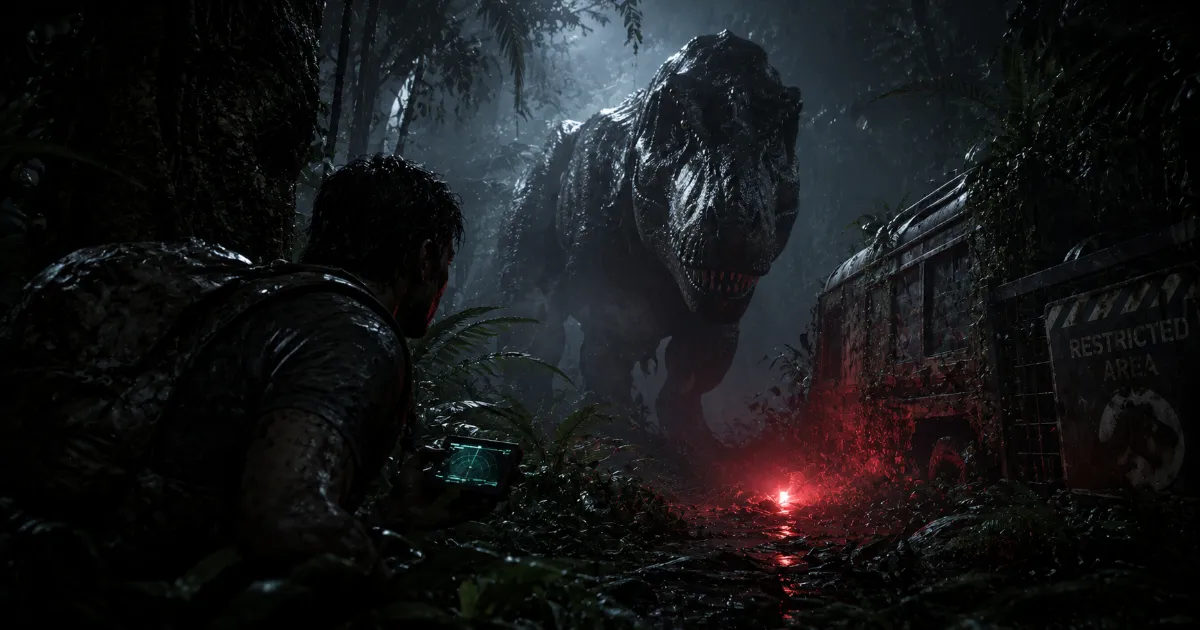
- Subject Overview: The Lost Wild Redefines Dinosaur Survival Horror Through Intelligent AI Ambush Mechanics — Key developments across Gaming.
- Technical Context: Detailed analysis of architectural changes, product capabilities, and engineering metrics.
- Industry Impact: Key implications for software developers, startup founders, and enterprise technology adopters.
The Evolution of Prehistoric Terror
The genre of dinosaur-focused gaming has long been dominated by the bombastic spectacle of Jurassic Park adaptations or the arcade-style action of Turok. However, The Lost Wild, developed by Great Ape Games, pivots sharply toward the psychological tension pioneered by titles like Alien Isolation. Instead of portraying dinosaurs as mindless monsters, the game treats them as living, breathing apex predators with distinct behavioral patterns, territorial instincts, and an unsettling curiosity toward the player.
Players find themselves stranded in a verdant, overgrown wilderness, tasked with uncovering the secrets of a defunct research facility. The environment is not a static backdrop but a dynamic ecosystem where the player is rarely the strongest entity. By stripping away the traditional power fantasy found in most creature-feature games, Great Ape Games forces users to rely on stealth, environmental awareness, and non-lethal distraction tactics to survive encounters that feel genuinely unpredictable.
Advanced AI and Emergent Gameplay
The core of the experience lies in the proprietary artificial intelligence governing the prehistoric inhabitants. Rather than following scripted paths, the dinosaurs in The Lost Wild utilize a sophisticated perception system. They react to sound, visual movement, and scent, creating scenarios where the player must constantly assess their risk profile. If a creature spots you, it might not immediately attack; instead, it may stalk you, test your defenses, or wait for an opportune moment to strike, mimicking the social hunting behavior observed in modern carnivores.
This design philosophy fosters emergent gameplay moments. A player might use a flare to distract a curious predator, only for the smoke to obscure their own vision, leading to a panicked retreat into dense foliage. The AI is programmed to learn from the player's behavior, meaning that consistent use of the same hiding spot or avoidance tactic might eventually result in the dinosaurs anticipating your movements, forcing players to adapt constantly to remain alive.
Visual Fidelity and Immersion Engineering
Built to utilize modern engine capabilities, the game focuses heavily on lighting and atmospheric density to heighten the sense of dread. The contrast between the lush, sun-drenched forests and the dark, claustrophobic corridors of the facility provides a necessary pacing shift. Sound design acts as an additional layer of information; hearing the low-frequency thrum of an approaching predator or the subtle snap of a twig behind you provides critical cues that often mean the difference between life and death.
| Feature | Traditional Survival Horror | The Lost Wild | Impact |
|---|---|---|---|
| AI Behavior | Scripted Patrols | Adaptive Predation | Unpredictable Encounters |
| Combat Focus | Aggressive Defense | Stealth and Distraction | High Tension Gameplay |
| World Interaction | Static Obstacles | Dynamic Ecosystem | Persistent Danger |
The Psychology of the Hunt
The Lost Wild taps into a primal fear that resonates with a broad audience. Unlike the supernatural horror of ghosts or the science-fiction horror of space, the fear of being hunted by an apex predator feels biologically wired into the human psyche. The developers leverage this by ensuring the dinosaurs never feel like game assets; they feel like animals protecting their domain. This respect for the source material, combined with gameplay mechanics that emphasize vulnerability, elevates the title beyond a simple action game into a survival simulation.
Architectural Implications
The design of The Lost Wild demonstrates a significant shift in how developers are approaching creature AI. By moving away from deterministic state machines toward more complex, goal-oriented architectures, developers can create entities that possess a sense of object permanence and agency. For the player, this translates to a more immersive experience where the virtual world feels independent of their presence, reacting naturally to their intervention. This evolution in game design suggests that future titles will likely prioritize ecosystem simulation over linear narrative beats to achieve high-fidelity tension.
Sources
Great Ape Games (thelostwild.com) PlayStation State of Play (playstation.com)