
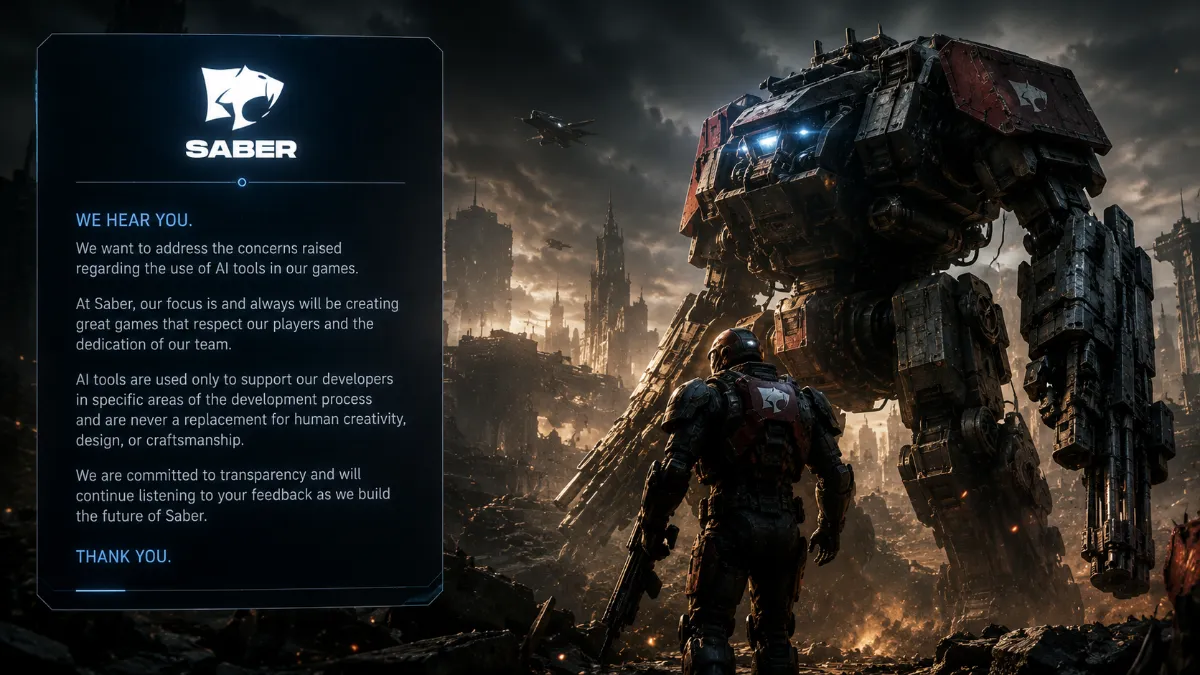
- Subject Overview: Saber Interactive Updates Steam Page to Address AI Tool Usage After Developer Backlash — Key developments across Gaming.
- Technical Context: Detailed analysis of architectural changes, product capabilities, and engineering metrics.
- Industry Impact: Key implications for software developers, startup founders, and enterprise technology adopters.
Addressing the AI Transparency Mandate
Executive Overview and Core Hook
The gaming industry stands at a volatile crossroads where the promise of accelerated development pipelines clashes directly with the human-centric ethos of creative artistry. Saber Interactive, a powerhouse in the development and publishing landscape, recently found itself at the epicenter of a firestorm regarding the role of generative artificial intelligence. Following public remarks from CEO Matthew Karch that touched upon the potential for AI to streamline production and potentially offset the need for traditional staffing models, the community reaction was immediate and overwhelmingly skeptical. This friction highlighted a growing demand for corporate responsibility, forcing major stakeholders to reconcile their technological ambitions with the expectations of a consumer base that deeply values human contribution in software design.
In response to this mounting pressure, Saber Interactive has implemented a formal AI transparency disclaimer on its Steam storefront. This decision is not merely a cosmetic update to a product page; it is a strategic acknowledgment of the social contract between developers and players. By codifying the use of AI tools, the studio aims to mitigate rumors, curb misinformation, and provide clarity on how synthetic assets are integrated into their titles. As the industry grapples with the ethical, legal, and creative implications of generative models, Saber’s shift serves as a case study in how transparency can be leveraged to rebuild trust. This development matters because it sets a precedent for how AAA and AA studios must communicate their internal methodologies to maintain brand integrity in a climate where automation is viewed with profound apprehension.
Technical Breakdown and Architecture
The architecture of modern game development is increasingly modular, relying on a complex stack of middleware, proprietary engines, and third-party assets. When an organization like Saber Interactive integrates AI into this pipeline, it generally manifests across three distinct domains: procedural generation of environment textures, natural language processing for non-player character dialogue, and automated code completion for routine software engineering tasks. Technically, this involves the ingestion of massive training datasets into localized or cloud-based large language models and diffusion models, which are then tuned to align with a specific game’s artistic direction.
From a workflow perspective, the incorporation of these tools is designed to reduce the overhead of repetitive tasks. For example, in the realm of texture mapping, neural networks can be utilized to upscale low-resolution assets to 4K fidelity, saving artists hundreds of hours of manual labor. However, the architectural risk lies in the lack of provenance. Without proper labeling, it becomes impossible for end-users to distinguish between human-crafted content and algorithmically generated output. Saber’s updated process involves a tagging system embedded within the Steam backend, which notifies the user about the specific nature of AI application—be it for visual, audio, or narrative elements. This requires a rigorous documentation process during the production phase, where project managers must audit assets to ensure they comply with the company’s internal AI governance policy before they are pushed to the live environment.
Markdown Comparison Table and Key Metrics
| Feature Category | Traditional Development Workflow | AI-Integrated Development Workflow | Transparency Level |
|---|---|---|---|
| Asset Creation | Manual 3D Modeling / Painting | Generative Model Prompting | Low vs. High |
| Narrative Writing | Human Scriptwriters | LLM-Assisted Drafting | Low vs. High |
| Quality Assurance | Manual Playtesting / Debugging | AI-Driven Stress Testing | Medium vs. High |
| Production Cycle | 3-5 Years | 1.5-3 Years | N/A |
- Key transparency metrics in current game development include the following:
- Asset Provenance Tracking: Ensuring every texture and model has a documented origin, whether human or synthetic.
- Ethical Data Licensing: Confirming that training sets used by AI tools do not infringe upon third-party intellectual property or artist copyright.
- Disclosure Granularity: Providing specific categories of AI usage rather than vague corporate statements.
- Community Feedback Integration: Establishing a direct line of communication for players to report concerns regarding the quality or presence of AI-generated content.
Developer and Ecosystem Impact
For the broader ecosystem of software engineers and creative professionals, Saber Interactive’s move is a significant data point. For startups, the pressure to adopt AI to remain competitive is high, yet the reputational risk of improper disclosure is now equally significant. Developers are being forced to build internal auditing tools that track the 'human-to-machine' ratio in their build pipelines. This creates a new niche for project management software that specializes in AI-compliance tracking, ensuring that studios can prove their workflows are ethically sound.
Furthermore, this shift impacts the cloud infrastructure market. As studios pivot toward more transparent AI use, there is an increased demand for private, verifiable AI instances that allow developers to train models on their own proprietary data rather than relying on black-box public APIs. This keeps the intellectual property secure while providing the efficiency gains that the boardroom demands. For the software engineering community, the takeaway is clear: the future is not about replacing the human element, but about creating a hybrid ecosystem where the human role is that of a curator and editor rather than a manual laborer. The ability to verify the provenance of code and creative assets is becoming a core competency for developers who wish to work in the modern gaming landscape.
Strategic Market Outlook and Analysis
The market for AI in gaming is rapidly maturing, moving past the initial 'hype cycle' into a phase of enterprise consolidation. Competition is fierce, and studios that fail to communicate their AI strategy risk alienation from their primary user base. Saber Interactive’s decision to update their Steam page serves as a defensive moat; by being transparent, they protect themselves from future backlash while potentially setting a standard that competitors may eventually be forced to follow through industry regulation or storefront mandate.
However, there are inherent trade-offs. Extreme transparency can lead to 'AI stigma,' where consumers reflexively reject any product labeled as AI-assisted, regardless of the quality of the final game. Companies must balance the need for honesty with the need to market their products effectively. The long-term outlook suggests that we will see a bifurcated market: 'AI-Enhanced' games, which are transparent about their tools and focus on scale and efficiency, and 'Artisan' titles, which market their total lack of AI as a premium, human-centric feature. Saber is hedging its bets by choosing the path of disclosure, a strategic maneuver that prioritizes long-term brand equity over the short-term benefit of hiding the technological nature of their production pipeline.
Sources
Saber Interactive (saber.games) Steam / Valve Corporation (steampowered.com)