
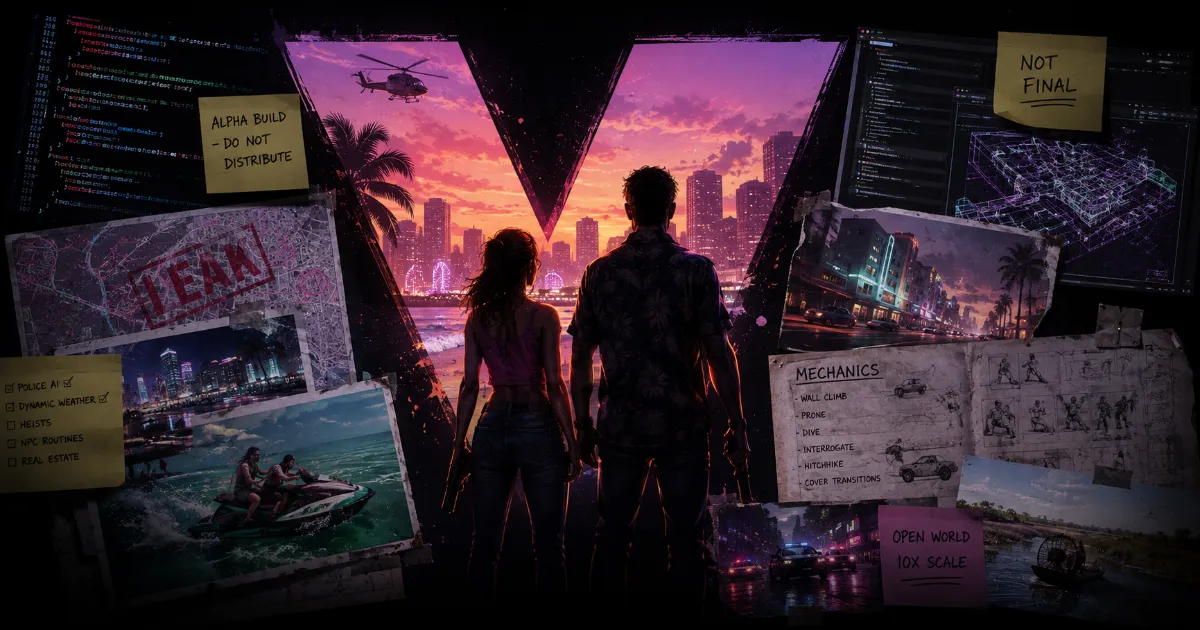
- Subject Overview: Grand Theft Auto VI Development Leaks Expose Unfinished Gameplay Mechanics and Open World Ambition — Key developments across Gaming.
- Technical Context: Detailed analysis of architectural changes, product capabilities, and engineering metrics.
- Industry Impact: Key implications for software developers, startup founders, and enterprise technology adopters.
Grand Theft Auto VI Development Leaks Expose Unfinished Gameplay Mechanics and Open World Ambition
Executive Overview and Core Hook
The unauthorized dissemination of early-stage development footage from Rockstar Games’ Grand Theft Auto VI has transcended typical news cycles to become a profound case study in the realities of modern software engineering. While the public reaction often focuses on aesthetic fidelity or narrative spoilers, the technical reality captured in these leaks provides a fascinating window into the iterative methodology required to build the world’s most ambitious interactive entertainment products. These clips, ranging from rudimentary character locomotion to early physics-based interaction tests, represent the "gray-box" phase of development—a period where core systems are built, tested, and discarded long before the polish of high-fidelity shaders or final textures is applied.
For the broader technology and gaming industries, this event highlights the extreme vulnerability of the modern development pipeline. Rockstar Games, a studio renowned for its near-obsessive commitment to quality control and secrecy, found itself forced to confront the public display of its "work-in-progress" architecture. Understanding this leak requires moving past the surface-level disappointment of unfinished graphics and instead appreciating the logistical nightmare of managing millions of lines of code, complex animation blending trees, and procedural generation systems that are essentially under construction. This analysis examines the technical scaffolding revealed in these leaks and what they signify for the future of triple-A game development and cybersecurity in high-profile creative environments.
Technical Breakdown and Architecture
The leaked footage offers a rare glimpse into the proprietary RAGE (Rockstar Advanced Game Engine) ecosystem. At this stage of development, the engine is clearly operating in a debug-heavy state, with telemetry overlays, wireframe debug views, and placeholder assets visible throughout the clips. The most notable observation is the focus on animation blending and physics interaction. In modern open-world design, the goal is to bridge the gap between static scripted events and dynamic, emergent gameplay. The leaked clips show the evolution of character controllers, where the locomotion system is being tuned to handle complex terrain navigation and environmental interaction.
From an architectural standpoint, the footage suggests that Rockstar is doubling down on its commitment to simulated environmental fidelity. We see evidence of advanced vehicle physics integration and sophisticated AI pathfinding systems that are designed to handle high-density traffic and pedestrian scenarios. The memory management systems visible in these debug logs suggest a massive overhead, hinting at a world that is significantly more interconnected than previous iterations. This is not merely about increasing map size; it is about increasing the density of data points that the engine must keep resident in memory at any given time. The integration of complex event-driven AI, combined with real-time dynamic weather and lighting systems, requires a robust streaming architecture that can load and unload assets seamlessly without causing stuttering or frame-pacing issues.
Markdown Comparison Table and Key Metrics
| Feature Category | Early Development (Leaked) | Target Triple-A Standard | Technical Implication |
|---|---|---|---|
| Asset Fidelity | Gray-boxed/Placeholder | Photorealistic/High-Poly | Significant storage delta |
| Physics Engine | Component-based testing | Integrated global simulation | High CPU overhead |
| AI Interaction | Hard-coded triggers | Emergent/Systemic behavior | Increased memory footprint |
| Animation | Key-framed/Root motion | Motion-matched/Procedural | Complex blend trees |
- Asset Pipeline Maturity: The leaks show that the game is in an active state of refinement, where high-fidelity meshes are likely being swapped for existing proxy assets to maintain performance during engine-level stress testing.
- Physics Integration: The focus on ragdoll-to-animation blending indicates a shift toward more tactile, physically grounded gameplay that rejects the "floating" character feel of older generation titles.
- Debugging Overhead: The presence of extensive debug menus and telemetry data confirms that the development team is currently focusing on system stability and edge-case error handling rather than visual finalization.
Developer and Ecosystem Impact
The repercussions of these leaks extend far beyond the reputation of a single studio. For software engineers, it acts as a stark reminder of the risks associated with remote-access development environments. Rockstar, like many other large-scale studios, transitioned to hybrid or remote work models during the recent global shift, which expands the attack surface for bad actors seeking to compromise proprietary intellectual property. This creates a challenging environment for developers who require high-speed access to massive asset repositories and source code databases.
Furthermore, the impact on the development cycle is significant. When a "vertical slice" of a game is leaked, the pressure on the development team to pivot their internal PR strategy or accelerate visual polish can be immense. This can lead to "crunch" culture, where engineers and designers are forced to abandon long-term structural improvements to appease public expectations regarding the game’s aesthetic state. In the long term, this forces studios to implement more draconian security measures, such as air-gapped development environments, restrictive VPNs, and granular permission controls, which can inadvertently stifle the collaboration and fluidity required for creative software engineering.
Strategic Market Outlook and Analysis
From a market perspective, Rockstar Games occupies a unique position. The "Grand Theft Auto" brand is a cultural juggernaut, and its development cycle is often viewed as the gold standard for open-world design. However, the leak forces a conversation about the necessity of "transparency" in development. Consumers increasingly demand insight into the creation process, but as these leaks demonstrate, the public is often ill-equipped to parse the difference between an unfinished engine build and a broken product. This creates a trade-off: studios can either remain opaque, potentially fueling skepticism, or become more open, risking the misinterpretation of their early-stage R&D.
Industry competitors are likely watching this situation with great concern. The theft of source code or proprietary assets is a existential threat to any studio that relies on its intellectual property to drive revenue. We expect to see a massive increase in enterprise-grade security spending across the gaming sector, with a focus on identity and access management (IAM) and data loss prevention (DLP) tools tailored specifically for the creative workflows of game developers. The era of "open-door" development culture in large studios is likely coming to an end, replaced by a more fortified, security-first approach to project management.
Sources
Rockstar Games (rockstargames.com) Take-Two Interactive (take2games.com)