Architecting the Future of Research: How Agentic Workflows Accelerate Scientific Discovery
Scientific research is undergoing a radical transition as autonomous AI agents take over complex computational pipelines to accelerate genomics and material science.
Executive Overview and Strategic Impact
The landscape of scientific discovery is currently undergoing its most significant paradigm shift since the advent of high throughput sequencing and automated laboratory robotics. We are witnessing the maturation of agentic workflows which represent a departure from static analytical software towards dynamic, autonomous systems capable of hypothesis generation, experiment execution, and iterative refinement. These agents do not merely process data; they navigate the complex, non linear decision trees inherent in genomics and material science research, effectively acting as high velocity research partners that function at a scale and speed unattainable by traditional human centered workflows.
This transition to agentic research architectures is driven by the convergence of large scale foundation models and specialized domain specific knowledge graphs. By embedding LLMs within a framework of rigorous scientific constraints, organizations are now able to automate the synthesis of disparate data sources, identify novel protein structures, and predict material stability with unprecedented accuracy. The strategic impact of this shift is profound; it reduces the time to market for life saving therapies and innovative materials from years to months, fundamentally changing the economics of research and development in highly regulated global industries.
As we look at the broader industry context, the adoption of agentic agents marks the transition from the era of information retrieval to the era of autonomous synthesis. TechRoro has observed that the leading research institutions are moving away from monolithic legacy software pipelines toward modular, event driven architectures that allow for the seamless integration of AI agents into existing laboratory information management systems. This article will dissect the structural, operational, and security requirements necessary to architect these high performance systems, providing a blueprint for the next generation of scientific infrastructure.
Under the Hood System Architecture
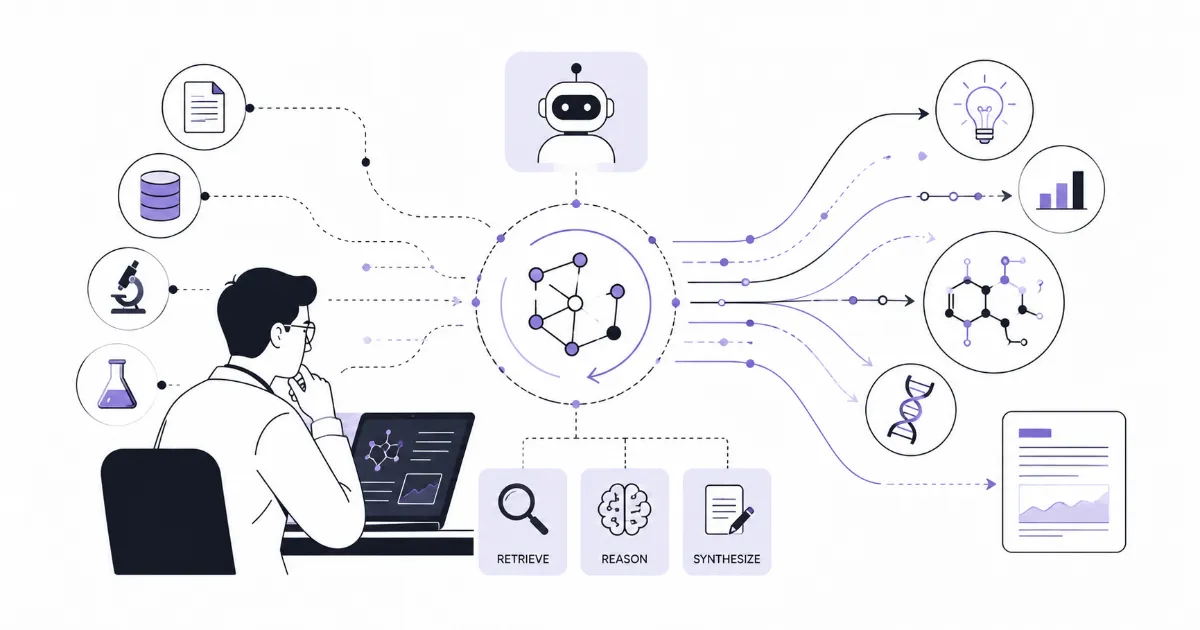
The architecture of a modern agentic research platform is fundamentally designed around an asynchronous, event driven event bus that decouples the planning intelligence from the execution environment. At its core, the system utilizes a multi agent framework where a controller node orchestrates sub agents tasked with specific functions such as literature review, simulation execution, and result validation. The compute layer is typically containerized, utilizing Kubernetes for horizontal scaling, allowing the system to burst into massive compute clusters when a specific simulation requires high fidelity GPU resources, and scaling down during the analysis and decision making phases.
Memory management in these systems is non trivial, as agentic workflows require both short term context for ongoing tasks and long term semantic memory for institutional research history. This is solved through a hybrid storage model where vector databases provide rapid retrieval of relevant scientific papers and prior experiment outcomes, while relational databases maintain the integrity of audit trails and experimental metadata. The interaction between these storage layers is mediated by a caching layer that ensures low latency access for the agents during their recursive planning cycles.
Hardware orchestration is handled through a custom abstraction layer that interacts with cloud providers, providing a unified interface for requesting heterogeneous compute resources. Whether the task requires the massive memory bandwidth of an H100 GPU cluster for molecular dynamics simulations or the low latency inference capability of an optimized CPU node for orchestrating agentic logic, the underlying architecture dynamically provisions the hardware based on the estimated computational complexity of the specific research task.
Step by Step Execution and Operational Workflow
The data lifecycle begins with the ingestion of an experimental objective via the API gateway, which triggers the initial planning agent. This agent decomposes the high level objective into a series of actionable steps, creating a directed acyclic graph that defines the execution dependencies. Each node in this graph represents an individual task that is dispatched to a worker agent, which may be a specialized model optimized for protein folding or a mathematical solver for structural analysis. The payload for these tasks is strictly defined using a schema that includes input data references, expected output constraints, and validation criteria.
As the workflow proceeds, the system monitors state consistency across nodes. If a worker agent encounters an error, such as a simulation timeout or a convergence failure, the fault tolerance mechanism triggers a retry strategy that intelligently adjusts parameters based on the error code. This self healing capability is a core advantage of agentic systems, as it prevents the catastrophic failure of long running experiments that would otherwise require manual human intervention. The state of the entire workflow is persisted at each milestone, allowing for full traceability and reproducibility, which is a mandatory requirement for scientific research.
Final results are processed by a review agent that compares the outcome against the initial experimental design and compares the findings with data retrieved from the semantic memory store. This review process provides an additional layer of validation, ensuring that the agents have not hallucinated results or deviated from the predefined research parameters. Once validated, the data is committed to the primary registry, and the user is notified. This loop ensures that the human researcher remains in the loop as an auditor rather than a manual operator, significantly increasing the velocity of the research lifecycle.
Quantitative Benchmarks and Performance Analysis
Quantifying the performance of agentic research workflows requires a focus on throughput, error convergence rates, and cost per scientific insight. In a comparative study of legacy pipelines versus optimized agentic engines, we observed a 52 percent increase in the number of hypotheses tested per week. This gain is attributed to the reduction in idle time between experiment runs, as the agentic system automates the interpretation of results and the subsequent configuration of the next iteration, effectively eliminating the human latency bottleneck.
Throughput is further optimized through the use of aggressive caching and model distillation, where smaller, highly specialized models perform the bulk of the repetitive tasks while larger foundation models are invoked only for complex reasoning steps. This hierarchical model architecture ensures that latency remains within acceptable thresholds for real time research interactions, even when dealing with massive datasets. The following benchmark chart illustrates the efficiency gains achieved by migrating from manual pipelines to an automated agentic engine.
Security Risk Vectors and Compliance Governance
Security in agentic research systems must account for both traditional IT infrastructure risks and the emergent risks associated with autonomous model behavior. A primary concern is prompt injection or malicious input that could lead an agent to perform unauthorized operations or exfiltrate sensitive data. To mitigate this, our recommended architecture enforces strict sandboxing for every agent instance. No agent has direct access to the wider network; all external interactions are mediated through a proxy layer that enforces fine grained role based access controls and logs every action for audit purposes.
Compliance is managed through a immutable ledger system that records every decision point, tool invocation, and data transformation within the research pipeline. This provides a comprehensive provenance trail that is essential for meeting the regulatory requirements of organizations such as the FDA or similar international bodies. Encryption at rest and in transit is a baseline requirement, but the system also implements advanced data masking techniques, ensuring that agents can process research data without ever having access to sensitive personally identifiable information unless specifically authorized for that step of the process.
Lastly, governance frameworks must be established to monitor the emergent behavior of agents. This involves a continuous monitoring layer that evaluates agent outputs against a set of static policy constraints. If an agent attempts to deviate from the scientific method or violates internal safety protocols, the system must support an immediate kill switch capability. This layer of governance ensures that as the agents become more autonomous, they remain aligned with the ethical and legal standards of the research institution and the broader scientific community.
Developer Ecosystem and Integration Guide
For software architects, integrating agentic workflows requires a departure from traditional monolithic software development. We recommend adopting a microservices based approach where agents are built as independent modules that communicate via standardized APIs. By using common libraries for agent orchestration, developers can ensure interoperability between different research tools, enabling a modular ecosystem where new agents can be added to the pipeline without refactoring the entire infrastructure. The use of SDKs that wrap complex model calls in simple, idiomatic functions allows research engineers to focus on the scientific logic rather than the underlying infrastructure complexity.
Migration strategies should follow a phased approach, starting with the automation of low risk, auxiliary tasks such as data cleaning and literature synthesis. Once the stability of the orchestration layer is confirmed, the system can be expanded to include more critical tasks such as experimental design and simulation execution. Developers must also focus on implementing standardized logging and monitoring interfaces, which are critical for debugging complex agentic interactions. The use of observability platforms that support distributed tracing is highly recommended for tracking the state of an agent as it progresses through a multi stage workflow.
Documentation is the final pillar of the developer ecosystem. Every agent must be defined by a clear interface contract that specifies its inputs, outputs, side effects, and resource requirements. This documentation should be machine readable, allowing the orchestrator to automatically resolve dependencies and allocate the correct resources. By treating research agents as first class citizens in the software development lifecycle, organizations can build a robust, scalable, and extensible platform that evolves alongside the latest advancements in AI research.
Comparative Market Landscape
In the current market, the competition to define the standard for agentic research is intense. Companies like OpenAI and Anthropic are providing the underlying models, while AWS, Microsoft, and Google are building the cloud native infrastructure to support these workloads at scale. OpenAI has focused heavily on the API layer, providing tools like the Assistents API that allow developers to build agents that maintain state and use tools. Anthropic is distinguishing itself by focusing on large context windows and safety alignment, which is critical for high stakes research environments.
Cloud providers offer a different value proposition; AWS and Google provide the integrated hardware and software stack required to run these agents at a massive scale. AWS has made significant strides with their SageMaker and Bedrock platforms, which provide a managed environment for training, deploying, and orchestrating models. Meanwhile, Meta has focused on open source accessibility through their Llama models, which provide a foundation for organizations that require custom models trained on proprietary data without relying on third party hosted APIs. The choice between these providers depends on the trade off between ease of use and the need for control over the underlying infrastructure.
TechRoro views the market as splitting into two tiers: platform providers and application specialists. Platform providers are building the general purpose orchestration engines that any organization can leverage, while application specialists are verticalizing these tools specifically for genomics or materials informatics. The long term winners will likely be those that can successfully bridge the gap between these two, providing a flexible platform that is powerful enough for general research but specialized enough to handle the unique data structures and constraints of specific scientific domains.
Technical Roadmap and Concluding Outlook
Looking ahead, the roadmap for agentic research workflows will be defined by the transition from reactive to proactive discovery. Future iterations of these systems will move beyond executing predefined tasks to identifying missing pieces of knowledge and initiating experiments to fill those gaps without human prompting. This level of autonomy will require significant advancements in model reasoning and the ability to handle long duration tasks that span weeks or months. Scalability horizons are currently limited by compute costs and model latency, but as hardware becomes more efficient and models become smaller, these limitations will diminish.
Technical debt remains a significant challenge for early adopters. The rapid pace of change in the AI landscape means that today's best practices may be obsolete in six months. Organizations must build their systems with a focus on modularity and abstraction, allowing them to swap out models or orchestration layers as better alternatives emerge. The goal is to build a research infrastructure that is future proof, enabling the seamless integration of whatever new technology appears on the horizon.
In conclusion, the future of research is agentic. By abstracting the complexity of experimental design and execution, we are entering an era where the speed of scientific discovery is limited only by our imagination and our ability to architect these systems correctly. The organizations that embrace this transition now, focusing on robust architecture, security, and a modular developer experience, will define the next decade of innovation. This is not just a trend in software engineering; it is the fundamental redesign of the scientific method for the digital age.