James Webb Telescope Data Rewrites Our Understanding of Ancient Galactic Origins
New data from the James Webb Space Telescope is fundamentally altering cosmic theories as astronomers uncover unexpected structures in the early universe.
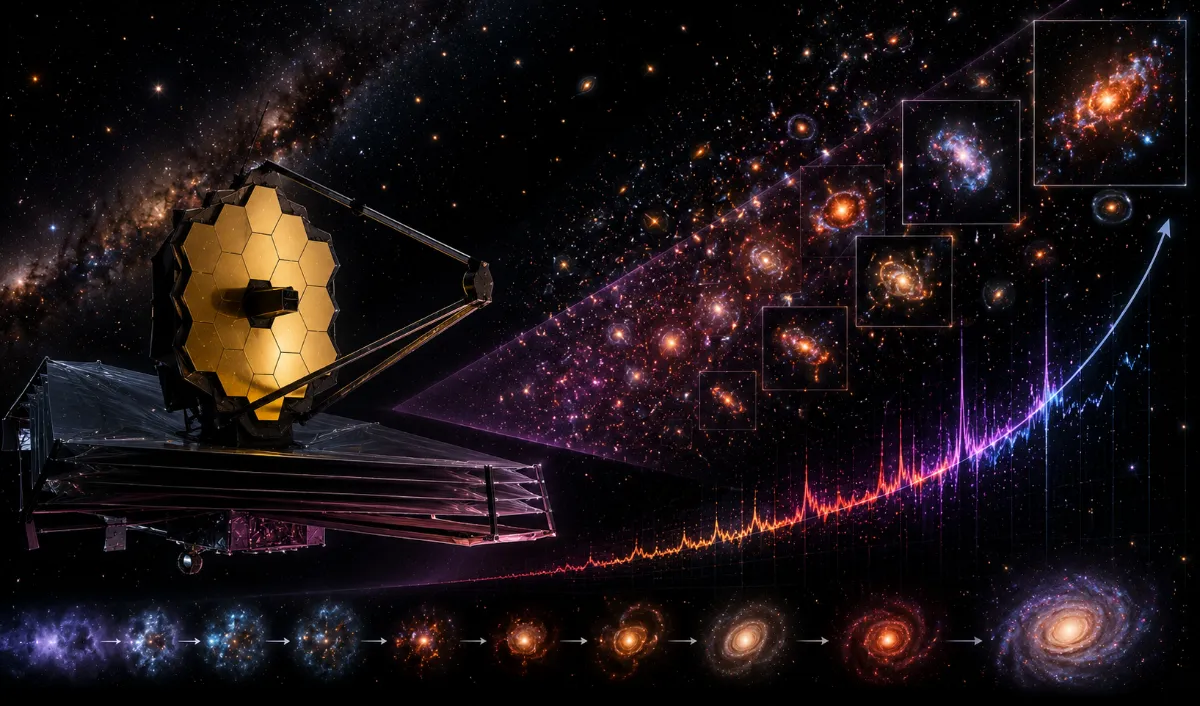
Peering Into the Dawn of Time
The James Webb Space Telescope has become the most transformative instrument in modern cosmology, providing a clear window into epochs that were previously obscured. Since reaching its observation post, the telescope has returned imagery and spectral data that defy conventional models of galaxy formation. Where once scientists expected to see a slow, orderly evolution of structures, they are now observing massive, complex galaxies existing much earlier than current models predicted, forcing a profound reassessment of our cosmic timeline.
This discrepancy between theoretical expectation and observed reality is the hallmark of a scientific breakthrough. By capturing infrared light from the most distant reaches of space, Webb is able to bypass the thick clouds of dust that hindered its predecessor. This ability to see through cosmic interference has revealed that the universe was far more active and chaotic in its infancy than previously theorized. Galaxies appear to have assembled into sophisticated, ordered states with surprising velocity, a discovery that challenges the standard model of dark matter interactions.
Challenging Cosmic Assumptions
- Rapid Galaxy Formation: Observations suggest that star formation occurred much faster than current gravitational collapse models account for.
- Structural Maturity: Ancient galaxies show signs of high metallicity and structural complexity, hinting at earlier generations of stars.
- Dark Matter Influence: Data is prompting a revisit of how dark matter halos facilitated early galactic clustering.
The Technical Precision of Deep Space Observation
Operating at the Lagrange point, the telescope functions as an incredibly precise thermal sensor. The engineering required to maintain the stability of its optics while keeping the hardware shielded from the heat of the Sun and Earth is a masterclass in infrastructure design. Every byte of data received is the result of a delicate dance between extreme cryogenic cooling and high-resolution imaging that essentially maps the history of the early cosmos.
We are looking at a universe that seems to be in a hurry. The structures we are seeing at such extreme distances are far more mature than we dared to imagine a decade ago. This isn't just a slight adjustment to our theories; it is a fundamental shift in our understanding of how the universe began.
The Road Ahead
As researchers continue to aggregate this influx of data, the scientific community is entering a period of rapid theory construction. The focus has shifted from merely observing the unknown to building new, more robust models that can accommodate the existence of early-universe behemoths. This process will take years of computational analysis and peer review, but the foundation has been set. The James Webb Space Telescope has successfully opened a new chapter in astrophysics, proving that our previous view of the ancient cosmos was merely a sketch of a much more dynamic, complex, and fascinating reality.