Hotel Network Hijacking Leads to Targeted Malware Campaigns
Travelers are increasingly at risk as threat actors compromise hotel Wi-Fi infrastructure to deliver sophisticated surveillance malware through fake update prompts.
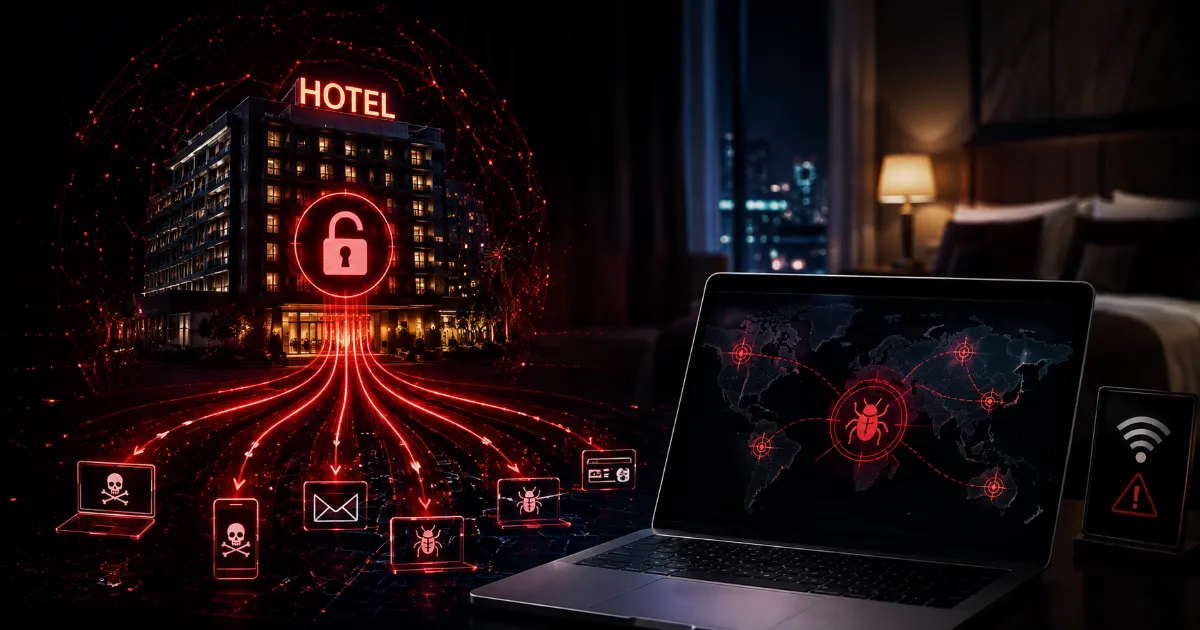
The Peril of Connected Travel
The convenience of public Wi-Fi in hotels has long been viewed as a necessary compromise for business travelers, but recent discoveries reveal a sophisticated campaign using this infrastructure as a launchpad for malware. By hijacking hotel network traffic, attackers are injecting fake browser update prompts into the user session, leading victims to download CornFlake, a potent remote access trojan designed for long term surveillance. This method exploits the psychological trigger of a browser update notification to gain administrative access on the victim's device.
Once installed, CornFlake provides the attacker with total control over the victim's digital environment. It can capture webcam feeds, log microphone audio, and record every single keystroke. For a corporate traveler handling proprietary data or accessing sensitive internal networks, the risk is absolute. The malware is specifically engineered to stay hidden, operating as a background process that is invisible to all but the most advanced endpoint detection systems.
Anatomy of the Wi-Fi Attack
The sophistication of this campaign lies in its placement. By positioning themselves between the user and the internet service provider, the attackers can manipulate the traffic stream in real time. They do not need to hack the user's computer directly; they simply wait for the user to initiate a legitimate request and intercept the response with their own malicious content. This man in the middle capability is remarkably hard for the average user to detect.
- Hijack Point: Compromised hotel router or gateway.
- Vector: Fake software update prompts injected into browser sessions.
- Malware Payload: CornFlake RAT with full surveillance capabilities.
- Goal: Long term monitoring of high value professional targets.
Protecting Your Digital Environment
Travelers must assume that any public Wi-Fi network, regardless of the hotel brand, is potentially compromised. The only way to ensure safety in these environments is through the use of a secure, reputable VPN that forces all traffic through an encrypted tunnel, preventing any local network intervention. Furthermore, users should never accept software update prompts while connected to public networks, as these are almost universally malicious attempts to gain control.
The Bottom Line
The reliance on public networks for work related tasks is a significant vulnerability in the modern professional landscape. As we continue to operate in a global, mobile, and interconnected environment, the responsibility to secure one's own data falls squarely on the individual and their organization's security policy. We must adopt a zero trust approach to networking, where the medium of connection is never assumed to be secure and every data packet is treated with the highest level of skepticism. The future of mobile work demands a new level of caution and technological preparation to avoid falling victim to these pervasive and persistent threats.