Embabel Agent Framework Hits 1.0 Milestone for Java Ecosystem
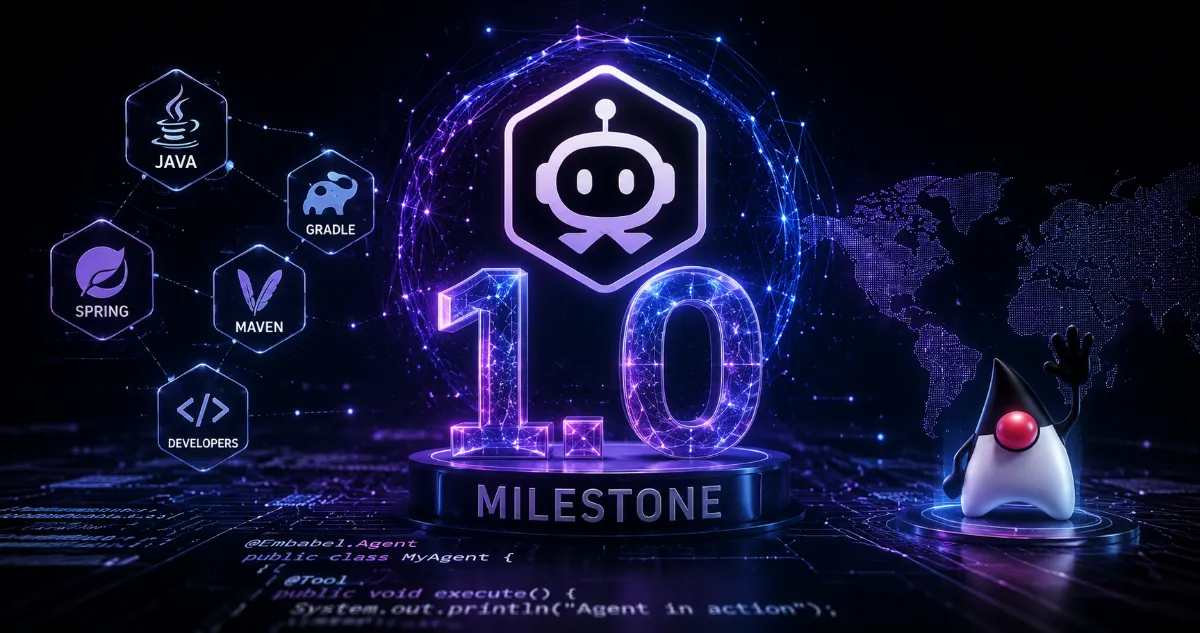
The Embabel agent framework reaches version 1.0, enabling Java developers to build robust AI agents with native language support and simplified abstractions.
Bridging the Gap for Java AI
Java has long been the backbone of enterprise computing, yet the rise of AI agents has largely been dominated by Python based ecosystems. The release of Embabel 1.0 changes this dynamic by providing a formal framework designed specifically for Java developers. This toolset allows for the construction, orchestration, and management of intelligent agents directly within the JVM, removing the need to build sidecar processes or manage complex IPC channels to interface with AI models.
Core Capabilities and Architecture
Embabel provides a high level abstraction for interacting with Large Language Models, enabling developers to define agent behaviors through familiar Java patterns. By leveraging standard interfaces, the framework allows for interchangeable model providers, meaning teams can pivot between different LLM backends without rewriting core business logic. This is particularly valuable for financial or healthcare institutions that may have strict requirements regarding data residency and model hosting.
Why Java Developers Need Embabel
- Strongly Typed Interactions: Reduce runtime errors by using Java types for model inputs and outputs.
- Seamless Integration: Hooks directly into existing Spring Boot or Jakarta EE environments.
- Simplified Orchestration: High level APIs for managing agent state and conversational history.
Layman Explainer
Think of Embabel as a translator and project manager for your software. Traditionally, if you wanted your Java application to use AI, you had to write a lot of messy 'glue code' to handle the communication between your app and the AI service. Embabel acts as a standard connector, allowing you to give your application 'instructions' that the framework automatically translates into the right format for the AI. It then takes the AI's response and organizes it back into a structure your Java application can use instantly, without any extra work.
Analyzing System Performance
| Feature | Benefit |
|---|---|
| Native JVM support | No foreign function overhead |
| Provider Agnostic | Easy model swapping |
| Declarative Agent Definition | Faster prototyping |
Real World Impact
For enterprise teams, the ability to build AI agents within the existing Java infrastructure means that they can leverage their current security and monitoring investments. There is no need to deploy new infrastructure or train teams on a completely different tech stack. Embabel brings the benefits of modern AI to the reliability of the Java ecosystem, allowing firms to build intelligent, autonomous services that are production ready from day one. As the framework evolves, the community can expect further enhancements in agent capability and integration depth with the broader AI middleware stack.