Resurrecting Legacy Systems with CPM 386 for Protected Mode Architecture
A deep dive into the technical revival of CP/M 386, bringing classic operating system architecture to modern protected mode environments.
Architectural Evolution of Legacy OS
The history of computing is littered with forgotten architectures that once defined the industry. CP/M once commanded the personal computing landscape before the dominance of MS DOS shifted the trajectory of consumer software. The emergence of CP/M 386 represents a fascination with bridging the gap between that heritage and the robust capabilities of the 386 protected mode, which introduced memory protection and multi tasking to the x86 ecosystem.
By porting the core logic of CP/M 68K to the 386 architecture, the developers behind this project have created a unique hybrid environment. This project does not merely emulate the system; it attempts to adapt the operating system's fundamental design principles to a processor capable of handling flat memory addressing and segmented protection. This exercise is primarily for those interested in low level systems programming and the historical evolution of kernel design.
Managing Memory and Protected Mode
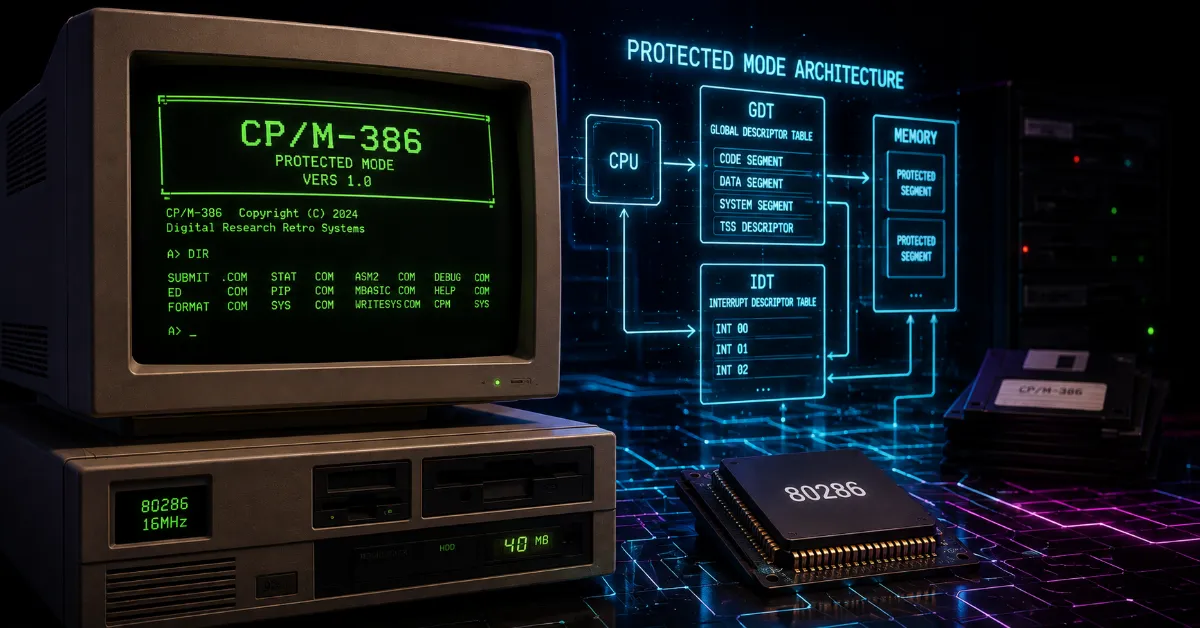
One of the most significant hurdles in this transition is the jump from the simple address spaces of earlier systems to the complex segmented memory model of the 80386 processor. CP/M was never designed with memory protection in mind, so the port requires a shim that sits between the legacy API calls and the hardware's protected rings. This layer manages privilege levels to prevent unauthorized access, effectively sandbox environments that were originally intended to have total system control.
- Key Technical Challenges:
- Handling privilege transitions between ring 0 and ring 3
- Adapting the CP/M BDOS calls for 32 bit registers
- Implementing efficient interrupt handling for legacy hardware hooks
- Maintaining compatibility with original CP/M application binaries
The Engineering Tradeoffs
Developers who tinker with this project will find that it serves as an excellent study in hardware abstraction layers. While nobody will be running a modern enterprise stack on CP/M 386, the project provides a clearer understanding of how operating systems handle task switching and resource management at the hardware level. It highlights why modern kernels are so significantly larger and more complex compared to their predecessors.
| Comparison | CP/M 68K | CP/M 386 |
|---|---|---|
| Addressing | Flat 16-bit | 32-bit Protected |
| Multitasking | Primitive | Supported via Hardware |
| Architecture | Motorola 68000 | Intel 80386 |
What Lies Ahead
Projects like CP/M 386 demonstrate the persistent interest in retro computing and system level archaeology. For the modern developer, it is a rare opportunity to strip away the abstractions of Docker, Kubernetes, and high level languages to see the metal beneath. While the project is clearly niche, it provides a valuable lesson in kernel architecture and the historical constraints that shaped modern computing. It is a reminder that the fundamentals of process management, memory allocation, and interrupt handling remain constant, even as the silicon evolves around them.