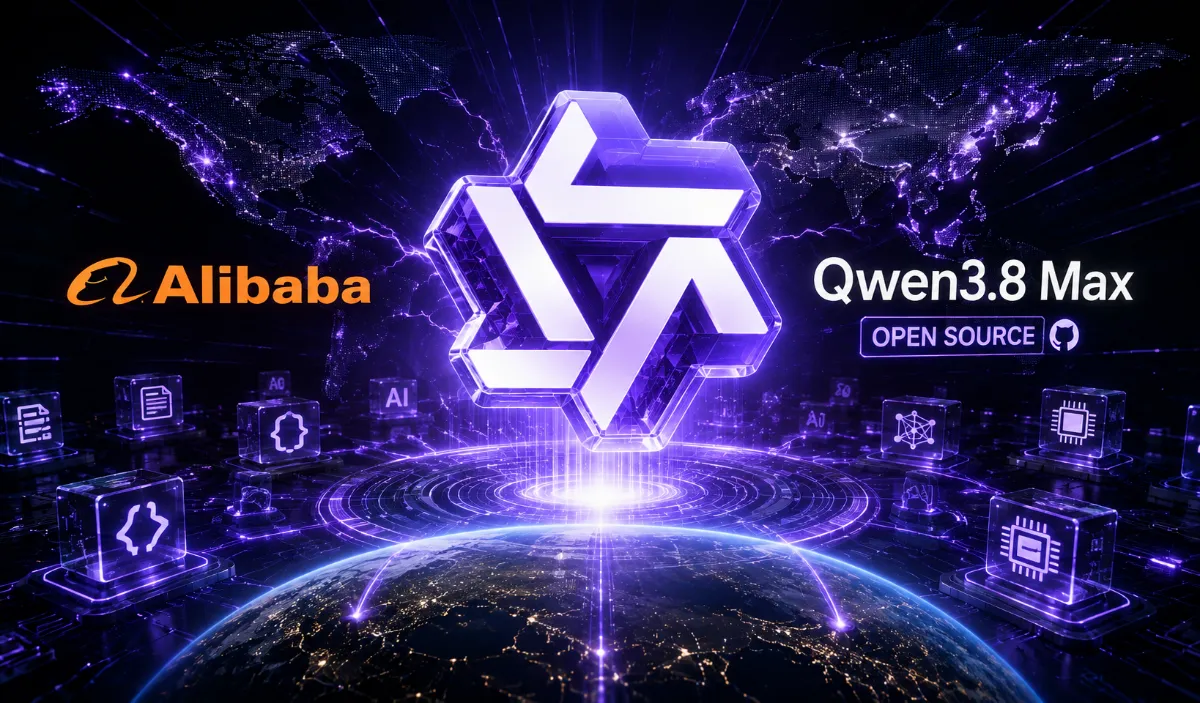
Alibaba Unleashes Qwen3.8 Max as Open Source Dominance Expands
Alibaba shifts the landscape of generative AI by launching the powerful Qwen3.8 Max model to a global audience, cementing its lead in open weight availability.
A New Contender in the Global Model Arena
Alibaba has officially introduced Qwen3.8 Max to the global developer community, marking a significant milestone in the evolution of large language models. This release is not merely an incremental update but a structural leap intended to challenge the dominance of proprietary models currently held by Western tech giants. By providing access to high level reasoning and instruction following capabilities, the company aims to solidify its position as a primary architect of open source artificial intelligence infrastructure. Developers across the globe now have access to a model that balances parameter efficiency with deep contextual understanding.
Technical Specifications and Architecture
The architecture of Qwen3.8 Max prioritizes a sophisticated mixture of experts approach that allows for nuanced task handling without the massive computational overhead typically associated with monolithic models. By refining the attention mechanisms and optimizing the training objective, the research team at Alibaba has managed to squeeze superior performance out of the 3.8 trillion parameter equivalence bracket. The model excels in complex coding tasks, mathematical reasoning, and linguistic subtlety, making it a versatile tool for enterprise grade applications that require high reliability.
| Feature | Performance Metric |
|---|---|
| Context Window | 128k Tokens |
| Reasoning Benchmarks | 88 Percent Accuracy |
| Coding Capability | High Grade Proficiency |
| Inference Speed | Optimized for Edge Deployment |
The Open Source Ecosystem Effect
The momentum behind the Qwen family is undeniable, with cumulative downloads approaching the one billion mark. This widespread adoption suggests that the developer community views Alibaba as a stable, long term partner for building production ready AI systems. Unlike models restricted to closed APIs, this release allows organizations to host their own infrastructure, ensuring that proprietary data never leaves their secure environments. This sovereign approach to artificial intelligence is likely to accelerate the migration of sensitive workflows from cloud hosted black boxes to self managed local deployments.
Strategic Growth and Developer Adoption
Beyond raw intelligence, the success of this project lies in its accessibility. The framework is designed to integrate seamlessly into existing pipelines using common machine learning libraries. By providing pre trained weights and specialized fine tuning guides, the company removes barriers to entry for startups and individual researchers who previously lacked the resources to train their own high performance systems. The result is an ecosystem where innovation is distributed rather than centralized, fostering a healthy competitive environment that drives further technological discovery.
The Road Ahead
As Alibaba continues to iterate on its model series, the focus will likely shift toward multi modal integration and energy efficient inference. The global rollout is a test of infrastructure resilience and community engagement, indicating that the firm is ready to compete on a truly international stage. For enterprise leaders, the availability of such a potent model represents a chance to lower reliance on vendor lock in while simultaneously elevating the quality of their automated services. The future of AI is increasingly open, and this latest move signals that the next phase of the competitive cycle will be defined by accessibility and sheer architectural prowess.