
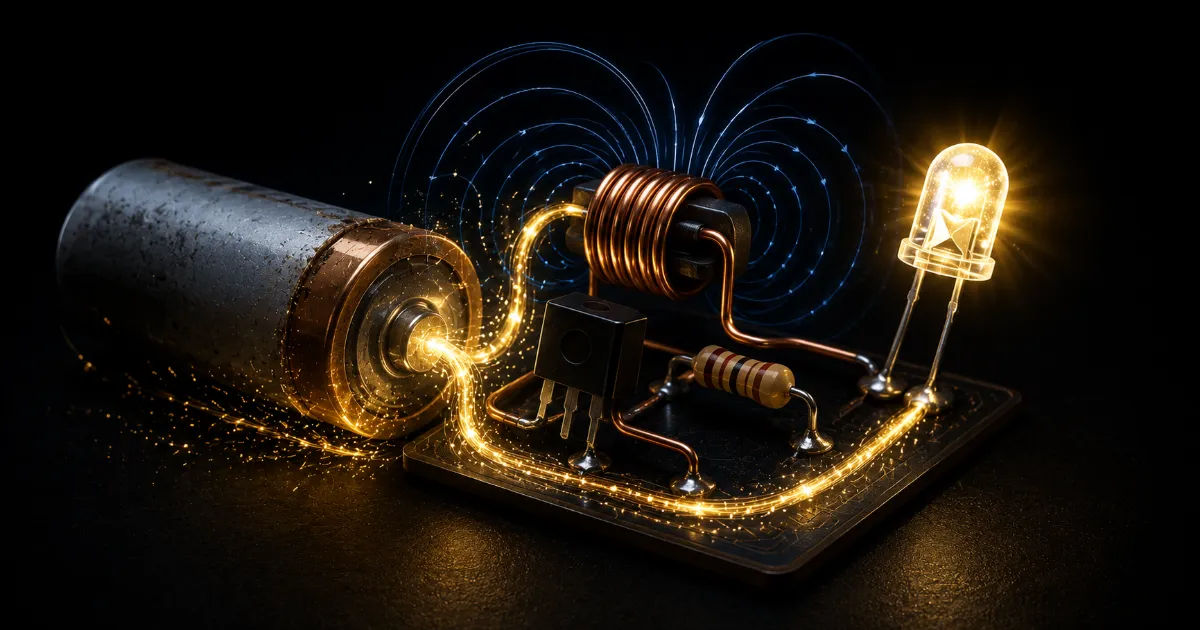
- Subject Overview: The Physics of the Joule Thief Circuit and How It Extracts Energy from Depleted Cells — Key developments across Energy.
- Technical Context: Detailed analysis of architectural changes, product capabilities, and engineering metrics.
- Industry Impact: Key implications for software developers, startup founders, and enterprise technology adopters.
The Illusion of the Dead Battery
In our modern consumer landscape, we define a battery as dead when it fails to provide the necessary voltage to run a device. However, most discarded batteries are far from empty. They contain a significant amount of residual chemical potential energy, but the voltage has dropped below the threshold required by standard electronic components. This is where the Joule Thief comes into play as a quintessential example of clever electromagnetic engineering.
At its core, a battery is a chemical reactor. As the reaction proceeds, the internal resistance of the battery increases, and the voltage potential drops. Most devices are designed to operate within a specific voltage range, usually close to the nominal rating of the cell. When the battery voltage dips below this, the device shuts down. The Joule Thief circuit ignores this constraint by using switching power supply principles to boost the available voltage at the expense of current.
Principles of Inductive Voltage Boosting
The secret sauce behind a Joule Thief is a simple toroidal inductor. This component is crucial because it allows the circuit to store energy in a magnetic field. When the circuit is active, a transistor switches rapidly on and off. During the 'on' phase, current flows through the primary coil, building up a magnetic field. When the transistor switches 'off', the magnetic field collapses.
- Inductive Kickback: As the magnetic field collapses, the energy stored in the inductor is released as a surge of voltage, often much higher than the input voltage from the battery.
- Voltage Transformation: The secondary coil acts to capture this surge, providing enough voltage to drive a low-power load like an LED, which requires a higher forward voltage than what a 'dead' battery can provide.
This process happens thousands of times per second. By cycling at such high frequencies, the circuit maintains a steady glow, effectively 'stealing' the last remnants of energy that would otherwise be wasted in a landfill.
Architecture and Component Breakdown
Constructing a Joule Thief requires only a handful of parts: a transistor, a resistor, and a toroid (a ferrite core wrapped with two coils of wire). The beauty of this design lies in its simplicity and efficiency. Despite the low component count, it functions as a highly sophisticated voltage booster.
| Component | Role in Circuit | Technical Impact |
|---|---|---|
| Toroidal Core | Energy Storage | Magnetic field management |
| NPN Transistor | Electronic Switch | High-frequency oscillation |
| Resistor | Base Current Limiter | Controls oscillation duty cycle |
| LED | Load | Visual output/Voltage indicator |
This minimalist architecture demonstrates the core principle of power electronics: energy conservation. By trading high current for high voltage, the circuit makes usable work possible even when the original energy source is nearing total depletion.
The Thermodynamics of Efficiency
While the Joule Thief is an incredible demonstration of physics, it is important to acknowledge that it is not a perpetual motion machine. The energy extracted is finite and defined by the chemical state of the battery. The Joule Thief simply allows the user to access energy that is otherwise inaccessible due to the limitations of standard voltage-gated electronics.
From a thermodynamic perspective, the circuit is simply a converter. The efficiency of the conversion depends heavily on the quality of the toroidal core and the switching speed of the transistor. As the battery voltage reaches extremely low levels, the circuit will eventually lose its ability to oscillate effectively, marking the true, final depletion of the cell.
Practical Applications in Resource Management
Beyond being a fun DIY electronics project, the Joule Thief serves as a foundational concept for modern power management integrated circuits. In renewable energy systems, similar principles are used in DC-to-DC converters to manage voltage levels between solar panels, battery arrays, and household appliances. The core mission is the same: to maximize the extraction of energy from a source regardless of its current voltage state.
In remote applications, such as low-power sensor networks or off-grid monitoring systems, the ability to utilize 'spent' energy can extend the operational life of a system by months or even years. This is a critical factor in lowering the environmental impact of electronic waste.
Key Takeaway: The Joule Thief illustrates that 'dead' is a relative term in electronics; through clever application of inductive physics, we can unlock latent energy potential that would otherwise be permanently discarded.
The Bottom Line
The Joule Thief is a testament to the power of fundamental physics in engineering. It reminds us that efficient design isn't about using the most complex components, but rather about deeply understanding the underlying properties of the materials we use. As we continue to push for more sustainable technology, the principles exemplified by the Joule Thief will remain essential for maximizing our energy resources and reducing the burden of battery waste on the planet.