
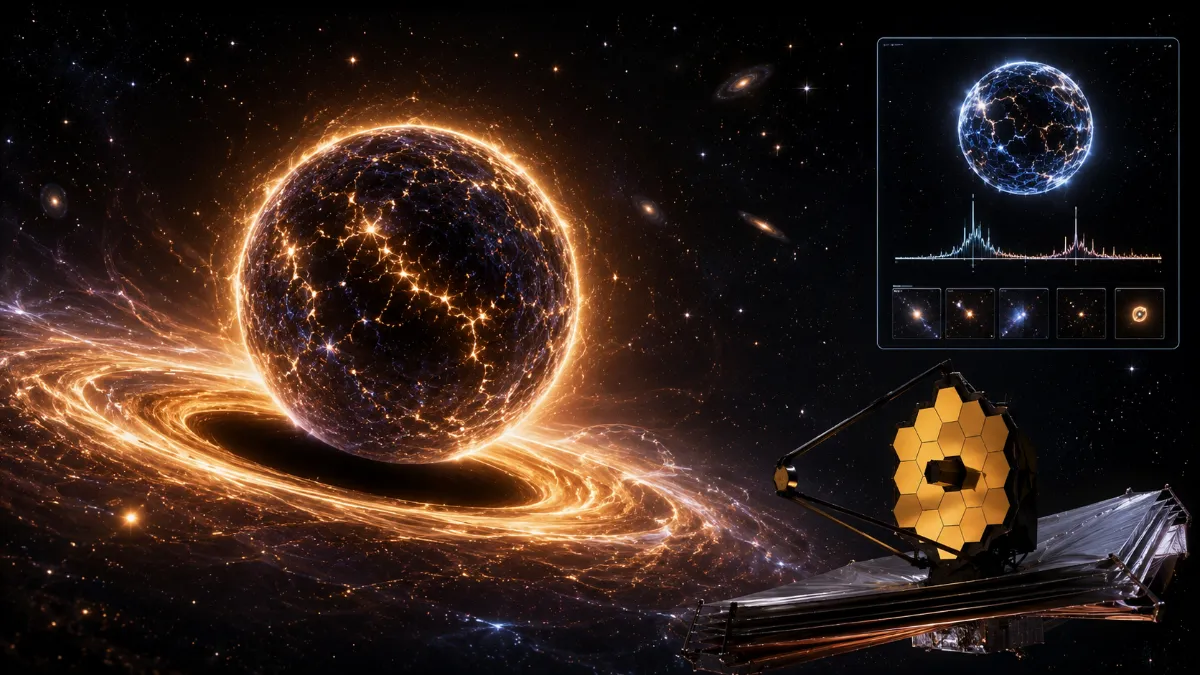
- Subject Overview: James Webb Telescope Data Validates Existence of Exotic Black Hole Stars — Key developments across Science.
- Technical Context: Detailed analysis of architectural changes, product capabilities, and engineering metrics.
- Industry Impact: Key implications for software developers, startup founders, and enterprise technology adopters.
Challenging the Standard Stellar Paradigm
For generations, the life cycle of a star has been described as a predictable struggle between the inward pull of gravity and the outward pressure of nuclear fusion. In this standard model, hydrogen atoms fuse into helium in the core, releasing the energy that lights up the universe. However, recent data captured by the James Webb Space Telescope has forced astronomers to reconsider the fundamental drivers of stellar illumination in the early universe. The appearance of massive, glowing, and impossibly bright objects shortly after the Big Bang does not align with traditional models of star formation.
These objects, dubbed dark stars, represent a revolutionary concept in astrophysics. Instead of nuclear fusion, these theoretical entities are powered by the annihilation of dark matter. If verified, these stars would be composed primarily of hydrogen but would harbor a core of dark matter particles that continuously destroy each other, releasing vast amounts of energy in the process. This mechanism could explain how massive stars were able to assemble themselves so quickly in the infancy of the cosmos.
The Physics of Dark Matter Annihilation
The central mystery of dark matter is that it interacts primarily through gravity, making it nearly invisible to electromagnetic detection. However, in the high-density environment of a protostellar cloud, the density of dark matter would be sufficient to allow for annihilation events. When two dark matter particles collide and annihilate, they convert their mass into energy, preventing the collapse of the star and allowing it to grow to sizes far beyond what fusion alone would permit.
These stars would be vastly larger than our sun, potentially reaching millions of times its mass, while remaining relatively cool compared to fusion-powered stars. Their light would be characterized by a distinct spectral signature, shifting into the infrared range as they radiate energy from their dark matter-fueled cores. This infrared glow is exactly what the James Webb Space Telescope has been capturing in its deep-field surveys, providing the first tangible evidence that these theoretical giants may actually exist.
| Feature | Standard Star | Dark Star |
|---|---|---|
| Primary Energy Source | Hydrogen Fusion | Dark Matter Annihilation |
| Mass Limit | Limited by Eddington Limit | Potentially Supermassive |
| Temperature | Very Hot | Relatively Cool |
| Lifetime | Millions to Billions of Years | Indefinite (depends on dark matter supply) |
| Core Composition | Helium/Metals | Dark Matter Density |
Bridging the Gap in Early Universe Cosmology
One of the greatest headaches for cosmologists has been the discovery of massive galaxies existing only a few hundred million years after the Big Bang. According to standard models of galaxy formation, these structures should have taken billions of years to accumulate the mass necessary to become so large. If dark stars were indeed the precursors to these galaxies, they would resolve this timeline discrepancy. These stars would act as seeds, gathering huge amounts of matter and eventually collapsing into black holes, which then serve as the gravitational anchors for the first galaxies.
This hypothesis provides a clean explanation for the rapid development of the early universe. Instead of waiting for small stars to die and generate heavier elements, the universe could have relied on these massive dark stars to quickly populate space with the gravitational potential needed to aggregate matter. This model shifts the focus of early cosmic evolution from traditional stellar physics to the enigmatic behavior of the dark matter that makes up the majority of the universe's mass.
- Gravitational Seeding: Dark stars acting as primordial black hole factories.
- Rapid Galaxy Assembly: Explaining the presence of massive structures in the early universe.
- Spectral Divergence: Utilizing infrared data to distinguish between fusion and annihilation signatures.
Implications for Fundamental Physics
The confirmation of dark stars would be the ultimate verification of the nature of dark matter. Currently, dark matter remains the most significant unknown in our Standard Model of cosmology. By studying the light emitted by these objects, astronomers might be able to deduce the mass and interaction cross-section of dark matter particles, essentially using the universe as a massive particle physics laboratory. This is a level of insight that could never be achieved in an earthbound collider.
Moreover, it challenges our understanding of stellar limits. We have long held that stars have a specific maximum size before they become unstable. If a star is fueled by a process that does not depend on the stability of a fusion core, those limits are effectively thrown out the window. This forces a complete rewrite of stellar evolution textbooks and necessitates a new classification of astrophysical objects.
Key Takeaway: The James Webb Space Telescope has provided the first observational hints that the early universe was populated by dark stars, a discovery that could finally solve the mystery of dark matter and early galaxy formation.
The Road Ahead
As we continue to process the data from the James Webb Space Telescope, the search for dark stars will intensify. Astronomers are now tasked with refining their models to distinguish the infrared signatures of these objects from distant, dusty galaxies that may mimic their appearance. If the existence of dark stars is confirmed through further spectral analysis, it will represent the most significant paradigm shift in our understanding of the universe since the discovery of cosmic inflation. We are no longer just looking at the history of stars; we are watching the dark, invisible scaffolding of the universe reveal itself.
Sources
Wired (wired.com), NASA James Webb Space Telescope (jwst.nasa.gov)