
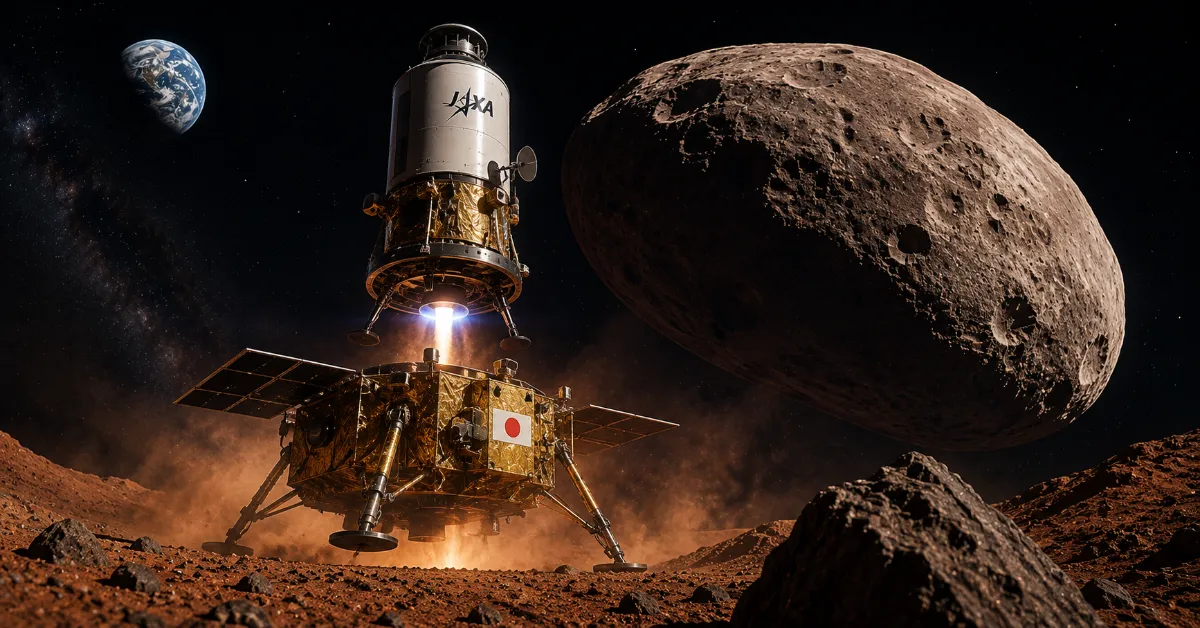
- Subject Overview: Japan Embarks on Ambitious Quest to Retrieve Martian Moon Samples — Key developments across Science.
- Technical Context: Detailed analysis of architectural changes, product capabilities, and engineering metrics.
- Industry Impact: Key implications for software developers, startup founders, and enterprise technology adopters.
The Scientific Significance of Martian Moons
The Martian moons, Phobos and Deimos, represent some of the most mysterious objects in our solar system. Scientists have long debated whether these bodies are captured asteroids from the outer reaches of the solar system or remnants of a massive collision on the Martian surface. By retrieving physical samples, Japanese researchers hope to settle this debate once and for all. If these moons formed from Martian ejecta, they might contain chemical signatures of a warmer, wetter early Mars, potentially harboring organic building blocks that could offer clues about the origins of life on Earth.
This mission is not merely an exercise in exploration but a high stakes effort to analyze primordial materials that have remained largely undisturbed for billions of years. Unlike the surface of Earth or Mars, which are constantly reshaped by tectonic activity, erosion, and volcanic processes, the moons of Mars exist in a state of relative stasis. The material retrieved by the proposed mission would serve as a time capsule, allowing scientists to look back through the geological records of our planetary neighborhood.
Navigating the Competitive Landscape of Space Exploration
The race to the red planet and its satellites has intensified significantly as multiple nations expand their space programs. Japan faces stiff competition from China, which has also signaled its intent to conduct its own sample return mission. The rivalry brings a new layer of complexity to the mission, as space agencies must manage not only the extreme technical challenges of operating in the Martian gravity well but also the geopolitical implications of planetary site selection and scientific discovery rights.
Japan’s strategy relies heavily on precision robotics and advanced propulsion systems that allow for multiple landing attempts on the small, low gravity surfaces of the moons. While China’s approach has historically focused on large scale infrastructure, the Japanese program emphasizes agility, high precision sampling, and a modular design that maximizes the return on scientific investment for each kilogram of sample material collected. This comparative tactical approach is summarized below.
| Feature | Japanese Mission Model | Standard Deep Space Mission | Strategic Impact |
|---|---|---|---|
| Sample Payload | High Precision Micro Samples | Bulk Regolith | Targeted Chemical Analysis |
| Landing Strategy | Multi Point Touch Down | Single Site Landing | Better Spatial Diversity |
| Communication | Autonomous Near Real Time | Deep Space Delay | Faster Hazard Avoidance |
Technical Hurdles of Low Gravity Landing
One of the most significant challenges for the team is the extremely low gravity environment of the Martian moons. Landing on Phobos is technically akin to docking with a small, irregular asteroid rather than descending onto a planet. Traditional landing gear designs are ineffective here, necessitating the use of specialized anchoring systems or surface adhesion technologies. The mission requires sophisticated autonomous navigation systems capable of adjusting trajectory in milliseconds without waiting for signal feedback from Earth.
Engineers are developing novel touch and go sampling mechanisms that interact with the surface only for seconds before retreating to a stable orbit. This requires a delicate balance of force, ensuring the probe captures enough material while preventing it from bouncing away into the void. The propulsion systems must also be robust enough to perform multiple orbital corrections within the complex gravitational pull of Mars itself, which can significantly destabilize a small craft.
The Search for Prebiotic Molecules
If the samples retrieved contain specific isotopic ratios, it could prove that the moons were once part of a larger, habitable Martian world. The presence of water ice or hydrated minerals within the captured regolith would be a landmark finding. Scientists are particularly interested in identifying prebiotic molecules, which are the precursor materials that eventually formed the biological building blocks of life as we know it. This research is directly tied to the fundamental question of whether we are alone in the universe.
By comparing the samples with existing data from previous rover missions on Mars, the team intends to create a comprehensive map of the elemental distribution across the Martian system. This mapping is essential for future crewed exploration missions, as it helps identify potential resources like water or fuel that could be harvested directly from the moon’s surface, significantly reducing the cost and weight of future supply logistics from Earth.
Global Cooperation and Scientific Transparency
Despite the competitive nature of the mission, Japan has emphasized its commitment to international scientific collaboration. The data obtained from the sample analysis will be shared with the broader astronomical community, fostering a global effort to understand planetary evolution. By treating the Martian moons as a collective human heritage rather than a nationalist objective, the mission aligns with the spirit of the Outer Space Treaty, ensuring that the fruits of this research benefit all of humanity.
- Payload Integrity: Protecting samples from cosmic radiation exposure.
- Autonomous Navigation: Utilizing AI driven pathfinding during the descent.
- Data Standardization: Aligning findings with existing NASA and ESA datasets.
Key Takeaway: The success of this mission will fundamentally reshape our understanding of planetary formation and potentially define the trajectory of future human exploration toward Mars and beyond.
The Road Ahead
The mission is currently in the late stages of architectural finalization, with hardware testing ongoing in simulated vacuum environments. As the launch window approaches, the focus will shift from theoretical modeling to the intense stress testing of life support for the samples themselves. Ensuring that the materials remain uncontaminated by Earth’s biosphere is a paramount concern for researchers who must create an airtight chain of custody from the surface of Phobos back to the laboratories on Earth. Japan’s commitment to this endeavor marks a pivotal shift in the global space race, moving away from simple orbital observation toward active, high stakes planetary intervention.